All species › Passerines › New World blackbirds › Baltimore Oriole
Baltimore Oriole | Icterus galbula
Baltimoretroepiaal | Turpial de Baltimore
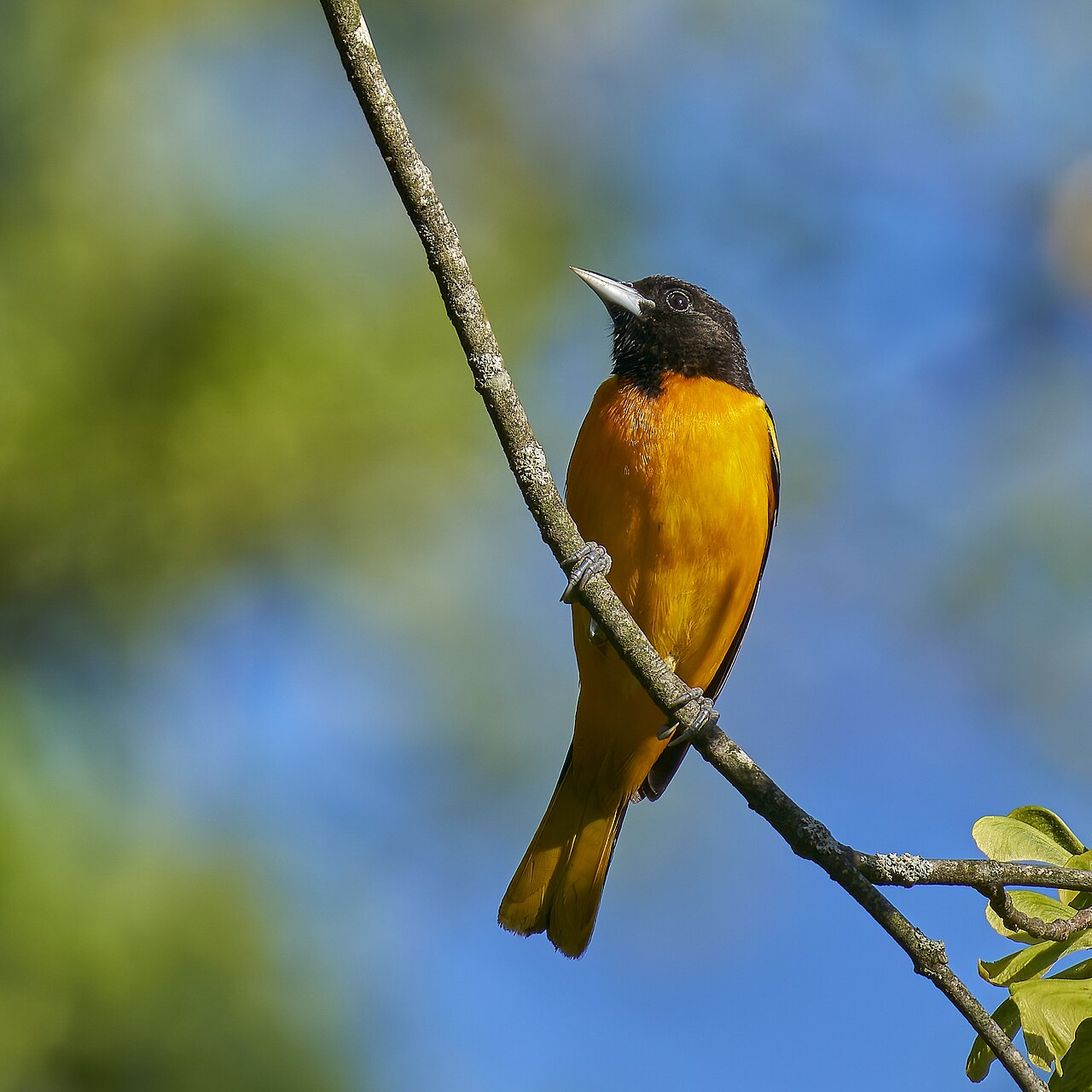
The adult male is orange with a black hood, but that is rarely what turns up in Europe. Almost every Baltimore Oriole found within the map area is a female or a first-autumn bird: dull yellow to orange-yellow, with brown wings and two white wingbars. They make landfall in September and October, usually in a garden or a clump of trees just behind the coast, and the occasional one sits out the winter at a feeder.
Click a thumbnail to switch the photo above.
Voice
The song is a short series of full, flute-like notes, two to eight of them with clear gaps between, warm in tone and never quite the same phrase twice; it does not sing in autumn and you will almost never hear it in Europe. What you do hear is the call: a dry rattling chek-ek-ek-ek, fired off from cover and loud for a bird of this size, and a clear two-syllable hew-li that sounds like a person whistling. A vagrant in a garden usually gives itself away with the rattle.
Recording: Jonathon Jongsma — CC BY-SA 4.0 · xeno-canto
Identification
A big songbird about the size of a Starling, with a strikingly long bill that is broad at the base and tapers to a fine point; there is no hook, and the upper mandible runs dead straight. The bill is blue-grey with a darker ridge and the legs are blue-grey. On the bird you are likely to meet in Europe the head is yellow to warm orange-yellow, often with a faint dusky wash over crown and lore; throat and breast are orange-yellow, the belly paler and the flanks off-white. The upperparts are olive-brown with dark feather centres, giving a lightly mottled back. The wing is dark with two white bars, the upper one broad and obvious. The tail is yellow-brown with darker central feathers. Adult males, seldom seen in Europe, are unmistakable: deep orange below, a solidly black hood and back, black wings with a white panel and orange corners to the tail.
Confusion species
For a European observer the Golden Oriole is the first thought, and a few marks rule it out: it is clearly bigger and heavier, the adult male has a thick red-brown bill, it lacks white wingbars altogether, and females and young birds are green-yellow with fine streaking right across the underparts. The Baltimore Oriole has plain, unstreaked orange-yellow underparts and a thin grey spike of a bill. The second trap is an unusually orange-toned Golden Oriole or an escaped cage bird: several American and Central American orioles are kept in captivity, and those are usually larger, more boldly marked and often carry a closed ring, so always look at the legs and at the wear on tail and wingtips. Finally the Starling, which at range has the same build and the same pointed bill, but is dark and spangled and walks with a quite different rolling gait.
Habitat
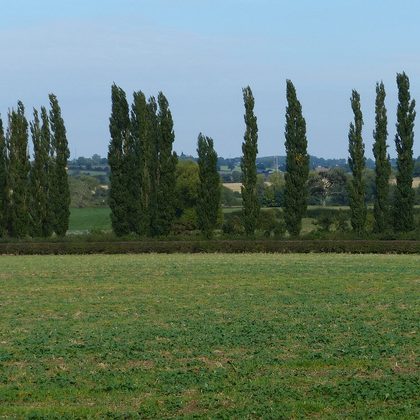
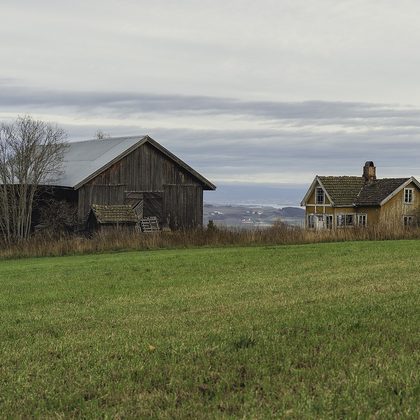
Here it is a bird of gardens, orchards and the sycamores and elms along a village road; on arrival it often sits in a dense hedge or an ivy-covered wall, later it hangs among the apples or on a feeder. The overwintering birds live on fat balls, halved apples and sugar water, and more than once that is the reason a bird stayed for months. At home it means open broadleaved woodland, hedgerows, orchards and the tall trees of streets and parks — never closed forest, always crowns with space around them.
Where the bird is most at home, classified with EUNIS — the European standard for habitats.


Range and movements
Breeds across eastern and central North America, and winters in Central America and northern South America. Within the map area it is a vagrant, with most records in the British Isles — chiefly the Isles of Scilly and Devon — and a scatter across the rest of north-west Europe and the Azores. The peak falls in the second half of September and in October; the odd bird turns up in winter and then sometimes stays loyal to one garden feeding station for months, into spring.
How and when to look
This is not a species you find by searching; it lands in somebody's garden. In the second half of October look hard at any unfamiliar yellow-orange bird at a feeder or in an orchard, and let the bill decide: long, straight, blue-grey and pointed, with no hook. Photograph head, wingbars, bill and above all the legs, because the rarities committee will want to know whether there is a ring. If the bird settles, report it at once and speak to the residents before a hundred people are standing on the pavement; it is precisely because the wintering birds stay loyal to one garden that thousands have seen them.
Conservation status
Not globally threatened (IUCN: Least Concern), with a population of several million, though numbers have slipped slowly in parts of the breeding range since the elms went out of the streets. For the region of this guide the question is not protection but origin. The autumn timing and the arrivals behind a fast Atlantic depression fit birds travelling under their own power, and that is how most records are judged. Two other routes still weigh in the balance: orioles have repeatedly been found aboard ships and so covered part of the crossing as passengers, and related species are kept as cagebirds, so a bird with a closed ring or a suspiciously unworn tail is treated with caution.
Scientific name
Icterus galbula | (Linnaeus, 1758)
Linnaeus described the species in 1758 as C[oracias] galbula; because it was later moved to another genus, the author and year stand in brackets. The genus Icterus was introduced in 1760 by Brisson. Icterus is from Ancient Greek ikteros, a yellow bird usually taken to be the golden oriole, the sight of which was thought to cure jaundice. galbula is the Latin name for a yellow bird, again probably the golden oriole. The specimen the first description was based on came from Virginia.