All species › Passerines › New World warblers › Yellow-throated Warbler
Yellow-throated Warbler | Setophaga dominica
Geelkeelzanger | Reinita gorjiamarilla
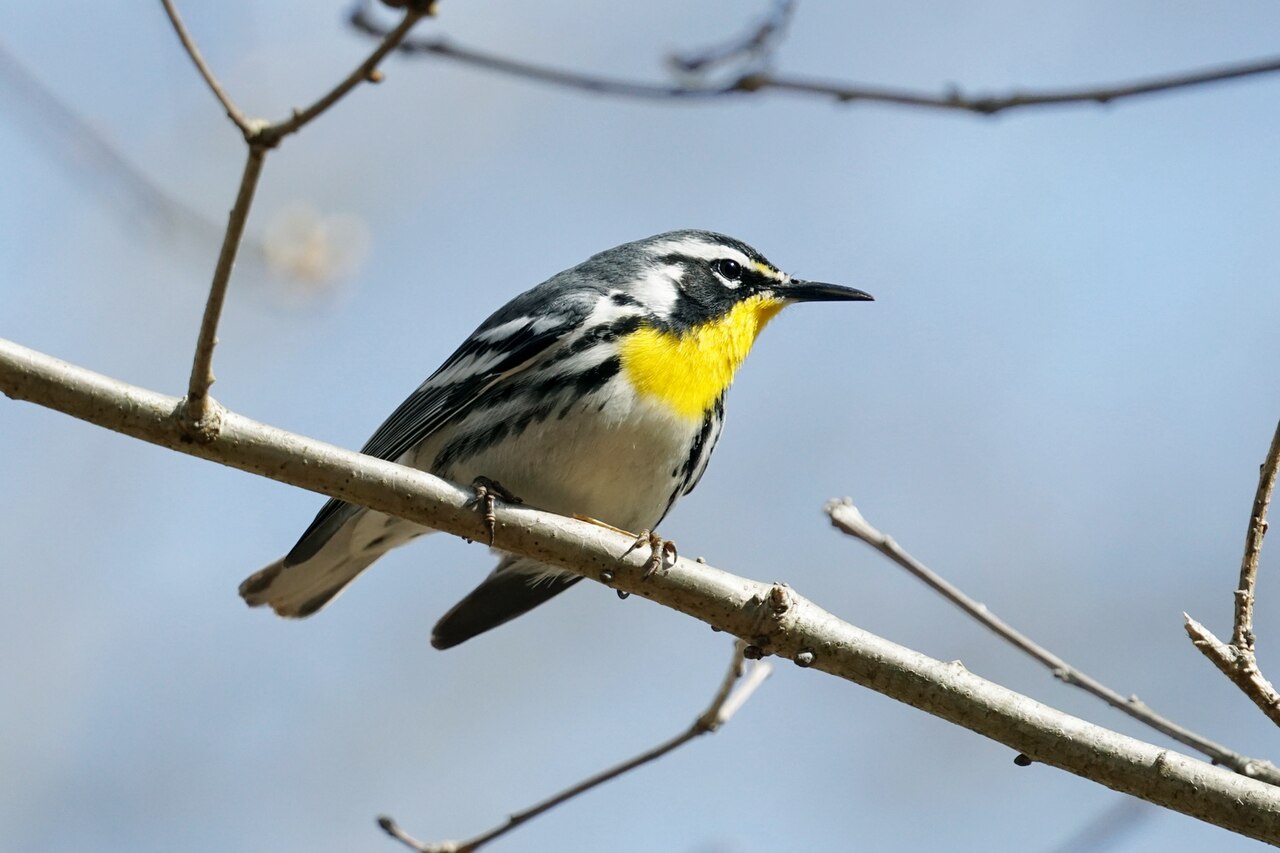
The Yellow-throated Warbler is grey, white and black but for one area: the throat and upper breast are sharply bounded yellow. It has the longest bill of all the Setophaga warblers and uses it to creep along branches and probe into crevices, pine cones and needle clusters, more like a creeper than a flitting warbler.
Voice
The song is a clear series of descending whistles that speeds up slightly at the end and often closes with an upward flick, roughly tee-tee-tee-tee-tew-wee. It carries far and sounds fuller and slower than the song of most warblers. The call is a sharp, high chip, closely like that of Yellow-rumped Warbler. Song starts in February in the south, far earlier in the season than in most relatives.
Recording: Bill Pyle — CC BY-NC-SA 4.0 · Lost Maples St. Natural Area, Bandera Co., Texas557, United States · xeno-canto
Identification
Unstreaked grey upperparts, two white wing bars, a white belly with black streaks along the flanks, and a yellow throat set sharply against the white breast sides and the black face. The head carries a black mask, a white patch below the eye and a white or yellow-tinged supercilium that turns white behind the eye. The sexes are alike; the female is slightly duller. Its foraging gives it away: slow, creeping along thick branches, often high and close to the trunk.
Confusion species
Black-and-white Warbler creeps along branches in the same way but is streaked black and white throughout, including crown and back. Black-throated Green Warbler has a black throat and a yellow face. Cape May Warbler has a yellow rump, a chestnut ear patch and streaked yellow underparts. Between subspecies: albilora west of the Appalachians has a wholly white supercilium and a shorter bill, dominica in the east usually a yellow-tinged one.
Habitat
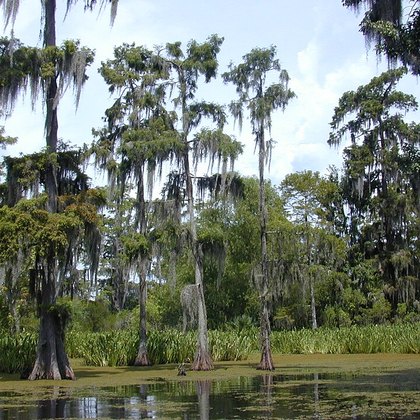
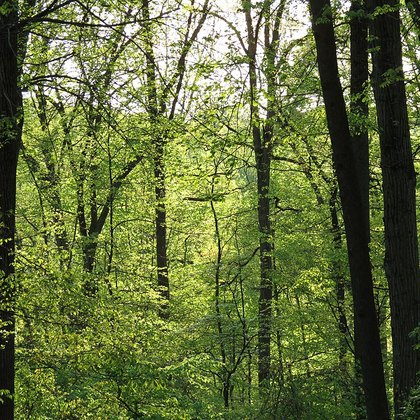
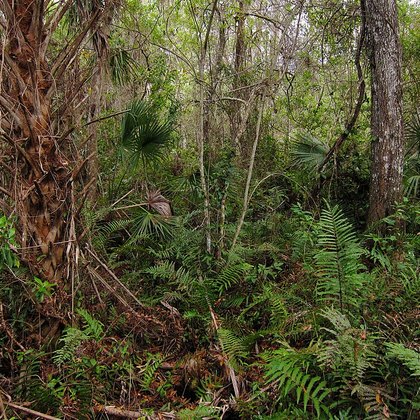
Two clearly different types: open pine forest with a low understorey, and wet deciduous woodland with bald cypress or sycamore along rivers and in forested swamps. Where Spanish moss hangs in the trees it builds the nest in it; elsewhere in a needle cluster high in a pine. Outside the breeding season it occupies second growth, palm stands, mangrove edge, parks and gardens, where it also visits agave and palm flowers.
Where the bird is most often found, arranged by the USNVC — the vegetation classification of the United States and Canada — and CMECS for sea and coast.



Range and movements
Breeds in the eastern United States, from southern Pennsylvania, New Jersey and southern New York and from northern Missouri south to the Gulf coast and east to the Atlantic; in Florida and along parts of the Gulf coast it stays all year. The northern limit is shifting gradually outward. It migrates early: arrival in March, departure from late July onwards. It winters along the Gulf coast of Mexico, on the Yucatán Peninsula, in Belize, Guatemala and Honduras and on the Caribbean islands, with Costa Rica and further south outside this guide's window.
- Resident
- Breeding (summer)
- Winter
- Passage
- dark = core range, pale = thinly spread
Where and when to look
In March and April the sycamores along a river are the best place: it sings then from a high branch and can be named by the descending whistled series before you see it. Then find the movement along the branch — a warbler that works slowly along a thick limb instead of flitting among the leaves is almost always this species or Black-and-white Warbler.
Conservation
Partners in Flight puts the global breeding population at about 2 million birds, with a score of 9 out of 20 on the Continental Concern Score. Numbers are stable and the range is expanding northwards. In the southeast the species depends on two habitats that are both under pressure: old open pine forest, which disappears through clear-cutting and the absence of fire, and bald cypress swamp, which shrinks through drainage and logging. The subspecies stoddardi of northwestern Florida and southern Alabama has a small range and is tracked separately.
Scientific name
Setophaga dominica | (Linnaeus, 1766)
Linnaeus described the species in 1766 as Motacilla dominica; because it was later moved to another genus, author and year stand in parentheses. The genus Setophaga was introduced in 1827 by William Swainson, from Greek sēs, sētos 'moth' and -phagos 'eating'. The species name dominica means 'of Santo Domingo', the island of Hispaniola, where the described specimen came from; the original statement named Jamaica and Dominica, and the type locality was later fixed on Hispaniola. The English name follows the yellow throat.