All species › Loons › Loons › Yellow-billed Loon
Yellow-billed Loon | Gavia adamsii
Geelsnavelduiker | Colimbo de Adams
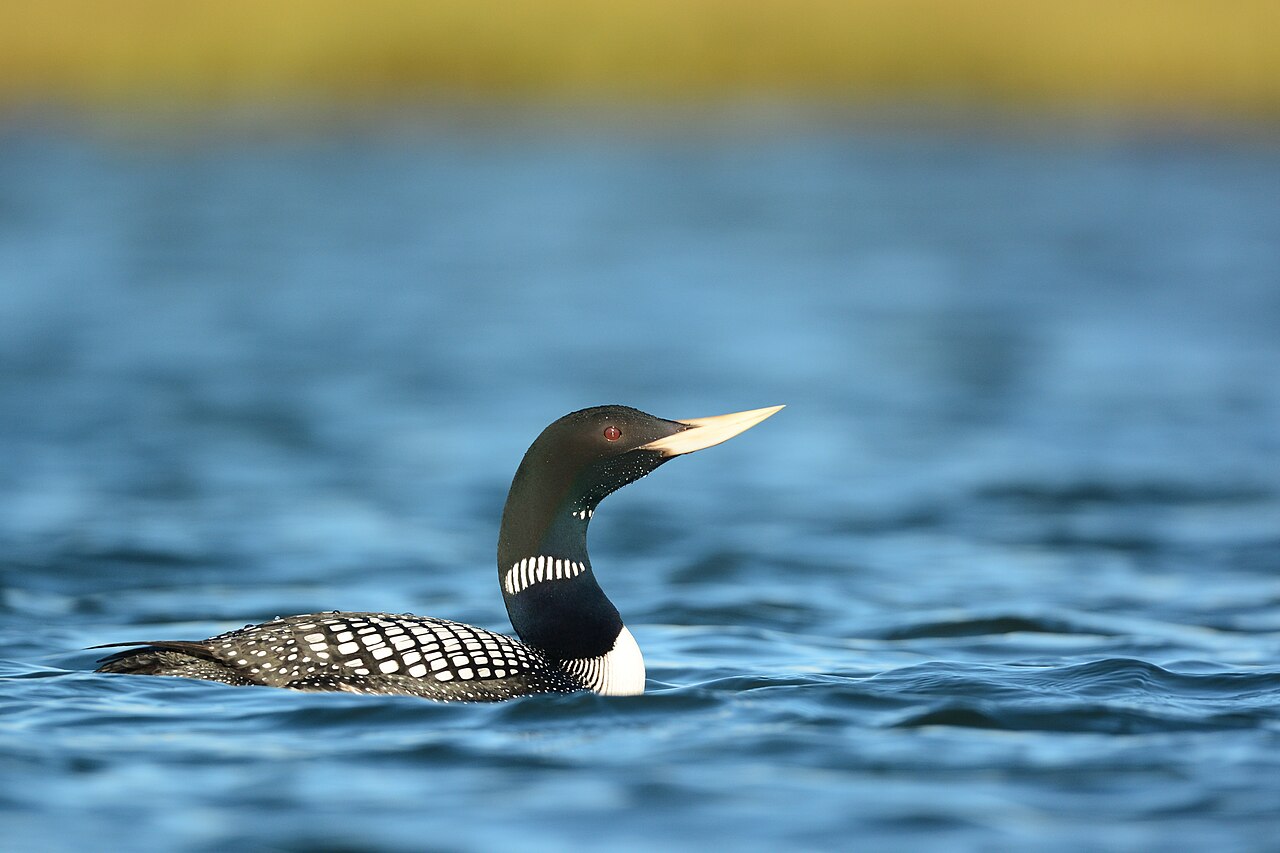
The Yellow-billed Loon is the largest and rarest of the world's five loon species: a heavy-bodied bird with a straight, slightly upturned bill that ranges from ivory to lemon yellow. It breeds in small, scattered numbers on remote tundra lakes in northern Alaska and Canada, and spends the rest of the year at sea.
Voice
The male gives a long, mournful yodel that carries far across the tundra water: oo-lee-oo-oo-oo. When alarmed, pairs switch to a shrill, laughing tremolo, and at close range a short, barking note can also be heard. On the water in winter the species is mostly silent, apart from a short, hard kwok used in contact between birds.
Recording: Seth Beaudreault (Toolik Field Station) — CC BY-NC-SA 4.0 · Toolik Field Station, North Slope, Alaska, United States · xeno-canto
Identification
In breeding plumage the Yellow-billed Loon is black and white: a glossy black head and neck with a white collar, a back checkered with white, and deep red eyes. The bill is already the key field mark: entirely ivory to lemon yellow, with a straight upper edge and an angled lower edge that make the bird appear to hold it slightly tilted upward. In winter plumage the head and neck turn plain sandy brown, and the pale, ivory-coloured bill becomes the only really useful mark. Young birds resemble winter adults but show a more faintly patterned back. The thick neck and blocky head also give the bird a heavier look than other loons at a distance.
Confusion species
The main confusion risk is Common Loon, which is close in size and behaviour but always keeps a dark line along the top of the bill, even in an otherwise pale winter plumage; in Yellow-billed Loon that line is entirely absent. Common Loon also has a straighter, less upturned bill and a more pointed head shape. Smaller species such as Pacific Loon and Arctic Loon are quickly ruled out by their size and slimmer bill.
Habitat
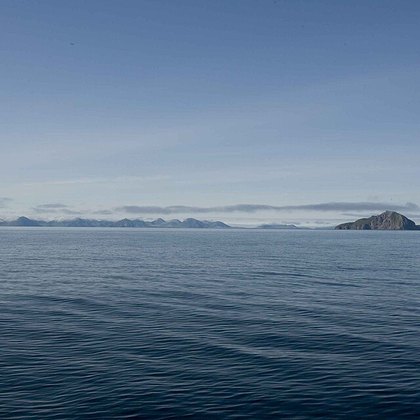
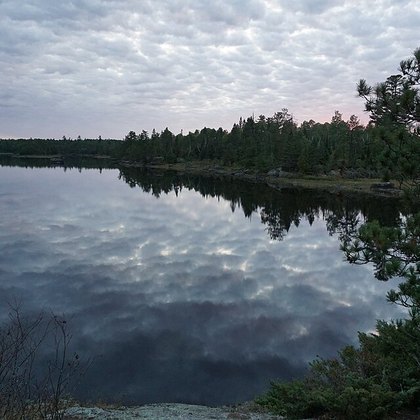
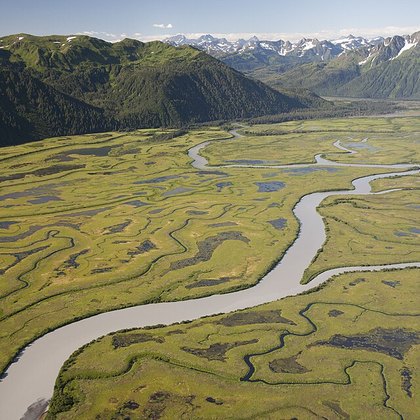
It breeds on large, clear tundra lakes with an irregular shoreline and a water depth of at least a few metres, far from trees and usually on an island or a spit that offers protection from predators. Outside the breeding season it seeks sheltered coastal waters, bays and straits with a soft bottom, where it dives for fish. Large, open inland lakes and rivers serve as stopover sites on migration. It avoids open farmland and forest altogether.
Where the bird is most often found, arranged by the USNVC — the vegetation classification of the United States and Canada — and CMECS for sea and coast.

Range and movements
It breeds scattered across the lowland tundra of northern Alaska and adjacent northwestern Canada, with the heaviest concentration in Alaska's National Petroleum Reserve. From there it moves to sheltered coastal waters, chiefly off British Columbia, in smaller numbers as far south as Washington. The world population is estimated at fewer than twenty thousand birds; numbers appear stable or slightly declining, and disturbance and pollution of the breeding lakes pose a risk.
- Resident
- Breeding (summer)
- Winter
- Passage
- dark = core range, pale = thinly spread
Where and when to look
Look for it in winter from a boat or a high coastal point in British Columbia, where it turns up among the far more numerous Common Loons; focus on bill colour and shape rather than size alone. Around the islands and straits of Haida Gwaii it appears most predictably.
Conservation
The world population is estimated at fewer than twenty thousand breeding birds, making it the rarest loon species; numbers appear stable or slightly declining, and the IUCN places it in the Near Threatened (NT) category. Over ninety per cent of Alaska's breeding birds occur in an area open to oil and gas development, the main threat it faces. At sea it is also at risk from entanglement in fishing nets.
Scientific name
Gavia adamsii | (Gray, 1859)
British zoologist George Robert Gray described the species in 1859 as Colymbus adamsii; it has since been placed in the genus Gavia, hence the parentheses around author and year. Gavia is Latin for a seabird and was already in use for the loon family. The species name adamsii honours Edward Adams, a British naval surgeon and naturalist who collected the type material. The type locality is Alaska, then still Russian America.