All species › Woodpeckers and allies › Woodpeckers › Yellow-bellied Sapsucker
Yellow-bellied Sapsucker | Sphyrapicus varius
Geelbuiksapspecht | Chupasavia norteño
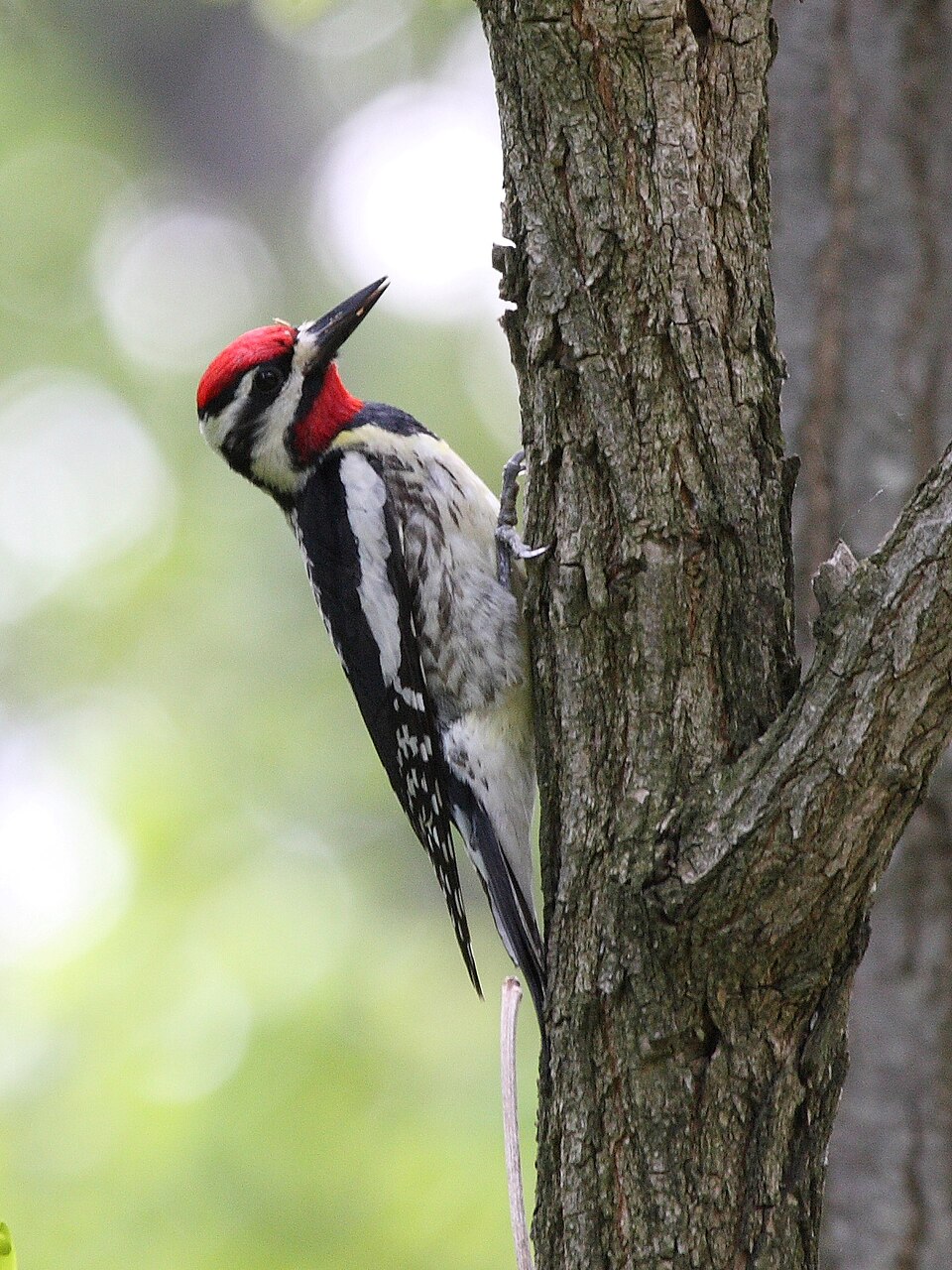
The Yellow-bellied Sapsucker is the only woodpecker in eastern North America that is almost entirely migratory: it breeds in the deciduous and mixed forests of Canada and the north-eastern United States and winters from the south-eastern US into Central America and the Caribbean. It drills neat rows of holes in the bark of trees and lives on the sap that wells up from them and on the insects attracted to it. A black-and-white woodpecker with a red forehead, a long white wing stripe and a yellowish wash on the belly.
Voice
The best-known call is a nasal, plaintive neeah, reminiscent of a cat's mew and heard especially often in spring. Territorial males also give series such as kwee-urk and wee-wee-wee-wee, and mates keep in contact with soft week-week calls. The drum is distinctive: a short, rapid opening that breaks into an irregular, stuttering rhythm of separate taps, like a Morse signal, often on resonant dead wood or on metal.
Recording: Bobby Wilcox — CC BY-NC-SA 4.0 · Skinner State Park, Hampshire County, Massachusetts, United States · xeno-canto
Identification
A medium-sized woodpecker with a red crown and forehead, bordered black, and a black-and-white striped head. The male has a red throat, the female a white one, both with a black bib. The back is black with a white or pale buff scaled pattern, and along the folded wing runs a long white stripe shared by all sapsuckers. The belly is pale yellow and the flanks are dark-streaked. Young birds are brownish with faint head stripes and, unlike related species, keep this juvenile plumage well into their first winter.
Confusion species
Red-naped Sapsucker of the west is the trickiest: it has a red nape patch and, in the male, so much red on the throat that it breaks through the black border; females there usually show red on the throat as well. Red-breasted Sapsucker has an entirely red head and breast. Hybrids with both species occur where their ranges meet. Hairy and Downy Woodpeckers have a white back stripe, no white wing stripe and no red on the forehead. The white wing stripe is the quickest feature for recognising a sapsucker as such.
Habitat
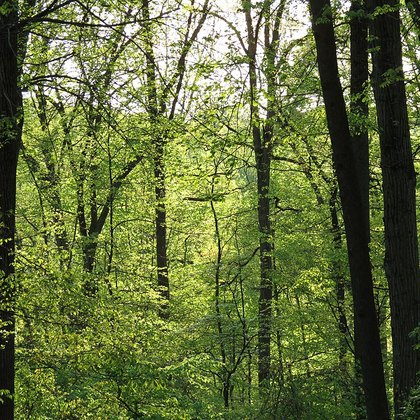
Young and mixed deciduous forest in the breeding season, especially with aspens, birches and maples, and forest edges with fast-growing trees in which it can drill its sap wells; in the Appalachians up to considerable heights. It prefers to nest in a living aspen or birch with heart rot, where the male excavates most of the cavity. In winter it is less selective and occurs in all kinds of woodland, from swamp forest to mountain forest, and in parks and gardens with suitable trees. The sap sometimes contains more than ten per cent sugar.
Where the bird is most often found, arranged by the USNVC — the vegetation classification of the United States and Canada — and CMECS for sea and coast.

Range and movements
Breeds from eastern Alaska and Yukon across the whole of forested Canada to Newfoundland, and in the United States in the Great Lakes region, New England and along the Appalachians south to North Carolina and Tennessee. Winters from the south-eastern United States through eastern Mexico and Central America to Panama, and in the Greater Antilles. Females migrate on average farther south than males. No subspecies are recognised. Vagrants have been recorded as far as Iceland, Ireland and Great Britain.
- Resident
- Breeding (summer)
- Winter
- Passage
- dark = core range, pale = thinly spread
Where and when to look
Look for horizontal rows of small, regular holes around the trunk of living trees such as birch, maple and hickory: these are the sap wells of this species, and it returns to them again and again to keep them open. Ruby-throated Hummingbird benefits from the same wells, especially early in spring when there are still few flowers, so an active sap tree can produce both species. In April the stuttering drum is the best sign that it has arrived on its breeding grounds.
Conservation
The IUCN rates the species as Least Concern (LC). Partners in Flight puts the global breeding population at about 14 million birds, and according to the Breeding Bird Survey numbers increased by almost one per cent a year between 1966 and 2019, possibly because young forest after logging and abandoned farmland suit its needs well. Its sap wells are a food source for hummingbirds, other birds, bats and insects, and it is therefore regarded as a keystone species. In orchards and among ornamental trees it is sometimes seen as a pest.
Scientific name
Sphyrapicus varius | (Linnaeus, 1766)
Linnaeus described the species in 1766 as Picus varius, based on the description and illustration by Mark Catesby; the type locality is South Carolina. Since its move to Sphyrapicus, author and year stand in parentheses. That genus was introduced by Baird in 1858 with this species as its type; the name comes from Greek sphura 'hammer' and Latin picus 'woodpecker'. varius is Latin for 'variegated' or 'motley', after the plumage. Red-naped and Red-breasted Sapsuckers were long regarded as subspecies of this species, until they were recognised as separate species in the 1980s.