All species › Passerines › Tyrant flycatchers and allies › Yellow-bellied Flycatcher
Yellow-bellied Flycatcher | Empidonax flaviventris
Berkenfeetiran | Mosquero Ventriamarillo
The Yellow-bellied Flycatcher is the Empidonax of sphagnum bog forest in boreal Canada and the northeastern United States. It is the only eastern Empidonax with a clearly yellow throat, and the only one that nests on the ground, hidden in moss or under the root of a fallen tree.
Voice
The song is a short, hoarse, descending che-BUNK or tse-berk, harder and rougher at the end than the sharp che-bek of Least Flycatcher. The call is a rising whistled per-WEE or tu-WEE, two syllables with an upward pitch — the most usable mark outside the breeding season, including on the wintering grounds. It sings mainly at dawn and dusk, from the lower and middle levels of a bog forest.
Recording: Stanislas Wroza — CC BY-NC-SA 4.0 · La Côte-de-Beaupré (near La Barrière-du-Maurice), Capitale-Nationale, Québec, Canada · xeno-canto
Identification
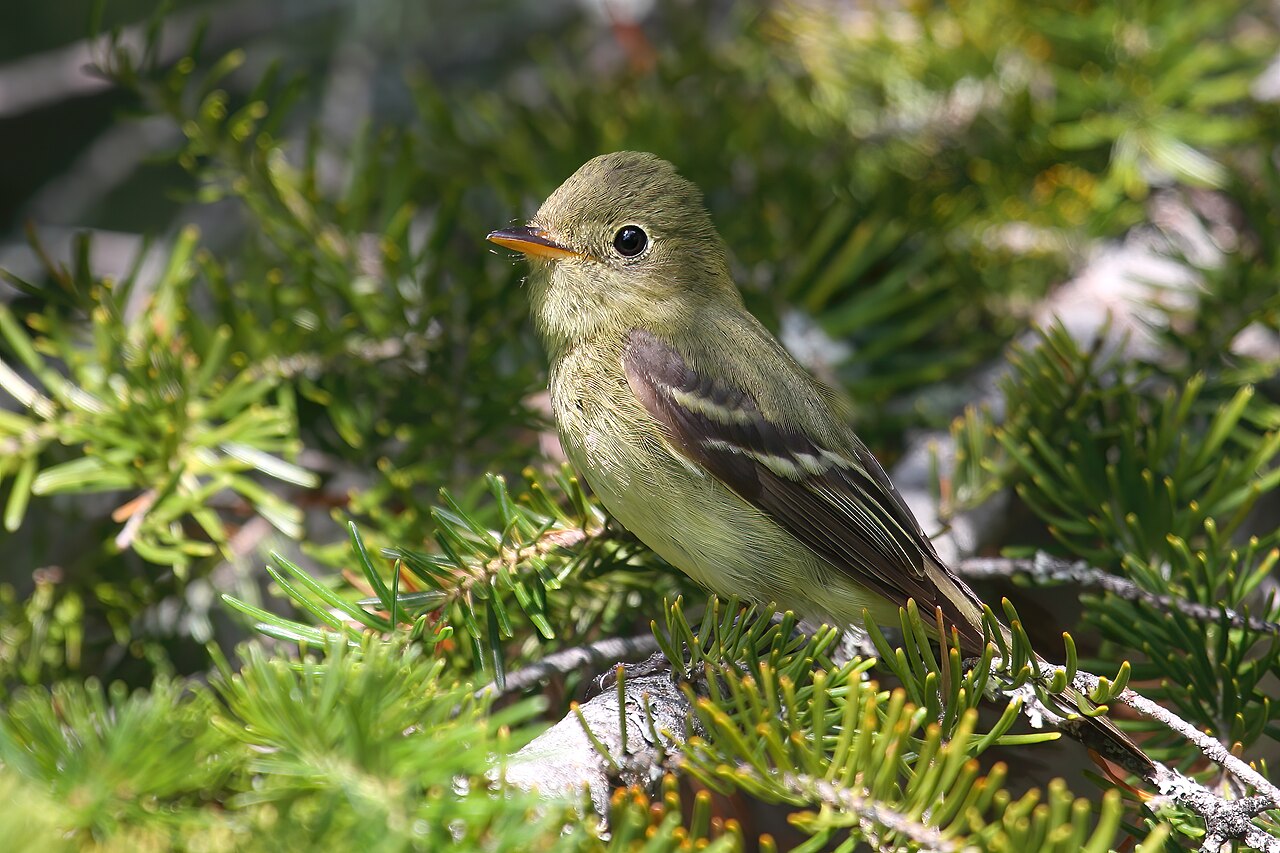
Green above, yellow below, with a yellow throat and an olive-grey wash across the breast; two pale yellow to whitish wingbars and a broad, complete eyering that sits as a pale ring around the eye and gives the head a wide-eyed look. The head is large with a peak at the rear of the crown, the tail short. The bill is broad and flat with a wholly orange-pink lower mandible. The overall yellow is the strongest of any eastern Empidonax, but voice remains the only identification that always closes: fresh autumn birds of other species can look yellow too.
Confusion species
Against Acadian Flycatcher: a white or at most pale yellow throat, a longer tail and a much longer primary projection, and an explosive peet-sa song with a soft peet call, against the descending che-BUNK and rising per-WEE. Against Alder Flycatcher: white throat, faint eyering, buzzy fee-BEE-o and dry pip, in wet alder scrub instead of bog forest. Against Willow Flycatcher: white throat, virtually no eyering, sneezy FITZ-bew and full whit, in open willow scrub. Against Western Flycatcher: an eyering drawn out to a point behind the eye, so teardrop-shaped rather than round, a thin rising pseet or two-parted pit-PEET, and a breeding range confined to the west; the ranges do not meet. A further mark, usable in the hand: Yellow-bellied has broad buff edges to the secondaries.
Habitat
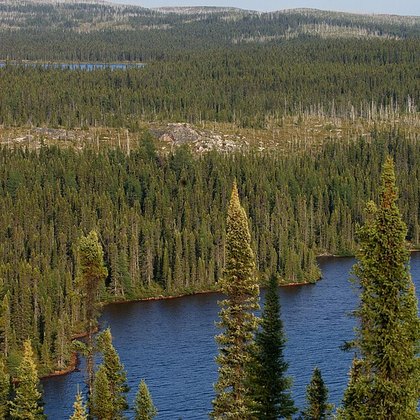
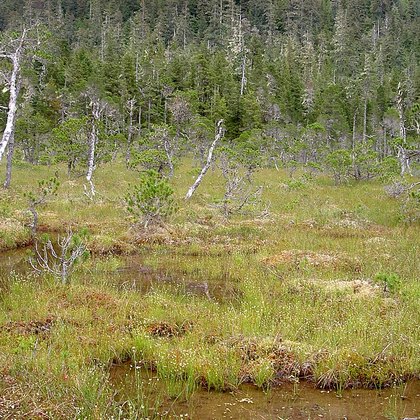
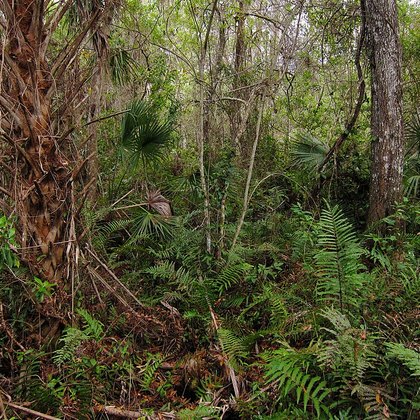
Damp, cool coniferous forest with a thick moss layer: black spruce bog forest, sphagnum peatland, swamps and streamside woodland with heath and blueberry in the understorey; in the southeast of the range also damp mixed forest with birch and balsam fir. It forages low to mid level. In winter it occupies humid tropical forest and shade coffee plantations in southern Mexico and Central America. The nest sits on or just above the ground, under a root, in a cavity in a log or in a moss hummock.
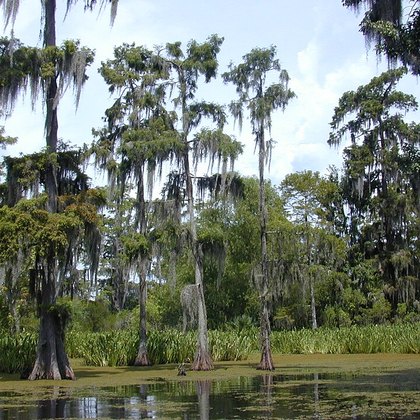
Where the bird is most often found, arranged by the USNVC — the vegetation classification of the United States and Canada — and CMECS for sea and coast.

Range and movements
Breeds from northeastern British Columbia and the Northwest Territories east through boreal Canada to Newfoundland, and south to northern Minnesota, northern Wisconsin, the Upper Peninsula of Michigan, the Adirondacks of New York and northern New England. It is a late spring migrant, usually not present until late May, and leaves in August and September. Migration runs through the eastern United States and eastern Mexico to a wintering range from southern Mexico to Panama.
- Breeding (summer)
- Winter
- Passage
- dark = core range, pale = thinly spread
Where and when to look
Look for it in late May or June in a black spruce and sphagnum bog, in the first hour after sunrise. On migration, in May and in September, it stands out most by the rising per-WEE call from dense scrub; if a small, yellow flycatcher with a round eyering is working through thickets in the eastern United States, it pays to wait for that call.
Conservation
Partners in Flight puts the breeding population at about 14 million birds; numbers have risen by about 2 per cent per year since 1966 and the species is rated Least Concern (LC). The range lies largely in thinly settled boreal country, where logging and peatland drainage act locally but do not set the overall picture. Loss of humid forest and of shade coffee on the wintering grounds is the main point of attention.
Scientific name
Empidonax flaviventris | (Baird; Baird, 1843)
William M. Baird and Spencer F. Baird described the species in 1843 as Tyrannula flaviventris, from a specimen near Carlisle, Pennsylvania; because it was later placed in Empidonax, author and year stand in parentheses. The species name is from Latin flavus 'yellow' and venter 'belly' — the English and Spanish names say the same. Empidonax goes back to Greek empis 'gnat' and anax 'master'. The Dutch name refers to birch, a tree of the damp northern woodland in which it breeds.