All species › Passerines › Parrotbills and allies › Wrentit
Wrentit | Chamaea fasciata
Winterkoningmees | Camea
The Wrentit is the voice of the Californian chaparral (dense, hard-leaved scrub of California's Mediterranean climate): an inconspicuous grey-brown bird that is almost never seen and heard twenty times on a morning's walk. It is neither a wren nor a tit, and for a century and a half it was shifted from one family to another before its place was settled. It is the only member of its family in the Americas.
Voice
Male and female both sing, and can be told apart by the phrase: the male ends in a rattle, the female breaks the series off before that rattle begins. Each bird keeps its own version for years, so a territory can be followed by ear without a bird ever being seen. Song is heard in every month and at every hour, with a clear peak from February to May. The call is a dry churring rattle, shorter than the song, with which a pair keeps contact in the scrub and which also serves as alarm.
Recording: Denise Wight — CC BY-NC-SA 4.0 · Vollmer Peak, Tilden RP, Contra Costa County, California, United States · xeno-canto
Identification
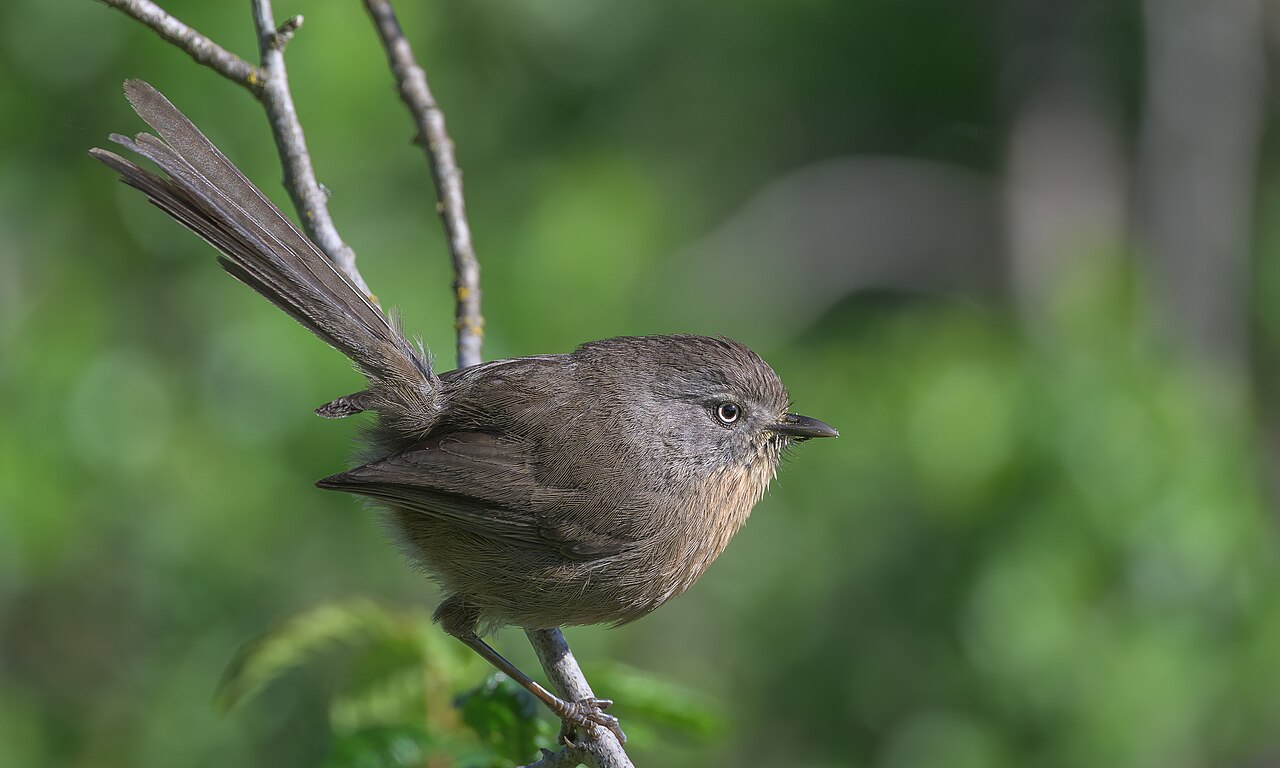
Fourteen to fifteen centimetres, thirteen to sixteen grams, and plain grey-brown: warmer brown in the north and greyer in the south. On the buff breast stands a fine, faint dusky streaking, often the only marking present. The surest mark at close range is the eye: a pale creamy-white iris in a dark face, giving the bird a fixed stare. Male and female cannot be told apart; young birds still have a dark eye. It flies rarely and briefly — a low, whirring hop from one bush to the next, and then it is gone again.
Confusion species
Bushtit (Psaltriparus minimus) is far smaller, greyer and moves through the same bushes in noisy flocks, with a much shorter bill; note that the female also has a pale eye, the male a dark one. Bewick's Wren (Thryomanes bewickii) has a white eyebrow, a thin decurved bill and white corners to the barred tail, and sings loud, varied phrases. California Scrub-Jay and California Towhee are both much larger and far heavier-billed. If what is left is a small brown bird with a long tail, the pale iris decides it.
Habitat
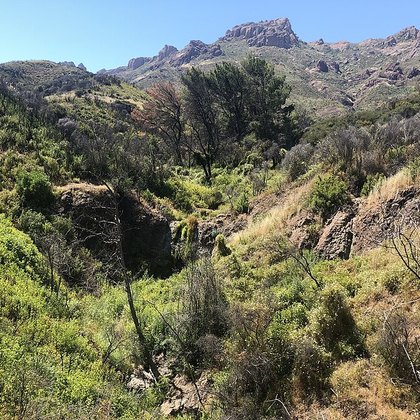
Chaparral of chamise, manzanita and ceanothus, coastal sage scrub on the sea hills, tangles of blackberry and poison oak along creeks, and overgrown gardens and park edges in the Californian suburbs. What it asks for is a shrub layer one to two metres high that is closed from the top to the ground; open grassland and closed forest it does not use. After a fire it disappears and returns only when the brush has closed again after five to ten years. It occurs from the coast to about fifteen hundred metres, rather higher in the south.
Where the bird is most often found, arranged by the USNVC — the vegetation classification of the United States and Canada — and CMECS for sea and coast.



Range and movements
A resident of the west coast, from the entire Oregon coast south through California west of the Sierra Nevada to northwestern Baja California, roughly to El Rosario at thirty degrees north. The floor of the Central Valley and the deserts east of the mountains stay empty. It does not migrate, and it has never crossed the Columbia: it is absent from Washington while being common on the far bank of the river. Logging in the Coast Range opened up young scrub during the twentieth century into which it has moved inland and north.
- Resident
- Breeding (summer)
- Passage
- dark = core range, pale = thinly spread
Where and when to look
Stand quietly at the edge of a chaparral slope in the morning and count the singers: there are often four or five within a couple of hundred metres. Searching achieves little, waiting does — the bird works its way slowly around you through the brush and comes into the open once or twice while doing so. If you get that half second, look at the eye and not at the plumage.
Conservation
Least Concern (LC), with an estimated world population of 2.2 million birds. Since 1966 numbers have fallen by about half a per cent a year, more than a third in all. The cause is the building over of exactly the coastal strip it belongs to: where scrub goes, isolated fragments are left, and because it will not cross open ground of more than a hundred metres, such a fragment loses the bird without it ever returning.
Scientific name
Chamaea fasciata | (Gambel, 1845)
Gambel described the species in 1845 as Parus fasciatus, among the tits; because it was later placed in another genus, author and year stand in parentheses. That genus, Chamaea, he introduced himself two years later, from Greek chamai, 'on the ground', for a bird that seldom shows itself above the bushes. fasciata is Latin for 'banded', from fascia, 'band', after the faint streaking on the underparts. The described bird came from California; Grinnell restricted the type locality to Monterey in 1932.