All species › Passerines › Bulbuls › Red-vented Bulbul
Red-vented Bulbul | Pycnonotus cafer
Roodbuikbuulbuul | Bulbul cafre
The Red-vented Bulbul comes from southern Asia and has been carried around the world as a cage bird. In the area of this guide it lives as an introduced species on Oʻahu, where it has been established since the mid-1950s, and in smaller numbers in southern Florida. It stands on the IUCN list of the hundred invasive species with the greatest impact.
Voice
Noisy, and heard through the whole year. The usual call is a clear, three-syllable whistle rendered in English as ginger beer; there is also a sharp pick and a rattling alarm call. At the roost and when groups meet, several birds chatter together at length.
Recording: David Darrell-Lambert — CC BY-NC-SA 4.0 · Jumeirah Village Triangle, Dubai, United Arab Emirates · xeno-canto
Identification
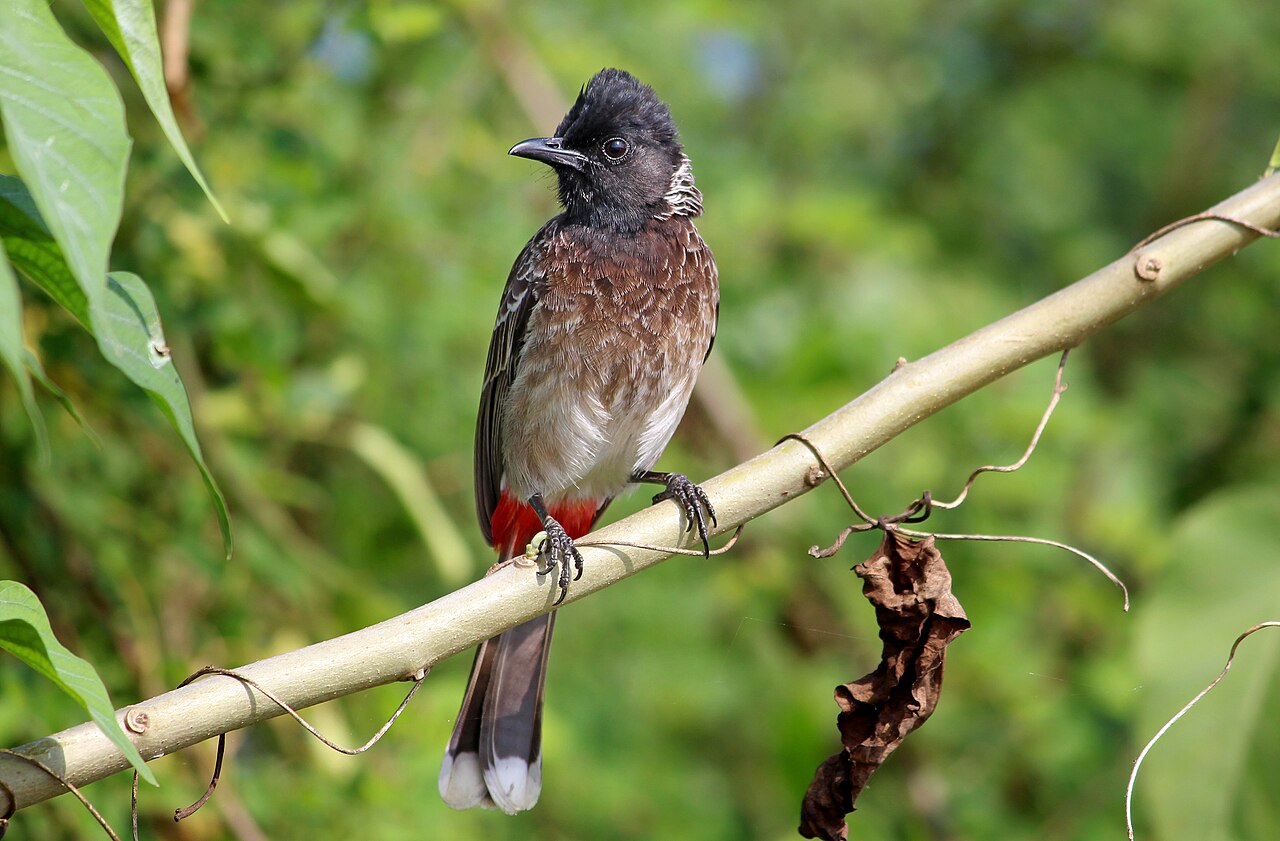
About the size of a starling, with a long black tail tipped white and a short crest that makes the head look squarish. Head, crest and throat are black, the rest of the body dark brown with a scaled pattern from pale feather edges. The rump is white and the undertail coverts bright red: those are the two marks that catch the eye as the bird flies off. Male and female look alike.
Confusion species
Red-whiskered Bulbul, also introduced in Florida and Hawaii, has a tall pointed black crest, a white cheek with a red patch behind it and white underparts; both species have red undertail coverts, but Red-vented is much darker and lacks the cheek patch. From Common Myna it differs by the red undertail, the white rump and the absence of a yellow eye patch and white wing patches.
Habitat
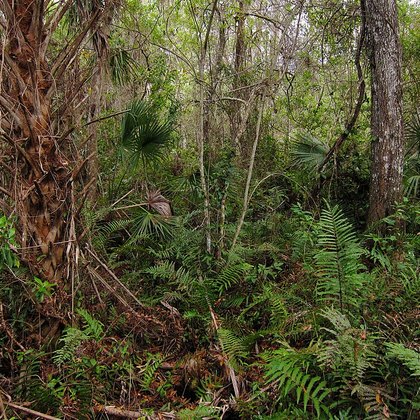
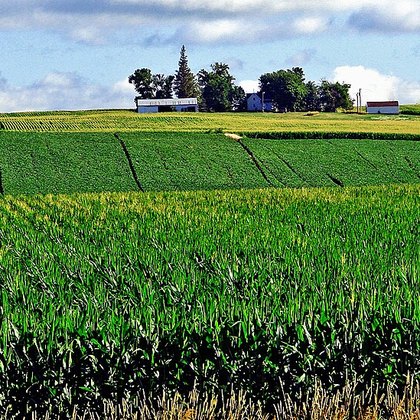
In its native range dry scrub, open forest, plains and cultivated land. In Hawaii and Florida chiefly gardens, parks, street trees, nurseries and orchards in and around built-up areas; it largely avoids closed, high-elevation native forest and stays in the lowlands and along edges.
Where the bird is most often found, arranged by the USNVC — the vegetation classification of the United States and Canada — and CMECS for sea and coast.




Range and movements
Native from Pakistan and India through Nepal and Bangladesh to Myanmar and southwestern China, with eight subspecies. Introduced and established on Fiji, Samoa and Tonga, in Argentina, in parts of the Middle East and on Oʻahu, where released cage birds in the mid-1950s were the start. It is not established on the other Hawaiian islands; there are scattered records on the island of Hawaii near Hilo and on the Kona coast. In Florida a small population has existed around Miami since the 1960s. New Zealand eradicated the species in 1955.
- Resident
- dark = core range, pale = thinly spread
Where and when to look
On Oʻahu it can be watched from a bench in a city park in Honolulu; watch the white rump as it leaves a street tree. In Florida the chance is far smaller and limited to a few residential districts of Miami-Dade. Perched birds often hold the crest flat — then look for the red undertail coverts under the cocked tail.
Conservation
In its native range the species is numerous and the IUCN places it in the Least Concern (LC) category. In the area of this guide management concerns not the species itself but its effects: on Oʻahu the damage to orchid nurseries is put at about 300,000 dollars a year, and the bird spreads the seeds of invasive plants such as miconia, ivy gourd and false kava. Hawaii lists it as injurious wildlife, with a ban on transport and release, to keep it from establishing on the other islands.
Scientific name
Pycnonotus cafer | (Linnaeus, 1766)
Linnaeus described the species in 1766 as Turdus cafer; the later move to another genus puts author and year in parentheses. The species name cafer is New Latin for 'of the Cape': following Brisson the type locality was wrongly given as the Cape of Good Hope and was corrected to Ceylon in 1930 — the bird has never occurred naturally in southern Africa. The genus Pycnonotus was introduced in 1826 by Friedrich Boie, from Greek puknos 'dense' and noton 'back', after the dense hair-like feathers of the nape and back. The English and Dutch names both name the red undertail coverts.