All species › Passerines › Tyrant flycatchers and allies › Tropical Kingbird
Tropical Kingbird | Tyrannus melancholicus
Tropische koningstiran | Tirano Tropical
The Tropical Kingbird is the most widely distributed kingbird of the continent: the range runs from southern Arizona and southern Texas all the way to Argentina. It sits on wires, posts and dead branches above open ground and takes flying insects from there. In North America it is above all a bird of Mexico; in the United States it breeds only in the far southern tip of two states.
Voice
The call is a high, tinkling trill: a rapid series of thin pip notes running together into pip-pip-pip-pirrrr, without the nasal, grating undertone of Couch's Kingbird. At dawn the male gives a longer version in which the same notes are repeated in groups. The sound carries far and is the only fully conclusive character in the Texas overlap zone.
Recording: JAYRSON ARAUJO DE OLIVEIRA — CC BY-NC-SA 4.0 · Brejo do tricolino oliváceo - Campestre de Goiás, Brazil · xeno-canto
Identification
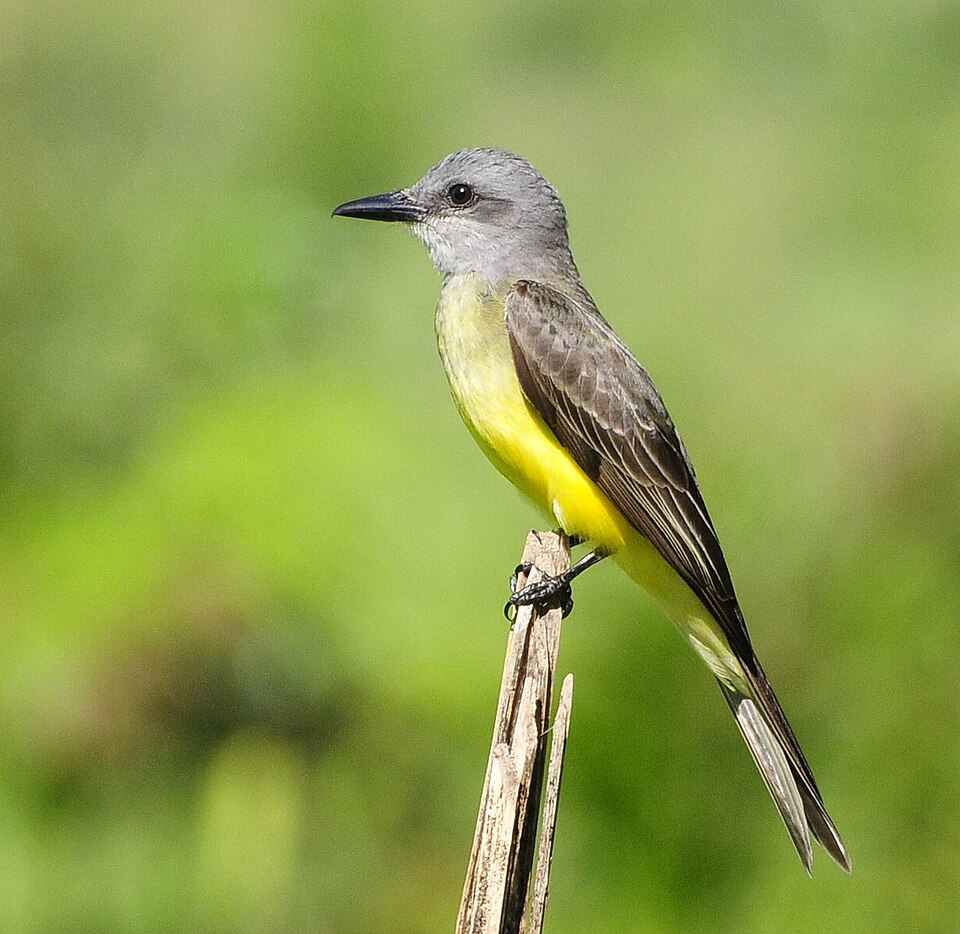
A heavy flycatcher with a big head and a long, thick bill. Head and neck are gray with a dark mask through the eye; the back is grayish green, the wings and tail gray-brown. The throat is pale gray, below which olive passes into bright yellow that reaches up onto the breast. The tail is brown, without white, and clearly notched to slightly forked. A concealed orange-yellow crown patch shows only in excitement.
Confusion species
Couch's Kingbird is all but identical and is separated by call: pip-pip-pirrrr (tinkling) against kip-kip-breeer (nasal and grating). Tropical also averages a longer, heavier bill and a grayer, less green back. Western Kingbird has white outer tail feathers and a straight, black tail; Tropical lacks that white and has a forked tail. Cassin's Kingbird has a dark gray head and breast, a white chin patch and a square tail with a pale terminal edge. Gray Kingbird has no yellow at all.
Habitat
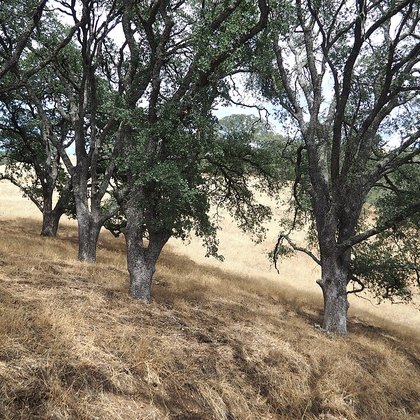
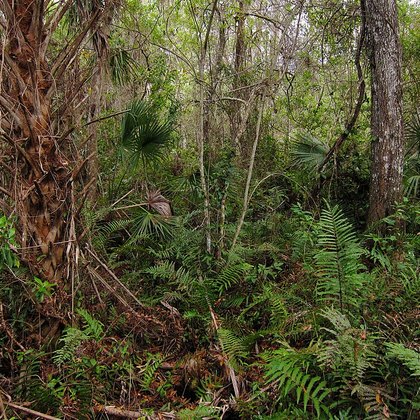
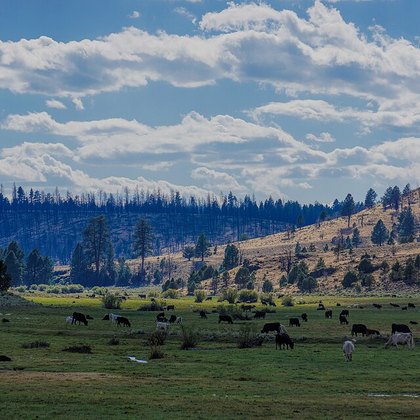
Open and semi-open country with scattered trees and lookout perches: savanna, open oak woodland, field edges, pasture, parks, town edges and the riparian zone of rivers and creeks. Also the edges of tropical forest, provided there is open space to hunt in. Closed forest it avoids. It adapts to human-made landscapes and often sits on telephone wires along roads.
Where the bird is most often found, arranged by the USNVC — the vegetation classification of the United States and Canada — and CMECS for sea and coast.



Range and movements
The range runs from southern Arizona and the lower Rio Grande through all of Middle America to central Argentina. Over most of Mexico and Central America it is resident; at the northern edge, in Sonora, western Chihuahua, Arizona and southern Texas, it is a summer visitor and moves south in winter. Outside the breeding season vagrants appear yearly along the Pacific coast of the United States and Canada, chiefly from September to November; since 2000 there have also been more reports from the interior and the east.
- Resident
- Breeding (summer)
- Winter
- Passage
- dark = core range, pale = thinly spread
Where and when to look
In Texas go by voice rather than by appearance: a silent bird in the Lower Rio Grande Valley usually cannot be named. The best chance in the United States is May to August at Patagonia and Nogales in Arizona, or along the Rio Grande near Brownsville. Watch the tail: a notch without white rules out Western Kingbird.
Conservation
The IUCN lists the species as Least Concern (LC). Partners in Flight puts the world population at about 200 million breeding birds and scores the species 4 out of 20 on the Continental Concern Score, the lowest concern category. Numbers are stable to increasing; the species gains from deforestation and from open, human-made landscapes, which provide more hunting ground and more perches. The breeding range in Arizona and Texas expanded during the twentieth century.
Scientific name
Tyrannus melancholicus | Vieillot, 1819
Vieillot described the species in 1819 as Tyrannus melancholicus, from a specimen taken in Paraguay; author and year stand without parentheses because the genus has not changed since. Tyrannus is Latin for 'absolute ruler' or 'king', after the concealed crown patch and the driving off of much larger birds at the nest. The species name melancholicus means 'melancholy'; why Vieillot chose it is not apparent from the description.