All species › Passerines › Crows, jays and magpies › Tamaulipas Crow
Tamaulipas Crow | Corvus imparatus
Mexicaanse kraai | Cuervo de Tamaulipas
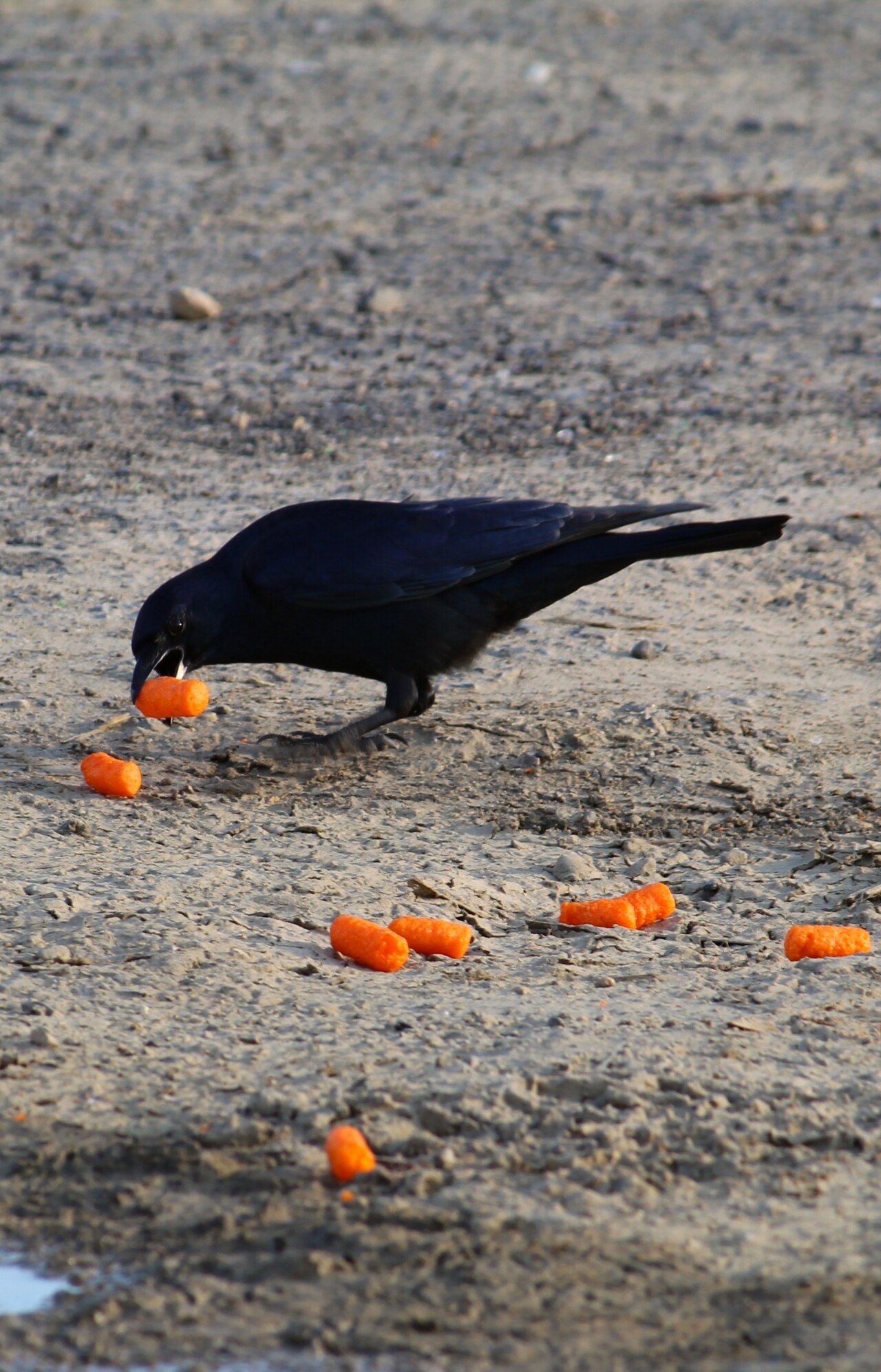
The Tamaulipas Crow is the smallest crow in North America and belongs to the dry brushland of northeastern Mexico. Between 1968 and the early years of this century it was a regular winter visitor at the Brownsville landfill in south Texas; since then it has rarely been seen there.
Voice
The call is not a caw but a low, frog-like croak, often written as a soft gar-lik with a rolling r in it. The pitch is lower and the delivery shorter and drier than in American Crow, and the bird usually calls without bobbing its head. In groups at a roost or a food source the sound runs together into a continuous grumbling. The difference from Chihuahuan Raven is audible: that species calls louder and higher, with a nasal quack.
Recording: Leonardo Guzman Hernandez — CC BY-NC-SA 4.0 · Sabinas y Saucillo, Gómez Farías, Tamaulipas, Mexico · xeno-canto
Identification
A small, slim, entirely black crow with a glossy blue-purple sheen on head, back and wings. The bill is slender and straight, the legs are fine, and the tail is short and squared off at the tip. In flight the wingbeats are quicker and shallower than in larger crows. Size is the first mark: at 34 to 38 centimetres it is clearly smaller than any other black corvid in the area.
Confusion species
American Crow, at 40 to 53 centimetres, is much larger, has a heavier bill and gives a clear caw-caw; its range in south Texas barely overlaps with this species. Chihuahuan Raven is larger again, shows a wedge-shaped tail in flight, raises its throat feathers when calling, and has nasal bristles running two-thirds of the way along the bill. Sinaloa Crow, on Mexico's west coast, is almost identical and was treated together with this bird as a single species, Mexican Crow, until the 1980s; the two ranges lie on opposite sides of the country and do not meet. In south Texas the field rule is: a small black crow that croaks rather than caws.
Habitat
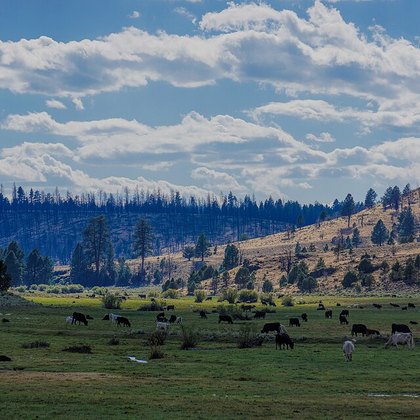
Semi-arid thorn scrub, mesquite country, field edges, pasture with scattered trees and the edges of villages, ranches and towns. Landfills and cattle feedlots supply much of the food. The species avoids mountains and closed forest and does not occur on the coast. The nest is placed in a tree or large shrub and resembles that of American Crow, but smaller.
Where the bird is most often found, arranged by the USNVC — the vegetation classification of the United States and Canada — and CMECS for sea and coast.





Range and movements
Resident in northeastern Mexico: Tamaulipas, eastern Nuevo León, eastern San Luis Potosí and northern Veracruz. In the United States it is confined to the extreme south of Texas. The first record there dates from 1968; through the 1980s and 1990s up to several hundred birds used the Brownsville landfill, and fieldwork for the Texas Breeding Bird Atlas between 1987 and 1992 confirmed breeding at two sites near the mouth of the Rio Grande. The last nesting was in 2001. Since then the species has fallen back to a rare and irregular visitor in Cameron County.
- Resident
- Breeding (summer)
- Winter
- dark = core range, pale = thinly spread
Where and when to look
In Texas the chance is small, and the best address is the area around the Brownsville landfill in the winter months. In Mexico, drive the back roads of Tamaulipas through mesquite (a thorny pod-bearing shrub of the Southwest that forms dense thickets) country and watch for small groups of black birds on fence posts and roadsides. Go by the croaking call; at distance the size is hard to judge without another corvid alongside.
Conservation
The IUCN places the species in the Least Concern (LC) category; in its Mexican core range it is common and benefits from agriculture and refuse. The Texas decline has not been explained: a coincidence with changed management at the Brownsville landfill has been suggested, but numbers also fell where the food supply stayed the same. Because the Texas population sat at the extreme edge of the range, that decline says little about the population as a whole, which is barely surveyed.
Scientific name
Corvus imparatus | Peters, 1929
James Lee Peters described the species in 1929 from a specimen taken at the Rio La Cruz in Tamaulipas; as it has never been moved out of Corvus, author and year stand without parentheses. Latin imparatus means 'unprepared, not equipped'; Peters does not explain in his description what he had in mind. The English and Spanish names refer to the Mexican state the type material came from. Until the 1980s this bird and Sinaloa Crow were treated as one species under the name Mexican Crow; the Dutch name preserves that older treatment.