All species › Passerines › New World warblers › Swainson's Warbler
Swainson's Warbler | Limnothlypis swainsonii
Swainsons zanger | Chipe coronicafé
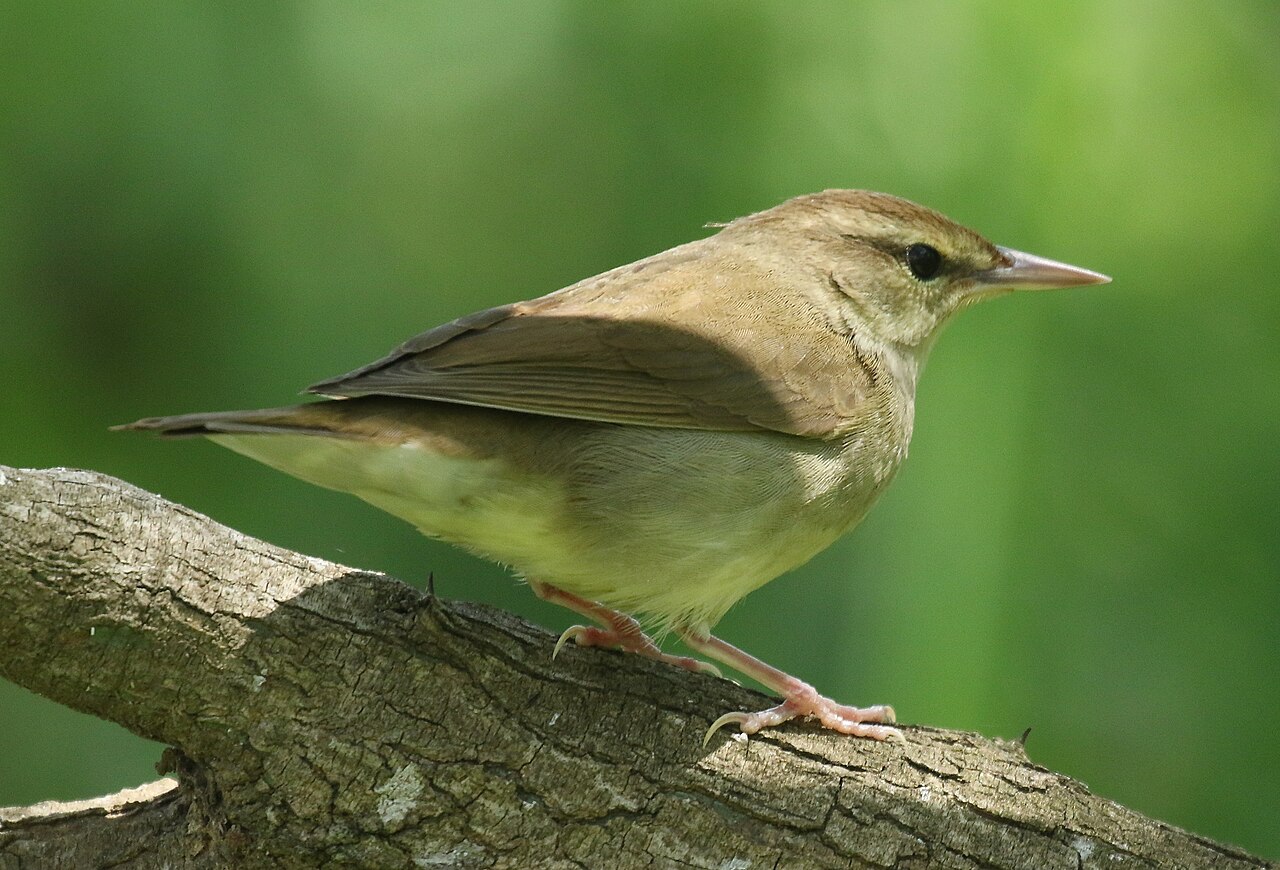
Swainson's Warbler is a heavyset, brown warbler with a stout bill that keeps to the densest thickets of the southeastern lowland forests. It is heard sooner than seen: the song comes out of an impenetrable wall of cane, bramble and vine.
Voice
The song is a series of three or four clear, even whistles followed by a descending, slightly slurred closing phrase: whee whee whee, chee-chew-weet. In structure it resembles that of Louisiana Waterthrush, but slower, fuller and without the hurried jumble at the end. From late March to late April the male sings almost continuously across a large territory, and is much quieter afterwards. The call is a flat, hard chip.
Recording: Sue Riffe — CC BY-NC-SA 4.0 · Minor E Clark Fish Hatchery, Rowan County, Kentucky, United States · xeno-canto
Identification
Plain olive-brown above, dingy white to pale yellow below, without streaking, wingbars or tail spots. The crown is rusty brown and contrasts with a long, off-white eyebrow stripe and a dark eye-line. The bill is long, straight and heavy for a warbler, and the forehead runs flat into it, giving the head an elongated look. Male and female are alike. It forages walking over the forest floor, flipping dead leaves with the bill rather than flitting in the canopy.
Confusion species
Worm-eating Warbler has a lighter, thinner bill and four black stripes over the head instead of a plain rusty crown; it also hangs at dead leaves in the shrub layer. Both waterthrushes are streaked below and bob the rear body. Ovenbird has an orange crown stripe with black borders, a white eye-ring and a streaked breast. By song, Swainson's Warbler is closest to Louisiana Waterthrush; the slower pace and the absence of the closing jumble separate them.
Habitat
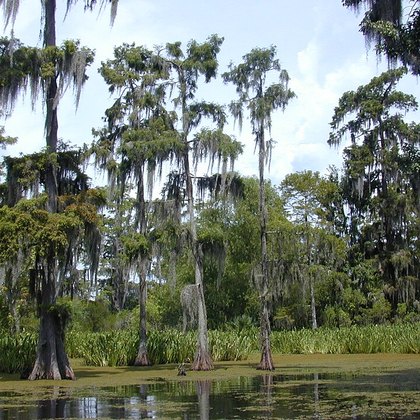
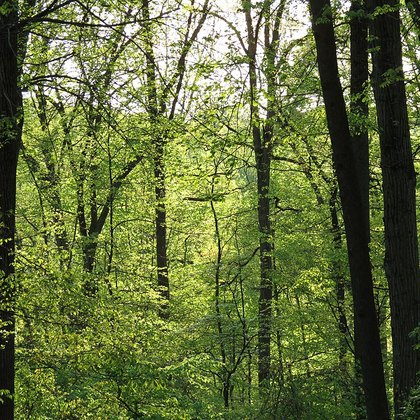
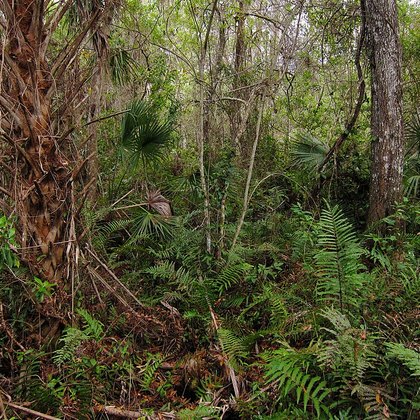
Two fairly different types. On the coastal plain and in the Mississippi valley: bottomland hardwood forest, cypress swamp and canebrakes of giant cane with a dense herb layer and abundant leaf litter, also loblolly pine plantation with a dense understorey. In the southern Appalachians: rhododendron thickets on moist mountain slopes to well over 1000 metres. Both share the same structure: a closed shrub layer above an open, leaf-covered floor. Territories are large, up to eighteen hectares. In winter in dry limestone forest and moist scrub.
Where the bird is most often found, arranged by the USNVC — the vegetation classification of the United States and Canada — and CMECS for sea and coast.

Range and movements
Breeds in the southeastern United States: from eastern Texas and eastern Oklahoma through Arkansas, Louisiana, Mississippi and Alabama to Georgia and the Carolinas, and north along the Appalachians to West Virginia, southern Ohio and Maryland, with scattered sites in southern Illinois and southern Indiana. Migration crosses the Gulf and the Caribbean and the range splits into two wintering parts: one moves southwest to the Yucatán Peninsula, Belize and Guatemala, the other southeast to the Greater Antilles, centred on the Blue Mountains of Jamaica.
- Breeding (summer)
- Winter
- Passage
- dark = core range, pale = thinly spread
Where and when to look
The best chance falls in the first half of April, when the male sings nearly all day. Stay on the trail and wait near a singing bird: it works its large territory and often comes right to the edge of the thicket on its own, whereas pushing into the wall drives it off.
Conservation
Partners in Flight puts the breeding population at about 160,000 birds; that is few for a New World warbler, but the trend is stable to slightly rising, the species is listed as Least Concern (LC) and the concern level is low. About 99 per cent of the original canebrakes have gone since colonial times, and the species has partly shifted to pine plantation with a dense understorey. Logging of bottomland hardwood forest, hurricane damage and collisions with communication towers during nocturnal migration are the known pressures. One banded male in South Carolina reached almost ten years of age.
Scientific name
Limnothlypis swainsonii | (Audubon, 1834)
Audubon described the species in 1834 as Sylvia Swainsonii; because it was later moved to another genus, author and year stand in parentheses. The species name honours the English ornithologist William Swainson. The genus Limnothlypis was introduced in 1914 by Witmer Stone, from Greek limnē 'marsh' and thlypis, a name for a small bird used repeatedly as a genus element in this family. The name thus means roughly 'marsh warbler'. The Spanish name chipe coronicafé refers to the rusty crown.