All species › Waders, gulls and terns › Sandpipers and allies › Spotted Sandpiper
Spotted Sandpiper | Actitis macularius
Amerikaanse oeverloper | Andarríos maculado
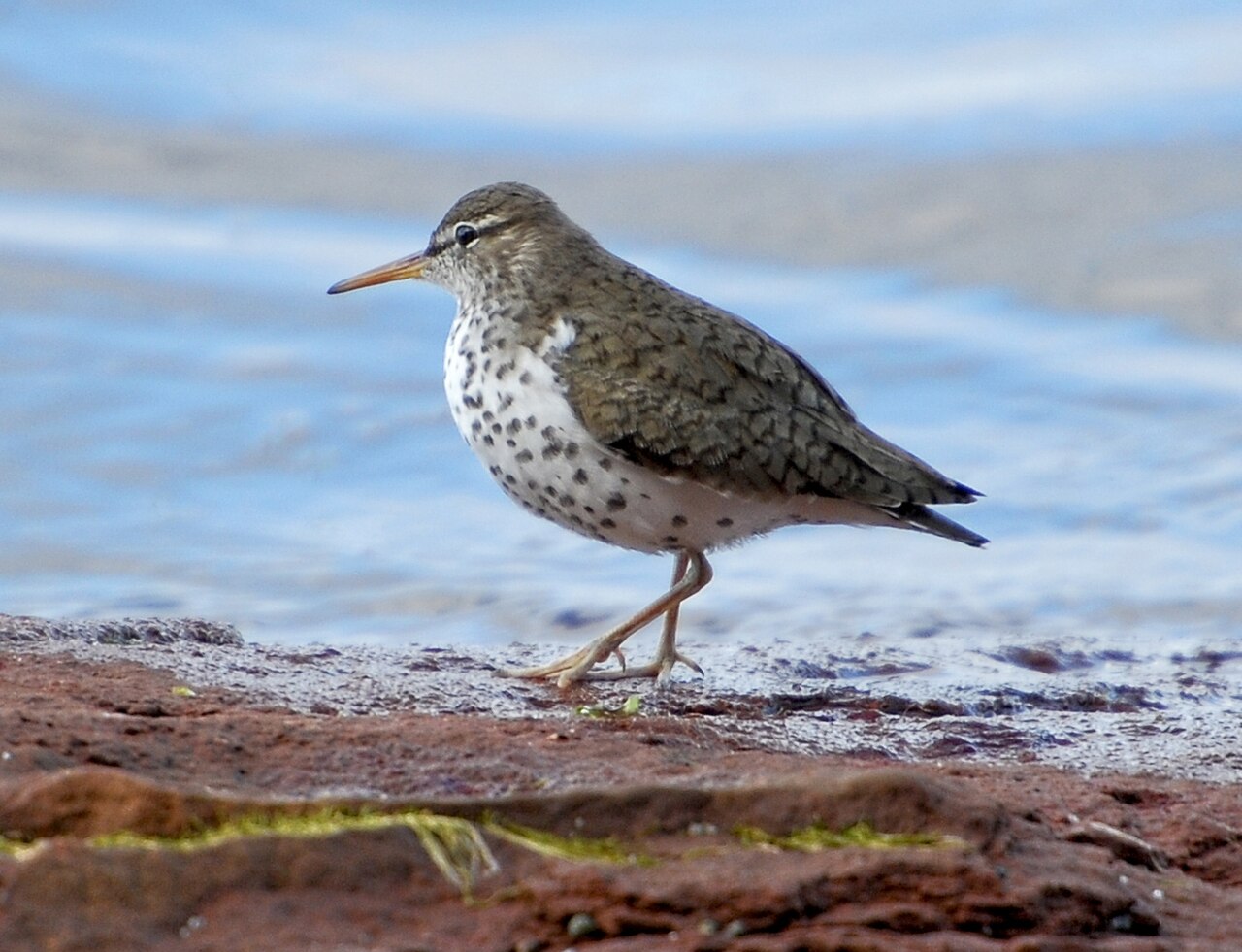
The most widespread breeding wader on the continent: at almost every stream, pond and lake shore from Alaska to Texas there is one teetering. In breeding plumage it is the only wader in North America with round black spots across the whole white underside. The roles are reversed in this species: the female is larger, holds the territory and may lay in turn for as many as four males, each of which incubates and raises the chicks himself.
Voice
The usual call is a clear two-syllable peet-weet, which on take-off turns into a fast series of weet-weet-weet-weet that seems to run along with the wingbeat. In spring the female uses a longer, rattling series to hold the territory and draw males. At the nest a soft, insistent chip sounds as soon as anyone comes too close. Outside the breeding season the call is often the first sign that one is walking along the shore, for the bird itself barely shows among the stones.
Recording: Manuel Grosselet — CC BY-NC-SA 4.0 · San Juan Guelavía, San Juan Guelavía, Oaxaca, Mexico · xeno-canto
Identification
In breeding plumage olive-brown with fine dark bars above, and white with round black spots below; the bill is then orange with a dark tip and the legs are yellowish to flesh-coloured. In winter plumage the spots go: the underside is then plain white, the upperparts are uniform grey-brown and the bill is dull yellow-brown. On each side of the breast a brown patch remains, with a white wedge running up between them to in front of the bend of the wing. In flight it shows a short, narrow white wing stripe that does not reach the body, and it goes low over the water with stiff, shallow beats alternating with short glides. Walking, it teeters ceaselessly with the rear body, even when standing still. Juveniles have neat pale and dark bars across the wing coverts.
Confusion species
Common Sandpiper (Actitis hypoleucos) of Eurasia, a visitor to western Alaska, has grey-green rather than yellowish legs, a tail that projects far beyond the wing tips and a white wing stripe running across the whole inner wing to the body. Solitary Sandpiper (Tringa solitaria) has a white eye-ring, dark wings without a stripe and barred outer tail feathers, and bobs with the whole front of the body instead of teetering behind. Terek Sandpiper (Xenus cinereus) is grey and has orange legs and an upcurved bill. An unspotted bird in autumn is awkward: look first at the leg colour and then at how far the tail projects beyond the wings.
Compare sandpipers, snipes and allies: bill, legs, wing bar and rump
Habitat
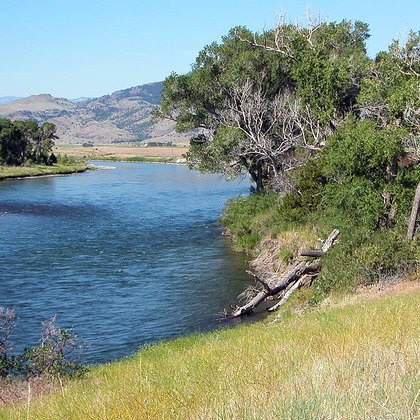
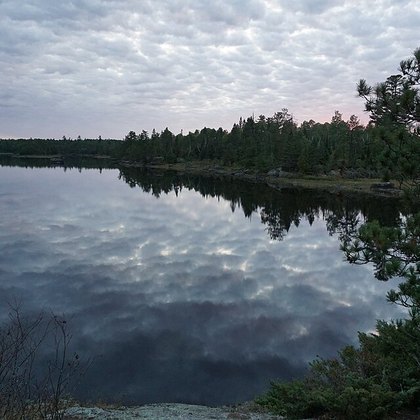
The edge of almost any water: streams and rivers with gravel or sand bars, lake shores, park ponds, reservoirs and ditches, from sea level to above the tree line in the Rocky Mountains. It needs an open strip along the water to walk on, and low growth beside it in which the chicks find cover. In winter it moves on to mangrove, river mouths, rocky coast and harbours, in Central and South America up to high in the mountains. It makes little use of broad bare mudflats, where most waders crowd together; it is almost always alone.
Where the bird is most often found, arranged by the USNVC — the vegetation classification of the United States and Canada — and CMECS for sea and coast.



Range and movements
It breeds from Alaska and the southern half of Canada across nearly the whole of the United States, the coastal plain of the southeast being the largest gap. It winters along the coast of California and in the southern United States, and on through the whole of Mexico, Central America and the Caribbean to Chile and Argentina. It migrates at night and usually alone; autumn passage begins as early as July and runs into October, the return falls in April and May. The breeding bird counts show a gradual decline over the past half century, sharpest in the east.
- Resident
- Breeding (summer)
- Winter
- Passage
- dark = core range, pale = thinly spread
Where and when to look
Walk along a stream with gravel bars in May or June and watch for a small wader that teeters behind and flies off low over the water on stiff wings. If you see two chasing each other, look at which is the larger: that is the female, and she is the one holding the territory. In August juveniles often stand alone at the edge of a park pond, where they let you come within a few metres.
Conservation
The Red List holds the species as Least Concern (LC); the breeding population is put at about 660,000 birds. The breeding bird counts show a fall of nearly 1.5 per cent a year between 1966 and 2019, well over half the population in total. The causes lie in the loss of wet shorelines, the hardening of riverbanks and water quality, with pesticides and run-off from farmland and towns.
Scientific name
Actitis macularius | (Linnaeus, 1766)
Linnaeus described the species in 1766 as Tringa macularia; because it was later moved to another genus, author and year stand in parentheses. The genus Actitis was introduced by Illiger in 1811 and goes back to the Greek aktites, 'dweller on the coast'. macularius is Latin for 'spotted', after the black spots of the breeding plumage. Linnaeus gave the origin as Europe and North America; the type locality was later fixed on Pennsylvania, after the plate by Edwards on which he drew.