All species › Passerines › New World warblers › Slate-throated Redstart
Slate-throated Redstart | Myioborus miniatus
Meniezanger | Candelita plomiza
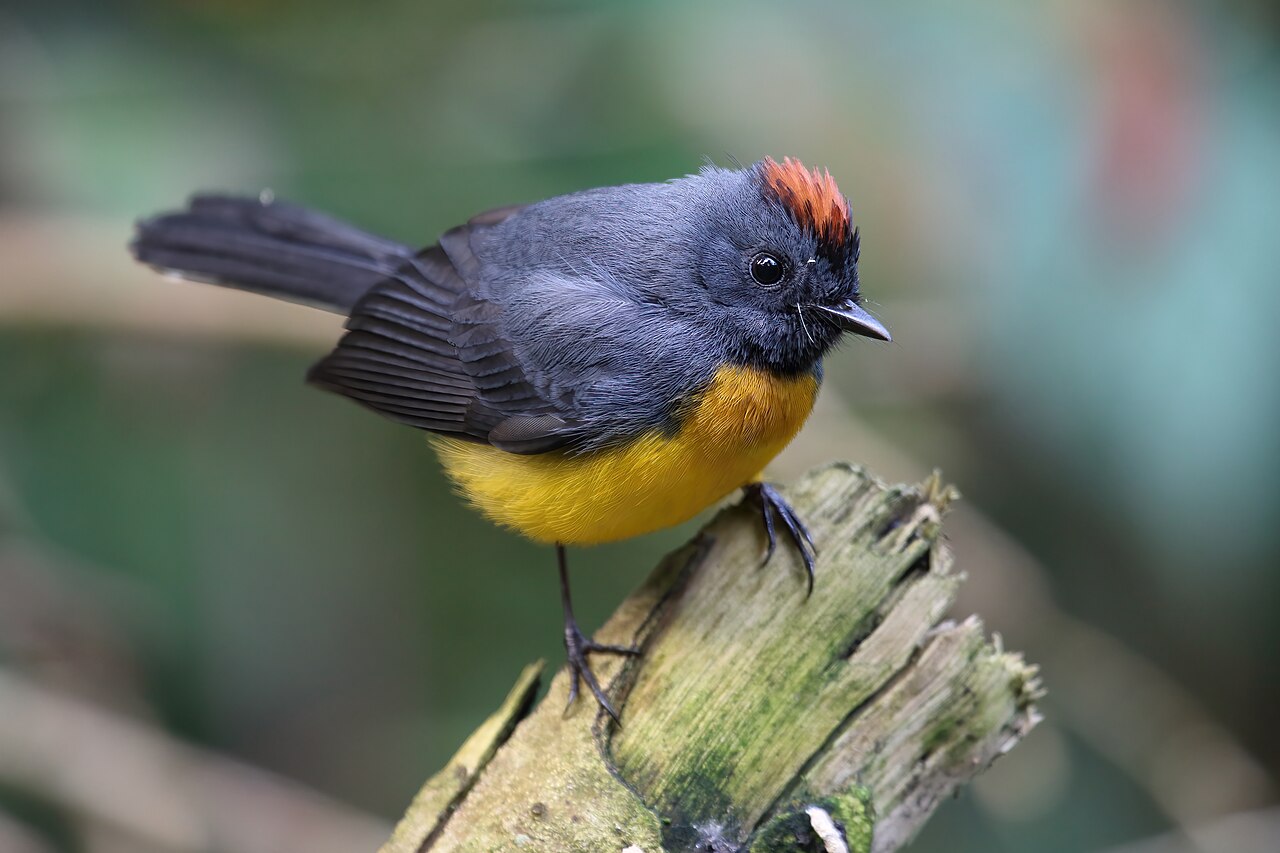
The Slate-throated Redstart is a small warbler of the mountain forests of Mexico and Central America that continually fans and closes its white-edged tail. Within the guide area it is resident in the Mexican highlands; north of the border it appears only as a vagrant in southeastern Arizona and West Texas.
Voice
The call is a sharp, high pik or chip, often repeated as the bird moves through the mid-storey. The song is a series of eight to fifteen clear, rapidly delivered notes that rises in pitch at the end or else trails off; the pattern varies strongly by region and by individual, so two neighbouring males may sing different phrases. Song is heard through most of the year, peaking from March to June.
Recording: Juan Freile — CC BY-NC-SA 4.0 · Bellavista Cloud Forest Reserve, Ecuador · xeno-canto
Identification
Upperparts, head and throat are slate grey, with a rufous crown patch visible only at close range or when the crown feathers are raised. The underparts are bright red in the Mexican subspecies; farther south they turn orange, and in the Andes yellow. The tail is black with broad white outer edges and white tips. The most telling feature is behaviour: the bird holds its wings half spread, fans the tail open and swings it from side to side, so that the white flashes and flushes insects which it then takes in the air.
Confusion species
Painted Redstart, the only relative breeding in the United States, has a large white wing patch, a white crescent below the eye and a black head without a rufous crown patch. Slate-throated Redstart lacks both white marks and has a grey rather than black throat. Red-faced Warbler shows red on the face but behaves normally with the tail and has no white in the outer tail feathers.
Habitat
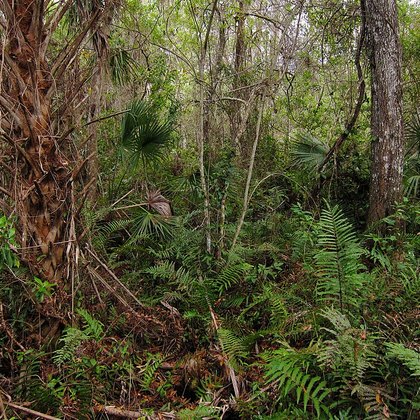
Humid montane forest roughly between 600 and 2500 metres: in northern Mexico pine-oak and oak woodland on the flanks of the Sierra Madre, farther south also cloud forest and semi-humid deciduous forest. It keeps to the upper understorey and mid-storey, often in stream canyons and at forest edges, and in winter joins mixed flocks with vireos, titmice and other warblers. Clear-felled land and lowland rainforest it avoids.
Where the bird is most often found, arranged by the USNVC — the vegetation classification of the United States and Canada — and CMECS for sea and coast.





Range and movements
The range runs from northwestern and northeastern Mexico through Central America and the Andes to northwestern Argentina, in twelve subspecies. Within the guide area it covers the ranges of both Mexican Sierras, from Sonora, Chihuahua and Tamaulipas southward, and Guatemala, El Salvador, Honduras and northern Nicaragua. The bird does not migrate, but drops a few hundred metres in elevation locally in winter. In the United States a few dozen records have been accepted, almost all from the border canyons of southeastern Arizona and the Big Bend area of Texas, spread over spring and summer.
- Resident
- Breeding (summer)
- Winter
- Passage
- dark = core range, pale = thinly spread
Where and when to look
In Mexican mountain canyons with oak and pine, look for a small bird that never keeps still: the spread fan of the tail with its flashing white catches the eye before the colour does. For a vagrant in Arizona or Texas the first thing to check is the wing — no white wing patch means it is not a Painted Redstart.
Conservation
The IUCN places the species in the Least Concern (LC) category; the range is large and the population is judged stable. Within the guide area the loss of montane forest in Mexico and Central America is the main pressure, but the species holds on in degraded forest and along edges as long as shrub layer and mid-storey remain. Systematic counts across the core range are lacking.
Scientific name
Myioborus miniatus | (Swainson, 1827)
Swainson described the species in 1827 as Setophaga miniata from a specimen taken in the woods near Valladolid, now Morelia in Michoacán; because it was later moved to another genus, author and year stand in parentheses. The genus Myioborus comes from Greek muia 'fly' and -boros 'eating', after its habit of catching insects in the air. The species name miniatus is Latin for 'painted with red lead', after the red underparts; the Dutch name refers to that same vermilion colour.