All species › Passerines › Cardinals and allies › Scarlet Tanager
Scarlet Tanager | Piranga olivacea
Zwartvleugeltangare | Piranga escarlata
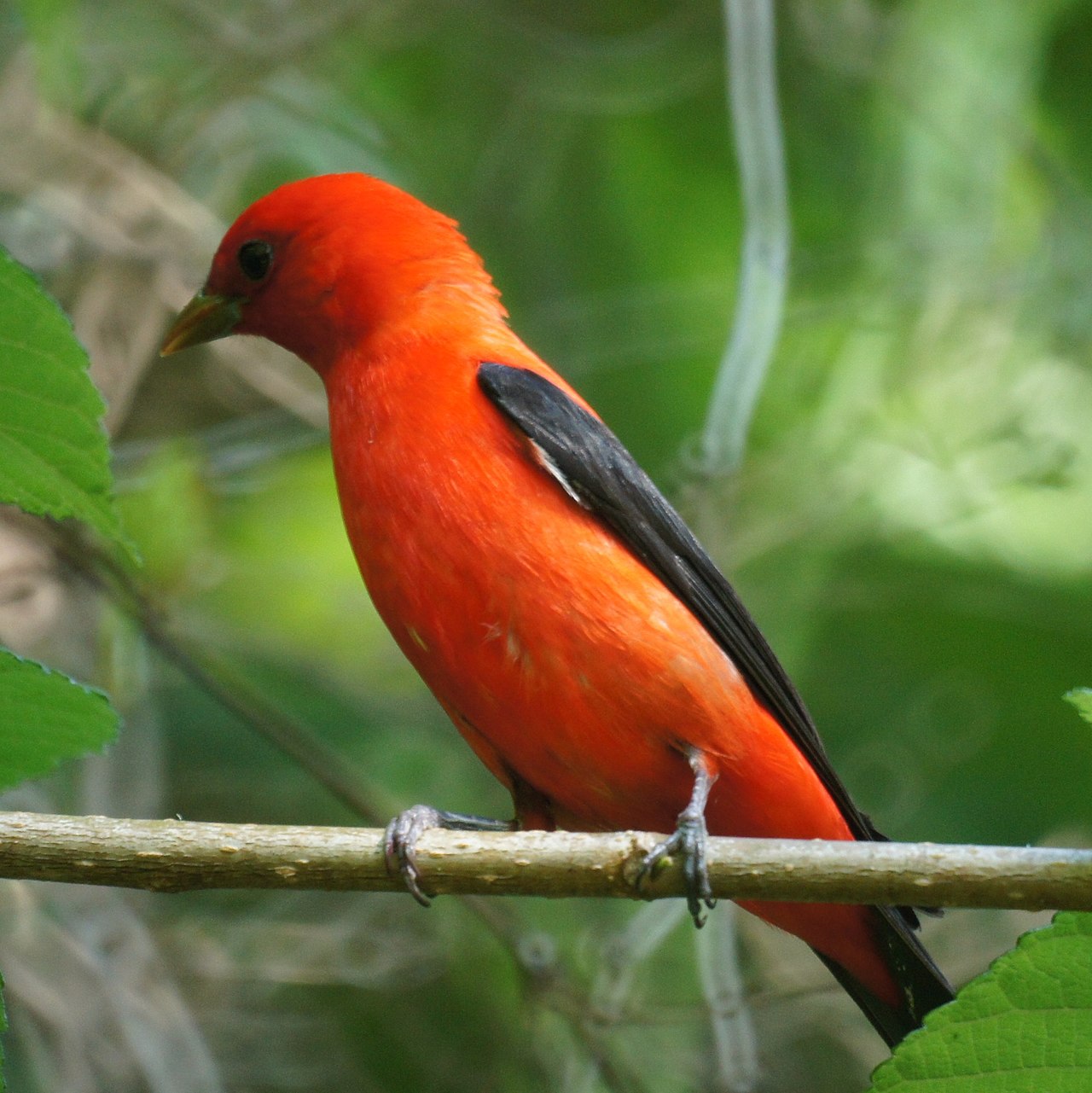
The Scarlet Tanager breeds in mature deciduous forest of eastern North America and winters in the mountain forests along the eastern edge of the Andes. In spring the male is scarlet with black wings and tail; after breeding it moults to yellow-green, with only the black wings retained.
Voice
The song is a hurried series of four or five rising and falling phrases with a burry, cracked tone, rather like an American Robin with a hoarse throat. The call is the most useful feature: a short, hard chip-burr, the second syllable pulled down and harsh. That call also betrays the bird in autumn, when the plumage no longer says anything.
Recording: steve — CC BY-SA 4.0 · Durham, Durham County, North Carolina, United States · xeno-canto
Identification
The breeding male is bright scarlet with deep black wings and tail — the sharpest colour contrast among the tanagers of the region. The female is yellow-green above, yellower below, with dark olive-brown wings and tail. From late summer the male moults into the green-yellow plumage of the female, but wings and tail stay black; birds in mid-moult are blotched red and green. The bill is shorter and blunter than that of Summer Tanager and pale horn to greyish yellow.
Confusion species
A male Summer Tanager is red through the wings and tail as well and has a pale, heavier bill. Western Tanager has a red head against a yellow body and two wingbars. In autumn the differences are smallest: a green tanager with black wings and a black tail is this species, one with olive-brown wings is Summer Tanager, and one with wingbars is Western Tanager. When in doubt the call settles it: the harsh chip-burr against the chuckling pit-ti-tuck.
Habitat
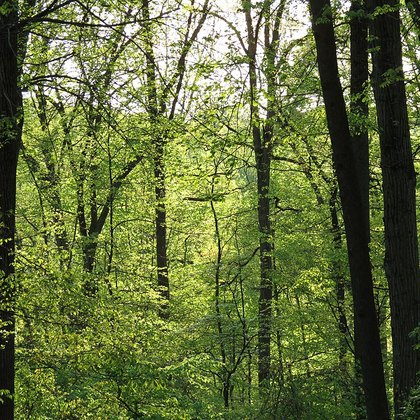
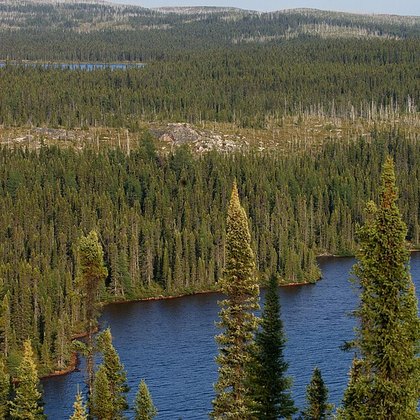
Large, unbroken tracts of mature deciduous and mixed forest, with oak, beech, maple and hemlock; it keeps high in the canopy and rarely comes low. Woodlots of less than a few tens of hectares are poorly occupied, and it is precisely in fragmented woodland that the brood is most vulnerable. On migration it is less particular and turns up in city parks, gardens and coastal thickets. It winters in montane forest and forest edge on the eastern slope of the Andes.
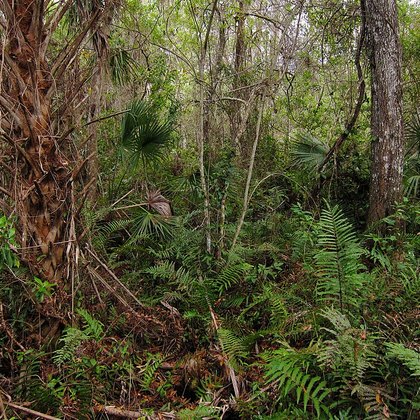
Where the bird is most often found, arranged by the USNVC — the vegetation classification of the United States and Canada — and CMECS for sea and coast.


Range and movements
The breeding range lies in the eastern United States and southern Canada: from southeastern Saskatchewan and Manitoba east across Ontario and Quebec to the Maritimes, and south to northern Georgia, northern Alabama and eastern Oklahoma, with the core in the Appalachians and the states around the Great Lakes. Migration runs across the southeastern United States, the Caribbean and the Central American isthmus to northwestern South America. Within the guide area the species is a passage migrant in autumn and spring on the Gulf Coast, in Florida and on Cuba; it winters well outside the guide area.
- Resident
- Breeding (summer)
- Winter
- Passage
- dark = core range, pale = thinly spread
Where and when to look
The best chance of the red male is the first half of May, when the trees are not yet in full leaf and the birds pass through singing along the Great Lakes and the Gulf Coast. After that, search high in the canopy and go by the song: burry and cracked rather than clear. In September always look at the wing, not at the body colour.
Conservation
The species is listed as Least Concern (LC) and the population is put at several million birds, with a stable to slightly declining trend. Sensitivity to fragmentation is the main point: in small woodlots nests are robbed more often and parasitised more often by Brown-headed Cowbird, against which this species has evolved no defence. Collisions with lit buildings on nocturnal migration and the loss of montane forest on the wintering grounds also count.
Scientific name
Piranga olivacea | (Gmelin, 1789)
Gmelin described the species in 1789 as Tanagra olivacea; because it later moved to another genus, author and year stand in parentheses. The genus Piranga goes back to the Tupi word tijepiranga, the name of a small bird in Brazil. The species name olivacea means 'olive-coloured' and rests on a female or a bird in autumn plumage; a name given later, erythromelas, 'red-and-black', fitted the male better, but the older name takes precedence. The Dutch name, 'black-winged tanager', names the black wings, which remain visible in every plumage.