All species › Passerines › New World warblers › Red-faced Warbler
Red-faced Warbler | Cardellina rubrifrons
Roodmaskerzanger | Reinita carirroja
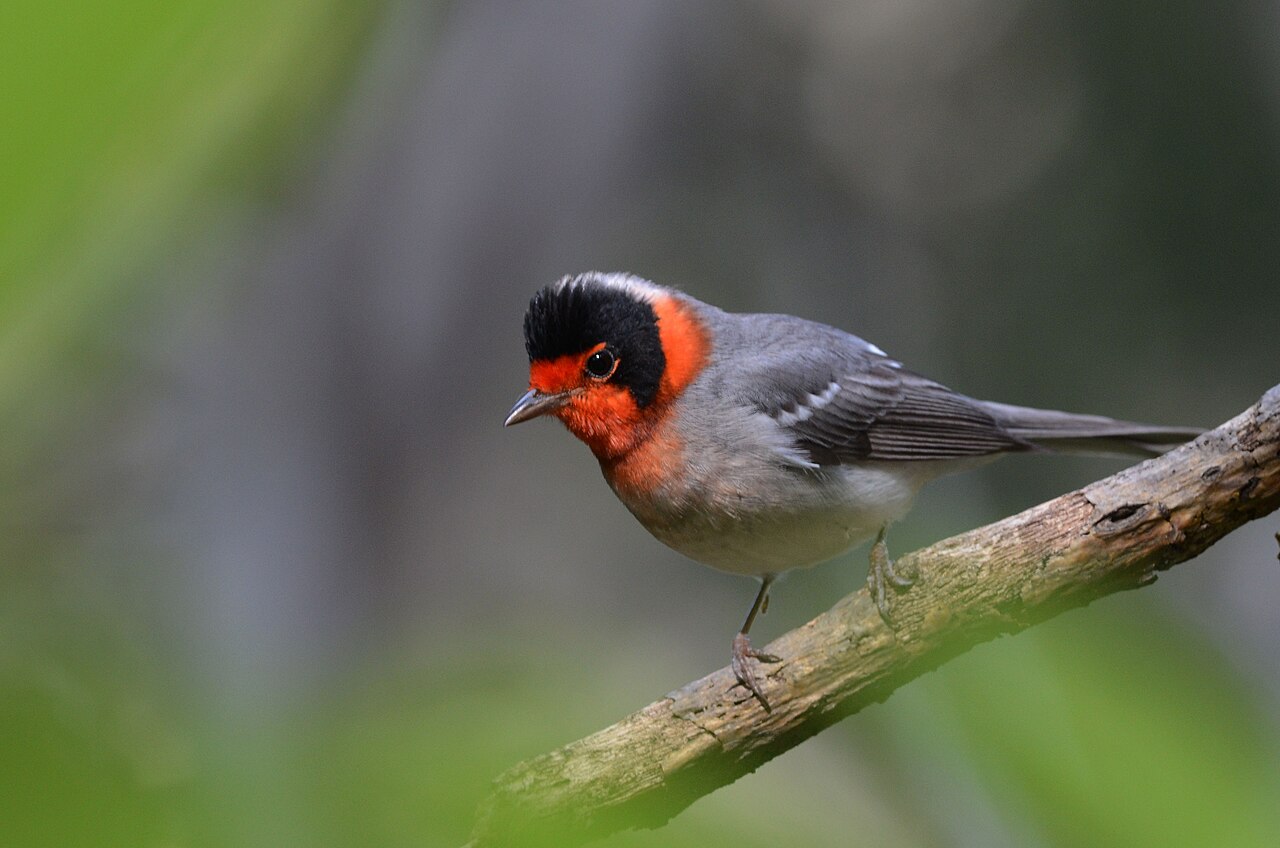
The Red-faced Warbler is grey above and white below, with a bright red face, a black crown and a white nape patch. It breeds in the conifer and oak forest of the high mountains of southeastern Arizona and southwestern New Mexico and of the Sierra Madre Occidental, and winters in southern Mexico and Central America.
Voice
The song is a clear series of four to eight whistled notes with a rising and falling ending, roughly sweet sweet sweet swee-swee-chew, close in tone to Yellow Warbler but usually slower and with more variation between phrases. The male sings from a branch halfway up the canopy. The call is a sharp, high chip, repeated in rapid series when the nest is disturbed.
Recording: David A. Brinkman — CC BY-NC-SA 4.0 · Pinos Altos, Grant County, New Mexico, United States · xeno-canto
Identification
The upperparts are pale blue-grey with a white rump that shows as the bird takes off; the underparts are white. Face, throat and upper breast are bright red. Crown and ear coverts are black and enclose the red face like a hood; a white patch stands on the nape. A single narrow white bar crosses the wing. The sexes are alike, though the red averages slightly less saturated in the female; immatures show pink to salmon red and duller black. The tail is often moved from side to side.
Confusion species
Within the United States confusion is all but impossible: no other warbler combines a red face with a black crown and a white nape patch. Painted Redstart is black with a red belly, a large white wing patch and white outer tail feathers, and has no red on the face. Slate-throated Redstart (Myioborus miniatus) lacks red on the head entirely. In Mexico Red Warbler (Cardellina rubra) can cause confusion, but it is red over the whole body, with a white or grey ear patch and no black crown.
Habitat
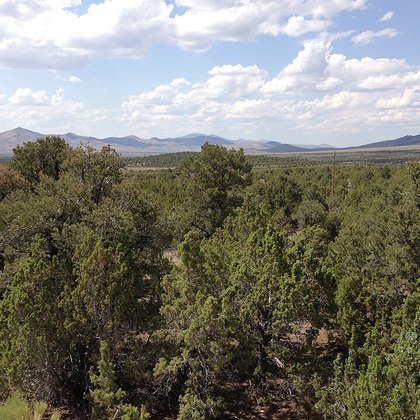
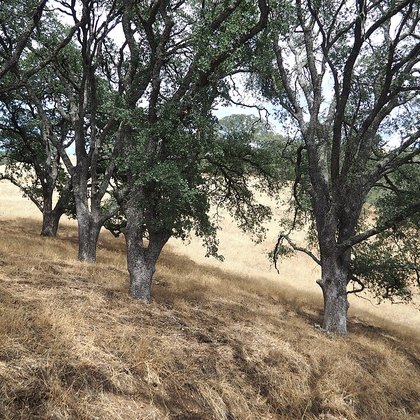
Montane forest of pine, pine-oak and spruce-fir between about 2000 and 3000 metres, by preference on steep slopes and in ravines with maple, aspen and an open understorey. The nest lies on the ground, in a small hollow under an overhanging grass tussock, a rock or a fallen trunk. On migration it occurs lower down, but keeps to comparable forest along watercourses. In winter it stays above about 1200 metres, in pine-oak and cloud forest, where it joins mixed flocks.
Where the bird is most often found, arranged by the USNVC — the vegetation classification of the United States and Canada — and CMECS for sea and coast.



Range and movements
In the United States it breeds in the high mountains of southeastern Arizona — the Huachucas, Santa Ritas, Chiricahuas and the White Mountains — and in southwestern New Mexico in the Mogollon Mountains and the Black Range. From there the range runs south along the Sierra Madre Occidental through Sonora, Chihuahua, Durango and Sinaloa, where it is largely resident. The northern breeders leave in August and September for southern Mexico, Guatemala, El Salvador and Honduras and return in April.
- Resident
- Breeding (summer)
- Winter
- Passage
- dark = core range, pale = thinly spread
Where and when to look
The best chance is May to July on the high trails of the Huachuca or Chiricahua mountains, above roughly 2000 metres, where it occupies the upper reaches of the canyons. Search from eye level to halfway up the canopy, in maple and aspen along the water, and watch the white rump: it gives the bird away on every short flight, even when the head is turned away.
Conservation
Partners in Flight puts the world population at about 350,000 birds and gives a Continental Concern Score of 14 out of 20; the species is on the Yellow Watch List, mainly because of its small range, but is listed by the IUCN as Least Concern (LC). Numbers in the United States are low and concentrated in a handful of sky islands, so a single large crown fire can affect a substantial part of the breeding range. Logging in montane forest and the loss of understorey to grazing reduce nest sites; in the winter range the contraction of pine-oak woodland presses on the population.
Scientific name
Cardellina rubrifrons | (Giraud, 1841)
Jacob Post Giraud described the species in 1841 as Muscicapa rubrifrons; because it was later placed in another genus, author and year stand in parentheses. The type locality is given in the original publication as Texas, but that rests on an error: the material came from Mexico. The epithet is formed from Latin ruber 'red' and frons 'forehead', hence 'red-fronted', which the English and Dutch names also refer to. The genus Cardellina was introduced in 1850 by Charles Lucien Bonaparte, from the Italian dialect word cardella for the European Goldfinch.