All species › Passerines › Tanagers and allies › Red-crested Cardinal
Red-crested Cardinal | Paroaria coronata
Roodkuifkardinaal | Cardenal copetirrojo
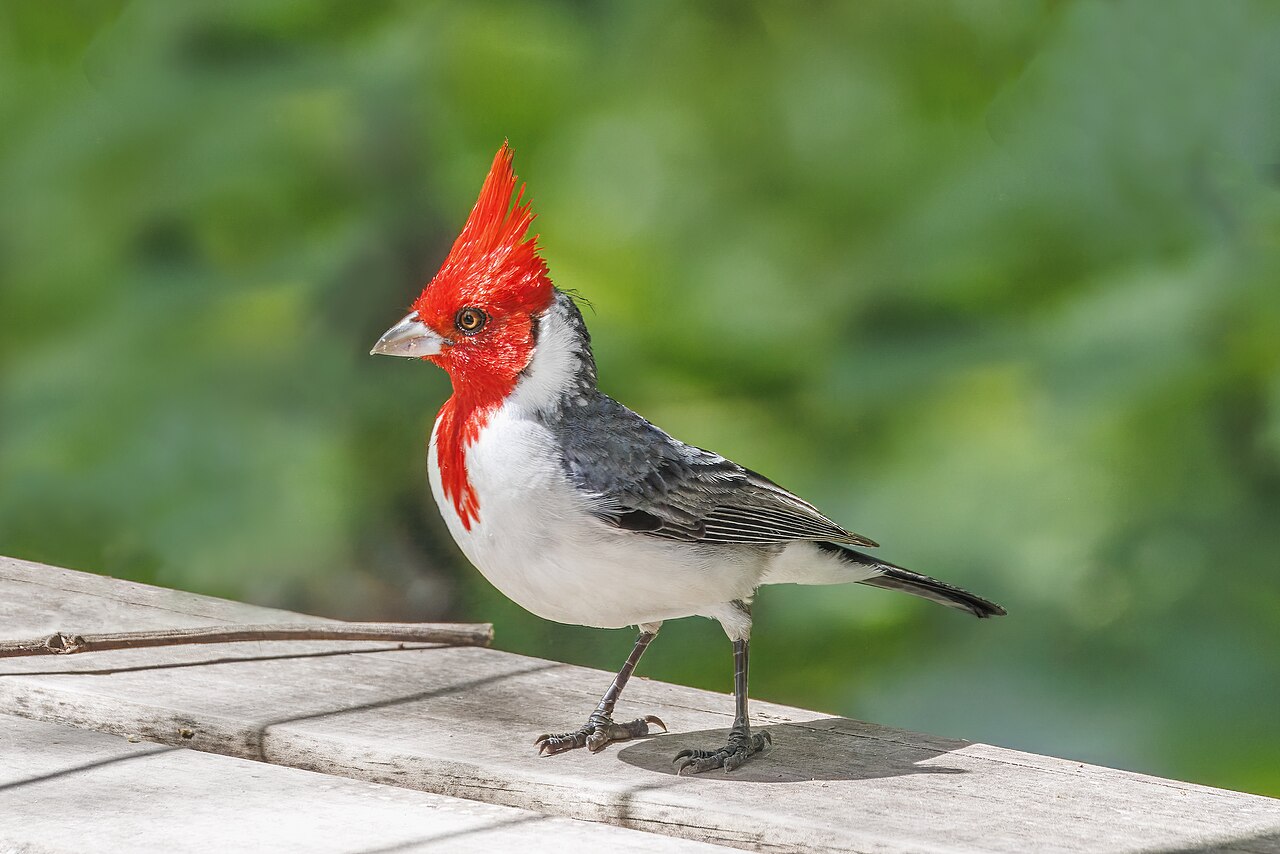
A grey and white bird with a fiery red head and a pointed, upstanding crest, at home in South America and released on Hawaii, where it is now among the commonest garden birds. It walks across lawns and through beach parks and lets itself be watched at close range. Anyone on the islands who sees a red crest crossing the grass is looking at this bird and not at a cardinal from the mainland.
Voice
A clear, unhurried whistled song of short motifs with a silence between them, warm in tone but with little variety: cheew-cheew ... choo-weet. Both birds of a pair sing, keeping contact while they feed apart over the grass. The call is a short, hard chip, and an alarmed bird gives a drawn-out, nasal cheeh. It sings all year round and most in the early morning.
Recording: Pedro Sanetti — CC0 · Cipolletti, General Roca Department, Río Negro Province, Argentina · xeno-canto
Identification
Head, throat and crest are bright red, sharply bounded against white underparts and a slate-grey back, wings and tail. The bill is conical and two-toned: dark on the upper mandible, pale at the base of the lower; the legs are grey. Male and female look alike. Juveniles are marked quite differently, with an ochre-brown head and crest instead of red, and the red only comes through after some months — which raises questions on Hawaii every autumn. The crest is raised in excitement and lies flat at rest, so the shape of the head can change a great deal.
Confusion species
Yellow-billed Cardinal (Paroaria capitata), also released on Hawaii, is the one real confusion species: it lacks the crest, has an entirely yellow bill and yellow legs, and its red runs further down the throat. Northern Cardinal (Cardinalis cardinalis), likewise released on the islands, is all red in the male and olive-brown in the female, and always carries a heavy orange bill and a black mask. In both cases the bill colour and the boundary between red and white decide it.
Habitat
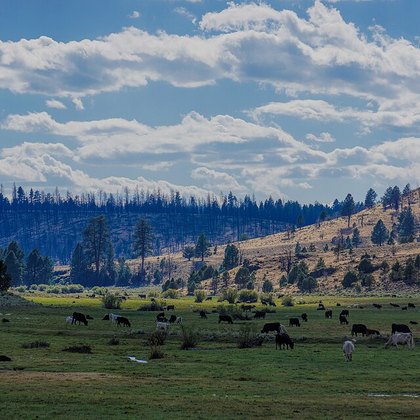
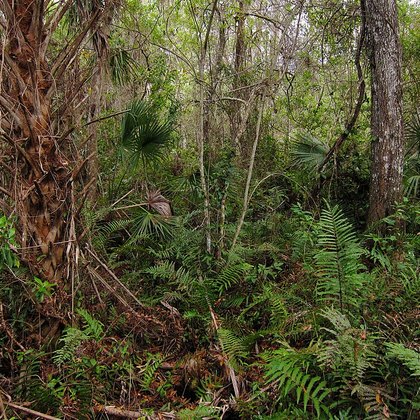
On Hawaii, half-open lowland with grass and scattered trees: gardens, parks, beach parks, golf courses, hotel grounds, roadsides and field edges. It hardly ever goes above four hundred metres and does not enter the native mountain forest, so it does not meet the islands' native forest birds in their own ground. In its home range it lives in thorn scrub, savanna and open woodland edge, often near water. Everywhere it takes its food on the ground, among short grass and on bare patches.
Where the bird is most often found, arranged by the USNVC — the vegetation classification of the United States and Canada — and CMECS for sea and coast.



Range and movements
Its own range lies in South America: Bolivia, Paraguay, Uruguay, northern Argentina and the extreme south-east of Brazil — outside this map. What the map shows is Hawaii alone, where birds were released on Oʻahu and Kauaʻi between 1928 and 1931 from stock brought in by way of San Francisco. From there it has spread over all the main islands: on Oʻahu it increased steadily from the 1940s to the 1990s and then levelled off, on Kauaʻi it grew strongly above all between 1972 and 1992, and on Molokaʻi it spread quickly after 1963. On Hawaii Island it is mainly on the eastern side; the western side also holds Yellow-billed Cardinal.
- Resident
Where and when to look
Any stretch of grass with trees along it on Oʻahu, Kauaʻi or Maui will produce it: a beach park, a hotel lawn, a car park with trees around it. It is not shy and will often keep walking a few metres away, so you can take your time over the crest and the two-toned bill and get juveniles right. Look above all early in the morning, when it sings and the red is deepest in low light.
Conservation
Least Concern (LC). In South America the species is widespread, though large numbers were trapped for the cage-bird trade in the past. On Hawaii the population is established and stable to increasing, and the bird is not managed or controlled there. It keeps to settled lowland and to introduced vegetation; it does not occur in the native mountain forest, where the islands' threatened birds are.
Scientific name
Paroaria coronata | (Miller, 1776)
John Frederick Miller figured the bird in 1776 in his plate work Icones Animalium and called it Loxia coronata, among the crossbills; because it was later placed in another genus, author and year stand in parentheses. The genus Paroaria was introduced in 1832 by Bonaparte and goes back to tiéguacú paroára, in Tupi the name of a small yellow, red and grey bird. coronata is Latin for 'crowned', for the crest. Miller gave no locality; Pinto fixed the type locality in 1944 on Rio Grande do Sul in southern Brazil.