All species › Passerines › Cardinals and allies › Pyrrhuloxia
Pyrrhuloxia | Cardinalis sinuatus
Grijze kardinaal | Cardenal pardo
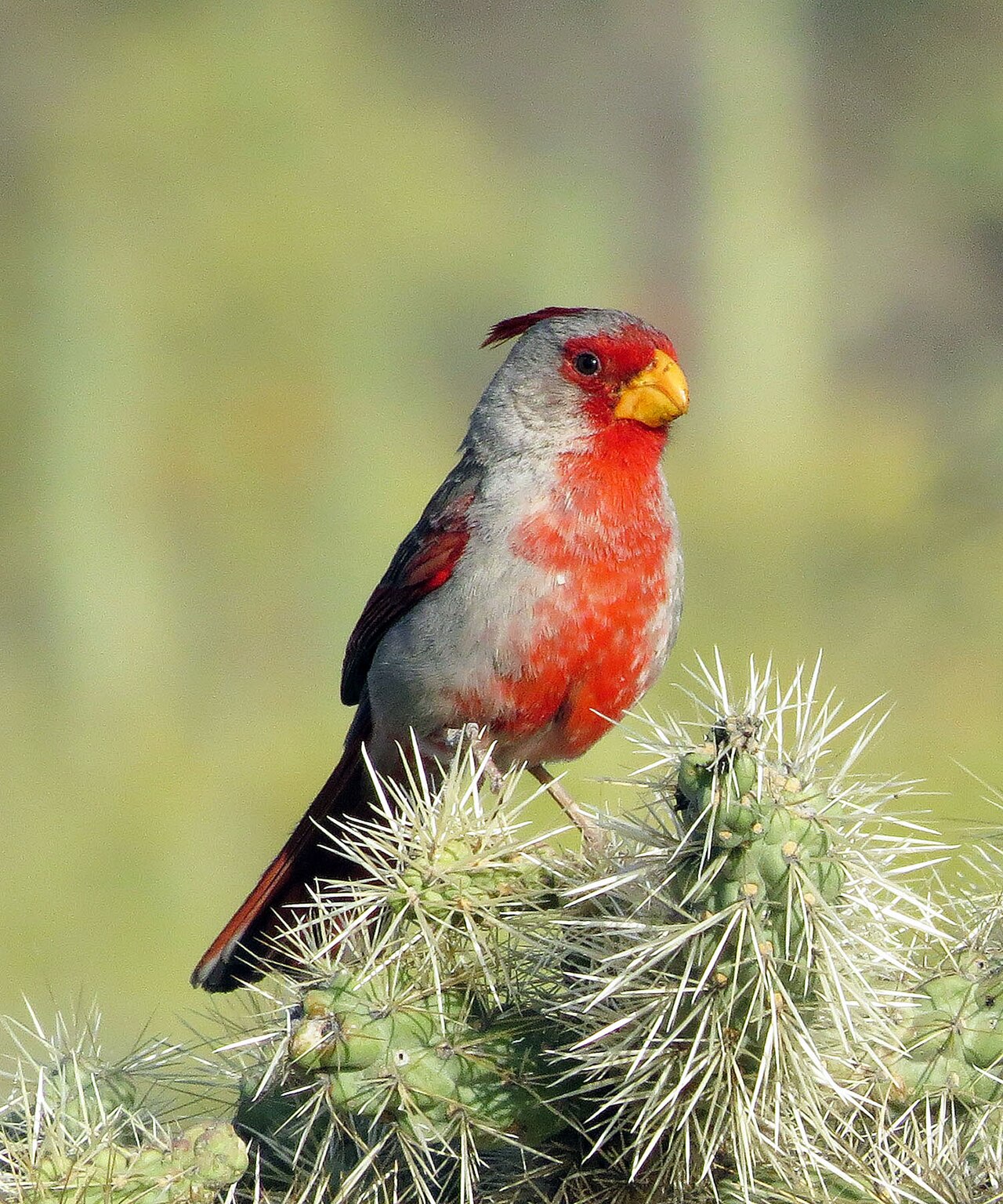
Pyrrhuloxia has the crest and the build of the Northern Cardinal, but is grey, with red only on the face, the tip of the crest, a band down the breast, the edge of the wing and the tail. The bill is different: short, deep and strongly curved, and pale yellow in the breeding season. This is the cardinal of the thorn scrub of the southwest, taking over where the country grows too dry for the Northern Cardinal.
Voice
The song is a series of clear, somewhat metallic whistles, quink-quink-quink or a rising wheet-wheet-wheet, thinner than the full whistling of the Northern Cardinal and in shorter series. Both sexes sing; in spring the male sings from a bare branch above the scrub, often well before sunrise. The call is a sharp chip, higher and drier than the Northern Cardinal's. Where the two species occur together the voice is usually the quickest way to separate them.
Recording: Scott Crabtree — CC BY-NC-SA 4.0 · Sabino Canyon NRA, Catalina Foothills, Pima County, Arizona, United States · xeno-canto
Identification
The male is grey, with a red crest tip, a red face and a red band down throat, breast and belly, and red in the edge of the wing and the tail. The female is grey-brown with buff underparts and only a little red on crest, wings and tail. The crest is long, thin and pointed and is raised more often than the Northern Cardinal's; the tail is long. The bill decides: short, deep, strongly curved and pale yellow in the breeding season, where the Northern Cardinal has a longer, straight-edged orange-red bill. Young birds resemble the female but have a dull grey bill, and in winter the adults' bill dulls as well.
Confusion species
The female Northern Cardinal is the standing mistake: she is warm olive-brown rather than grey, and has a longer, straight-edged orange-red bill without the strong curve. Between the males there is no doubt, since the Northern Cardinal is wholly scarlet. The female Phainopepla is also grey and crested, but slimmer, with a thin bill, a red eye and white patches in the wing in flight. Against the sky the crest is no help: look then at the upper edge of the bill and at how much red there is in the tail.
Habitat
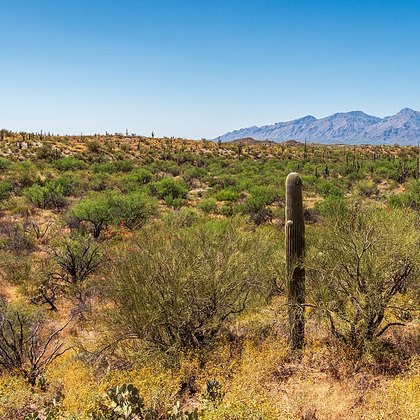
Thorn scrub of the hot lowlands: mesquite (a thorny pod-bearing shrub of the Southwest that forms dense thickets), hackberry, catclaw and cholla, and above all the denser mesquite belts along dry washes. In Texas that is the brush of the Rio Grande, in Arizona and New Mexico the mesquite flats and the ground between them and the desert. It avoids bare, treeless flats and irrigated farmland, and higher in the mountains it stops. In winter it comes in small flocks to the edges of the desert towns, feeders included.
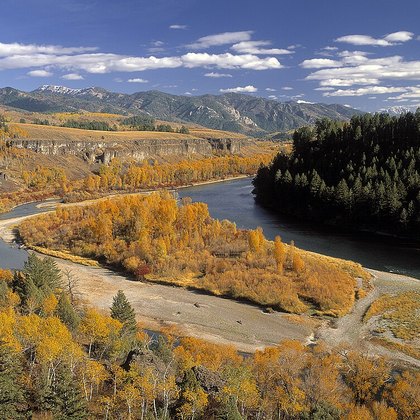
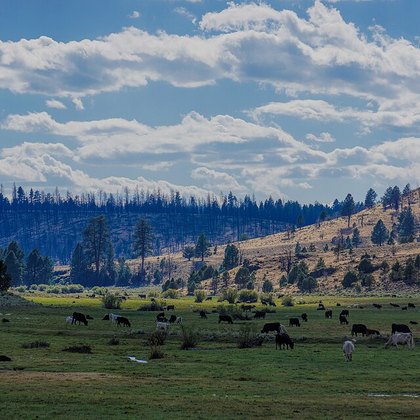
Where the bird is most often found, arranged by the USNVC — the vegetation classification of the United States and Canada — and CMECS for sea and coast.

Range and movements
Resident in southeastern Arizona, southern New Mexico and western and southern Texas, and south through the dry north and centre of Mexico. It does not migrate, but outside the breeding season it roams in flocks and turns up some way beyond the breeding range, especially in dry years. In the southwestern United States the border with the Northern Cardinal shifts back and forth with the water: where irrigation and planting make the brush greener the Northern Cardinal gains ground, and where it stays dry and thorny this bird does.
- Resident
- Breeding (summer)
- Winter
- dark = core range, pale = thinly spread
Where and when to look
Look for it in winter along a dry wash with tall mesquite: there are flocks of ten to twenty then, often with sparrows, and they are noisy. In March and April it is mainly detected by ear: the male whistles from a bare branch above the scrub before sunrise and stays there for half an hour. If it is sitting against the light, look at the upper edge of the bill — no other bird of this size in the desert carries that curve.
Conservation
Least Concern (LC), and stable taken as a whole. Where the low thorn scrub is turned into farmland or built over it disappears; in the Lower Rio Grande Valley that shows most clearly. On grazed land it holds on as long as the mesquite is left standing, and it goes as soon as that is cleared to bring the grass back.
Scientific name
Cardinalis sinuatus | Bonaparte, 1838
Bonaparte described the species in 1838 as Cardinalis sinuatus, in the same year in which he introduced the genus Cardinalis; author and year stand without parentheses because the species is once again in the genus in which it was described. sinuatus is Latin for 'curved', from sinuare, 'to bend', after the curve in the cutting edge of the bill. The English name Pyrrhuloxia is an old genus name that has stayed on as the bird's name: a contraction of Pyrrhula, the bullfinch, and Greek loxos, 'slanting', which also sits in Loxia, the crossbill — both refer to the shape of the bill. The type locality is given as 'western parts of Mexico'.