All species › Gamebirds › Guans, curassows and chachalacas › Plain Chachalaca
Plain Chachalaca | Ortalis vetula
Bruine chachalaca | Chachalaca oriental
The Plain Chachalaca is the only member of its family that reaches the United States, and only barely: it gets no further north than the thorn scrub along the lower Rio Grande. Of the two million birds estimated worldwide, fewer than two thousand five hundred breed in the United States. Anyone looking for it rarely finds it by looking; the shouting comes first.
Voice
The name is the call: a hard, raucous three-syllable cha-cha-LAC that rises above the scrub in the first minutes of light and again towards sunset. Male and female call at different pitches, and because they alternate half a beat apart a pair sounds like one bird shouting with two voices at once. There is also a short grunting kuk with which a group keeps in touch while feeding, and a shrill alarm when a hawk passes over. The chorus also breaks out in the middle of the day when the weather turns, with falling pressure or an approaching squall.
Recording: Scott Crabtree — CC BY-NC-SA 4.0 · Edinburg Scenic Wetlands & World Birding Center (near Edinburg), Hidalgo County, Texas, United States · xeno-canto
Identification
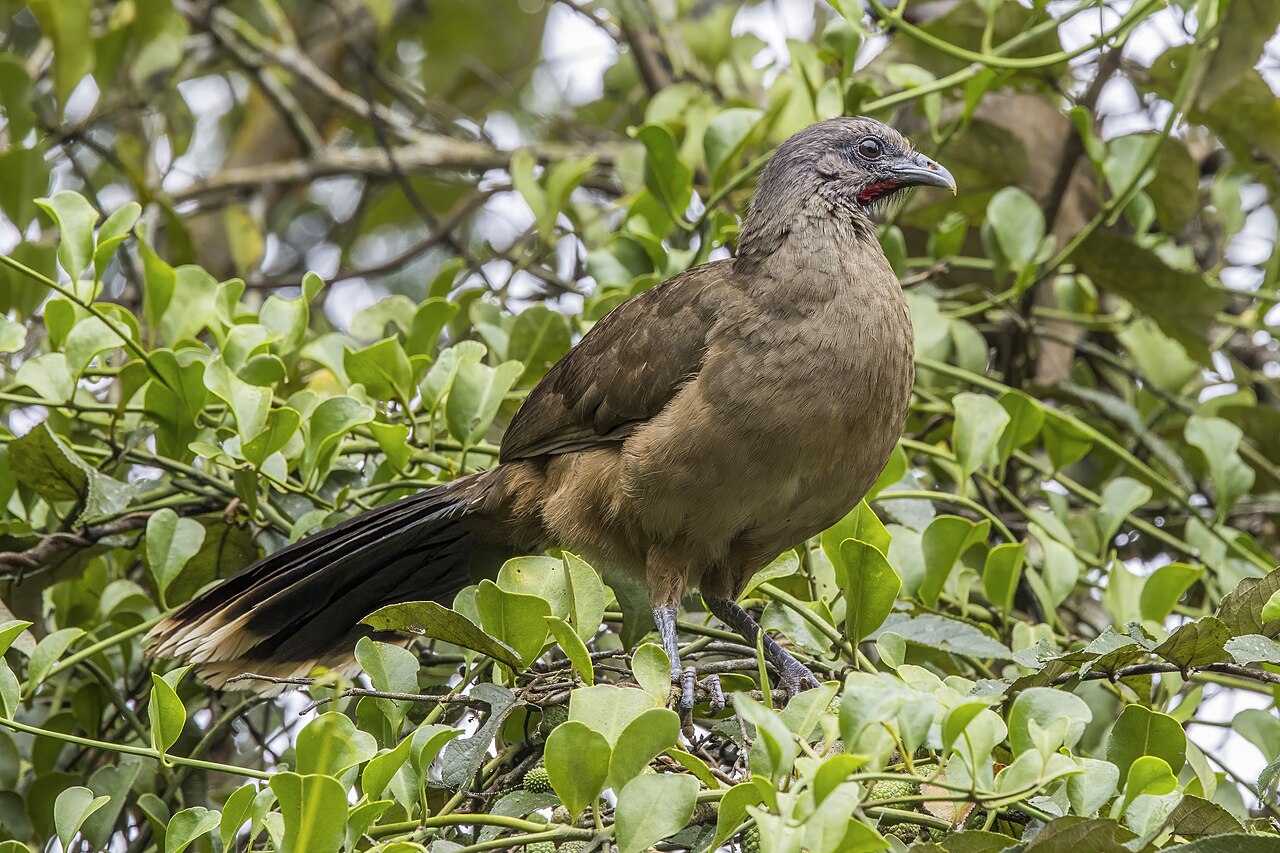
A large, slender bird with a small grey head, a long neck and a long tail, olive-brown with a green gloss and a narrow off-white edge at the tip. The body is dull greyish brown, paler towards the belly, without streaking or spotting that shows at any distance. On the throat is a patch of bare skin that flushes red in excited birds; bill and legs are grey. The sexes look alike, though the female is slightly smaller; young birds are duller and shorter-tailed. In flight it stands out by its short rounded wings, a few quick beats and then a long glide from tree to tree with the tail spread.
Confusion species
In southern Texas the Great-tailed Grackle (Quiscalus mexicanus) is the bird most often taken for it: slimmer, glossy black or warm brown, with a yellow iris and a tail carried like a keel. Greater Roadrunner also has a long tail, but is heavily streaked, carries a crest and runs on the ground instead of moving through the canopy. From Honduras southwards the species is replaced by Gray-headed Chachalaca (Ortalis cinereiceps), with a grey head and rufous in the primaries. Crested Guan (Penelope purpurascens) of tall forest is a head bigger, carries a crest and is finely streaked white on neck and breast.
Habitat
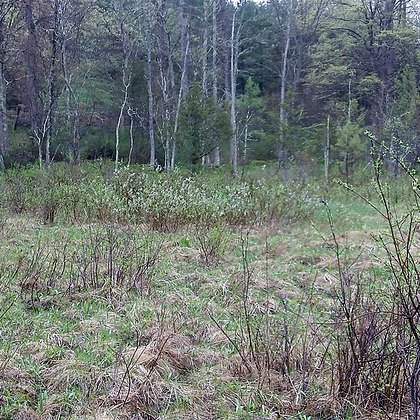
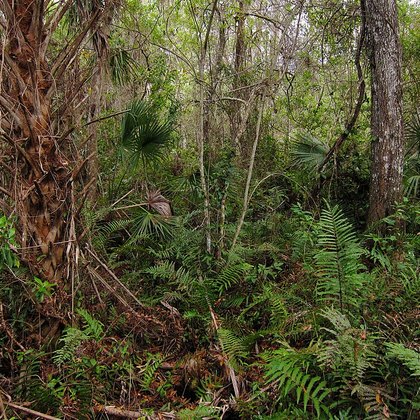
Dense, thorny scrub and low woodland along watercourses, with a closed canopy the birds can climb through and an impenetrable understorey to vanish into; the Tamaulipan brushland of the delta is the classic example. Where that scrub meets settlement it follows: in citrus groves, along thickets behind gardens and at feeding stations with seed or fruit it has become a familiar bird in southern Texas. It avoids open farmland and bare pasture, and unbroken tall rainforest is not its place either; what it wants is the edge and the dense bush. Water is almost always nearby, in the form of a river arm, a resaca (a cut-off river channel in the Lower Rio Grande valley) or a drinking place.
Where the bird is most often found, arranged by the USNVC — the vegetation classification of the United States and Canada — and CMECS for sea and coast.



Range and movements
Resident from the lower Rio Grande in southern Texas south along the Gulf slope of Mexico, across the Yucatán Peninsula, and through Belize, Guatemala, Honduras and Nicaragua to north-western Costa Rica. It does not migrate and hardly wanders: a valley, a river arm and a strip of scrub are enough for a group to stay in for life. In Texas the range contracted during the twentieth century as delta scrub was cleared for farming and for the growing towns, but in the refuges and in the gardens of the Rio Grande cities it holds on well. Outside the natural range an introduced population has lived for a century on Sapelo, Blackbeard and Little St. Simons off the coast of Georgia; those islands are not shown on the map here.
- Resident
- Breeding (summer)
- Winter
- Passage
- dark = core range, pale = thinly spread
Where and when to look
Stand on a trail at Santa Ana, Bentsen-Rio Grande Valley or Estero Llano Grande at first light and wait: the chorus starts by itself, and then it is a matter of looking into the crown of the nearest tree rather than at the ground. By day it shows itself less, but a feeding station with orange slices or seed works, where it often comes in small parties. Watch for movement in the branches: a limb bending heavily with no wind is almost always this bird.
Conservation
The world population is estimated at two million birds and the species counts as not threatened; on the Continental Concern Score (the North American 1–20 concern score) it scores eleven out of twenty, meaning low concern. The bottleneck is not the number but the place: the great majority of the original scrub in the Rio Grande delta has been cleared, and what remains lies in separate blocks that are being stitched together by land purchase and replanting. In Texas it is a game bird with a short season and a small daily limit; elsewhere in the range overhunting is a real pressure in places, because a bird that calls loudly and lives close to villages is easy to find.
Scientific name
Ortalis vetula | (Wagler, 1830)
Johann Georg Wagler described the species in 1830 as Penelope vetula, among the guans; because it was later moved to another genus, author and year stand in parentheses. The genus Ortalis was introduced by Merrem in 1786, after Greek ortalis, a young hen. The specific name vetula is the Latin word for 'little old woman', a diminutive of vetus 'old'; why Wagler chose it he did not explain. Tampico in Tamaulipas has been designated as the type locality, by Miller and Griscom. The word chachalaca itself comes from Nahuatl, the language of central Mexico, where it means something like to chatter, so that the bird still carries its own shouting in its name.