All species › Waterfowl › Ducks, swans and geese › Green-winged Teal
Green-winged Teal | Anas crecca
Wintertaling | Cerceta común
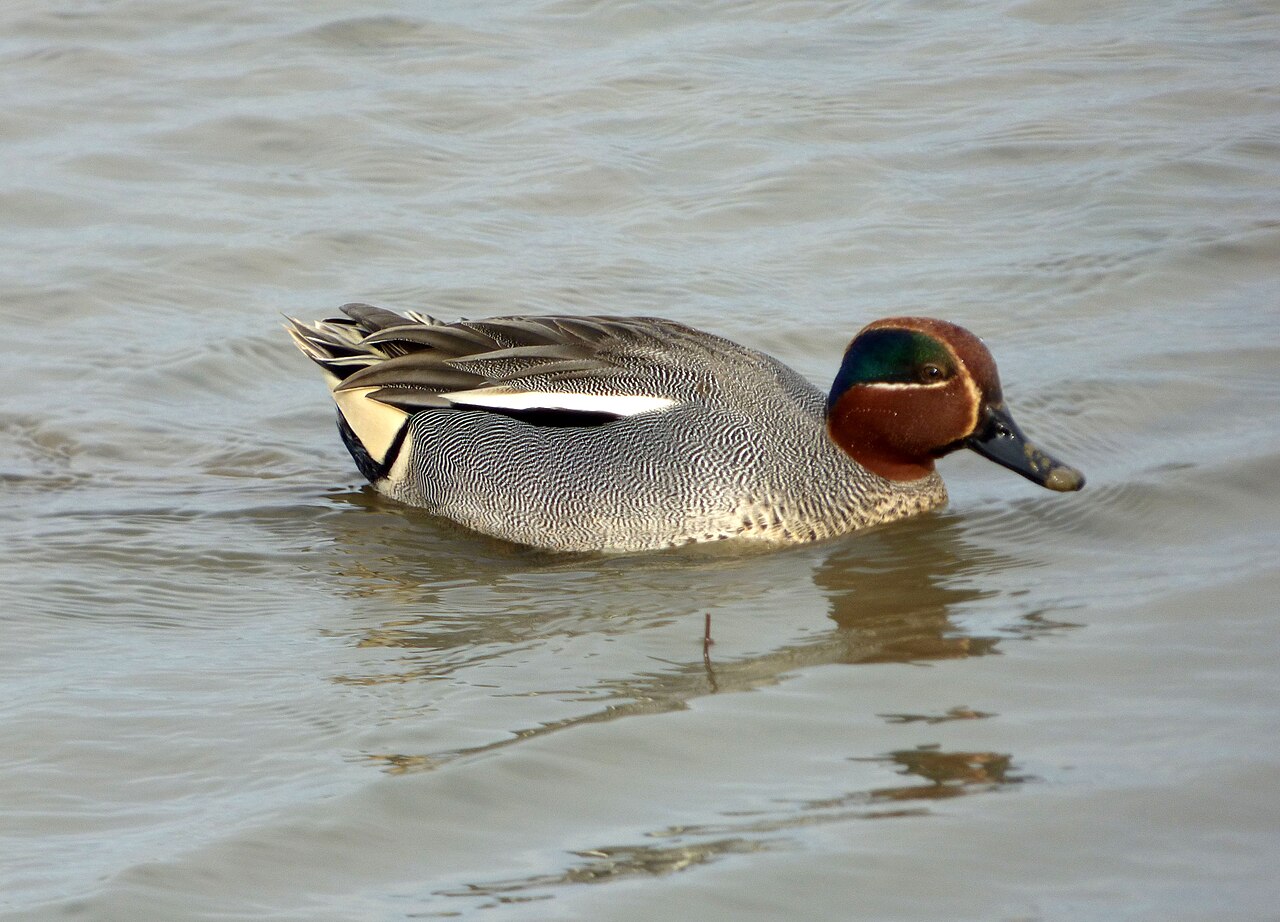
The Green-winged Teal is North America's smallest dabbling duck: a compact, fast-flying bird that moves through the air in tight, agile flocks as if it were a single organism. The male carries a finely marked chestnut head with a green eye patch, one of the most subtle duck colours on the continent up close, while at a distance it registers mainly as a small dark speck among larger ducks.
Voice
The male gives a bright, ringing whistle, a double or triple kreek-kreek, which at range sounds more like a frog than a duck and carries far across the water from groups of displaying males. The female quacks high and sharp, in a short, descending series, much thinner than a Mallard's. In mixed flocks the male's whistle is often the first sign that teal are present among the other ducks.
Recording: Stanislas Wroza — CC BY-NC-SA 4.0 · Kaamanen, Finland · xeno-canto
Identification
The male has a chestnut head with a broad, glossy green eye patch running from the eye into the nape, edged by a thin cream border, a grey vermiculated body with a vertical white stripe before the wing, and a cream triangle beneath the tail. The female is small and evenly mottled brown, with a relatively short, dark bill and little bold pattern. Both sexes show a bright green speculum edged narrowly yellow or white in flight, and the small size combined with a fast, agile flight in tight flocks is itself a useful mark. Juveniles resemble the female.
Confusion species
Blue-winged Teal is of similar size but shows a pale blue rather than green upperwing patch, best seen on flushing birds, and the male entirely lacks the green eye patch. The female Green-winged Teal is confused with females of other small dabbling ducks, but is smaller and more compact, with a shorter bill and a fast, low, skimming flight in dense flocks. Eurasian Teal, a vagrant from Siberia and, on the Atlantic side, from Europe, shows a horizontal rather than vertical white stripe before the wing; such birds are rarely identified with certainty without good photographs.
Habitat
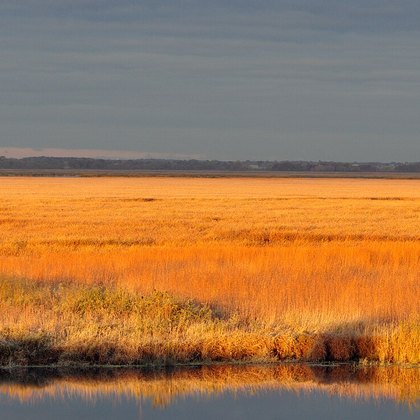
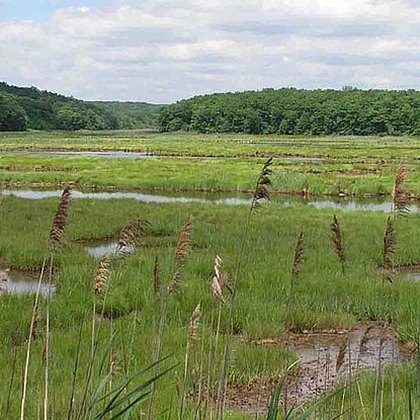
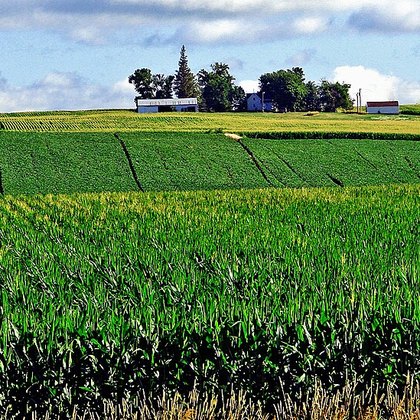
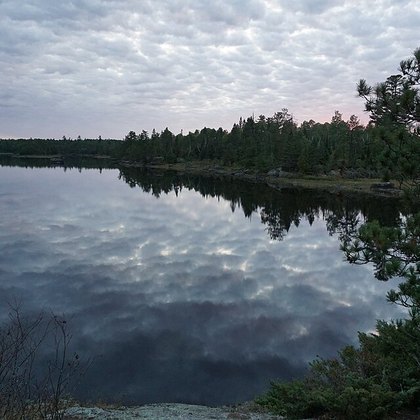
It breeds beside shallow, herb-fringed pools and slow streams in open woodland, scrub and tundra, where dense low vegetation shelters the nest. Outside the breeding season, hardly any small, shallow body of water is too small: muddy marsh edges, flooded meadows, shallow rice fields and sheltered coastal marshes are all used, often in greater numbers than any other duck species present. It avoids deep or open water; muddy edges where it can dabble on foot are what it seeks.
Where the bird is most often found, arranged by the USNVC — the vegetation classification of the United States and Canada — and CMECS for sea and coast.

Range and movements
The Green-winged Teal breeds across nearly all of Alaska and Canada, from tundra to boreal forest, extending south into the northwestern United States. It winters across nearly the whole southern and central United States and Mexico, with the largest concentrations in California's Central Valley, the Gulf Coast, and the marshes of the Mississippi Valley, and passes through in small numbers into Central America. The North American population has increased strongly since the mid-twentieth century, unlike many other dabbling ducks, possibly because the species depends less on prairie potholes and is more flexible in its choice of habitat.
- Resident
- Breeding (summer)
- Winter
- Passage
- dark = core range, pale = thinly spread
Where and when to look
Look for it on a muddy, shallow marsh edge in autumn: Green-winged Teal often dabble on foot in mud rather than swimming, and betray themselves by movement before colour. A tight flock that flushes all at once and banks sharply just above the water is almost always this species.
Conservation
The global breeding population is estimated at nearly seven million birds and increased between 1966 and 2019, one of the few dabbling ducks with a clearly positive trend. It is one of the most heavily hunted ducks on the continent, which so far does not appear to be harming the population thanks to quotas based on annual surveys, and it benefits from breeding grounds largely in remote parts of Canada and Alaska, beyond the reach of most habitat pressure. Loss of small, shallow wetlands remains a local concern; the species is listed as Least Concern (LC).
Scientific name
Anas crecca | Linnaeus, 1758
Linnaeus described the species in 1758 as Anas Crecca, among the ducks where it is still placed; author and year therefore stand without parentheses. Anas is Latin for 'duck'; crecca is a Latinized Scandinavian word Linnaeus adopted to imitate the male's call, related to the Swedish kricka. The type locality lies in Europe; Linnaeus himself restricted it to Sweden in 1761.