All species › Grebes › Grebes › Pied-billed Grebe
Pied-billed Grebe | Podilymbus podiceps
Dikbekfuut | Zampullín picogrueso
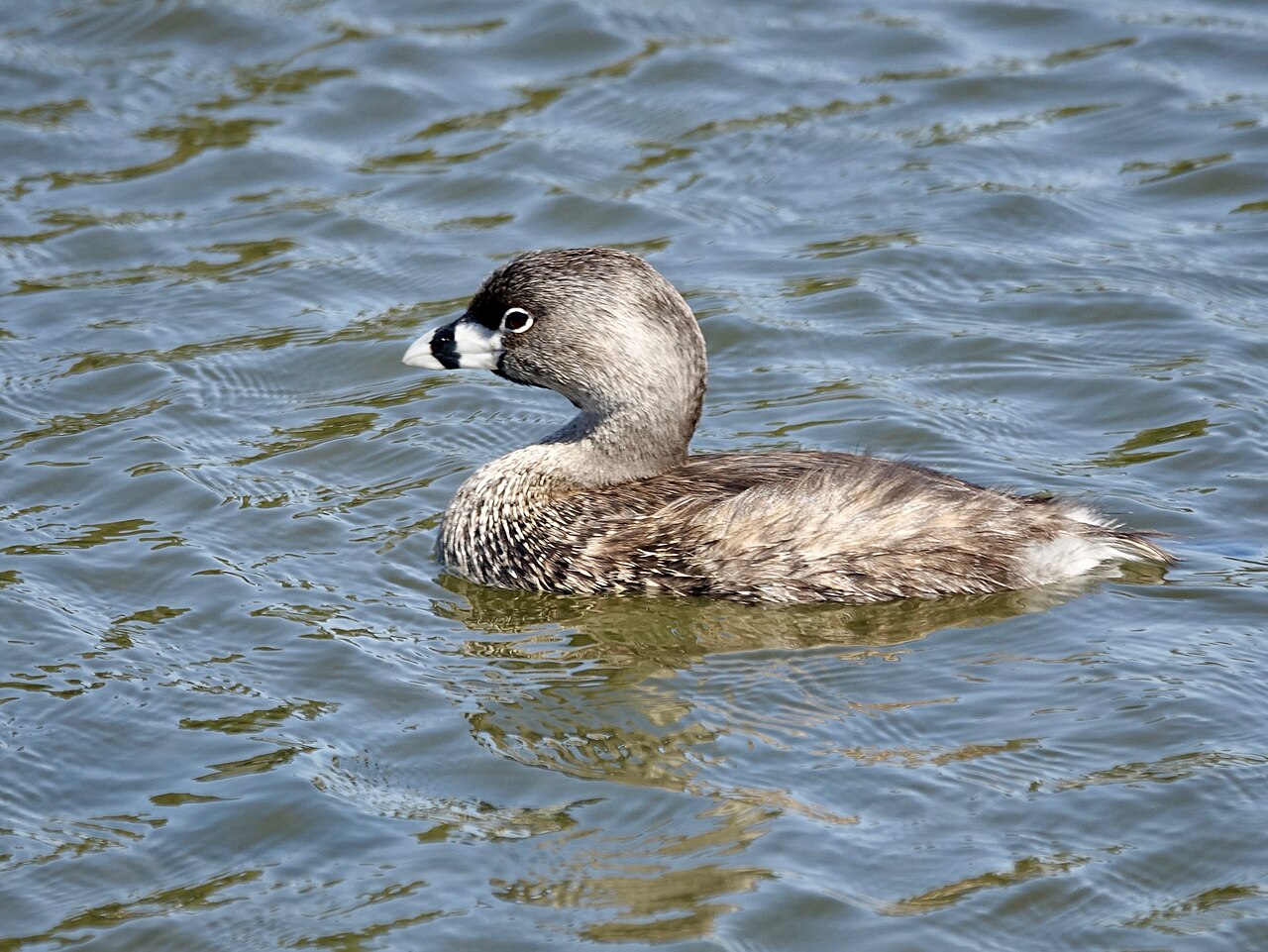
Pied-billed Grebe is the most widespread grebe in North America and, after Least Grebe, the smallest, a stocky brown diver that betrays its presence by voice long before it is seen. Its thick, chicken-like bill — white with a black band in breeding plumage — sets it apart from every other grebe at a glance. It breeds almost anywhere fresh water meets dense shoreline vegetation, from Canadian ponds to Caribbean marshes.
Voice
The call is a loud, far-carrying, somewhat cuckoo-like cackle that speeds up and then slows again: kuk-kuk-kuk-kuk-cow-cow-cow-cow-cow, followed by a series of shorter, wailing kow notes. Both members of a pair sing, especially in early morning and at the start of the breeding season, to mark their territory against rivals. Anyone who hears such cackling from dense reeds or cattails without seeing the bird has almost certainly heard a Pied-billed Grebe. Outside of song it is quiet and rarely calls.
Recording: Stanislas Wroza — CC BY-NC-SA 4.0 · Marais Léon-Provancher, Portneuf, Québec, Canada · xeno-canto
Identification
In breeding plumage the Pied-billed Grebe is plain brown with a black throat patch and the diagnostic thick, ivory-coloured bill crossed by a broad black band. Outside the breeding season the throat patch and bill band disappear, leaving a uniform dull brown bird with a plain pale bill, which invites confusion with other small grebes. The body is short and stocky with no visible tail, and the bird sits low in the water. Juveniles have a striped head; downy chicks are zebra-striped and often carried on a parent's back.
Confusion species
In non-breeding plumage it resembles Eared Grebe (Podiceps nigricollis) and Horned Grebe (Podiceps auritus), but both have a thin, pointed bill against the thick, blunt bill of the Pied-billed Grebe. In the southernmost tip of Texas it overlaps with the much smaller, darker Least Grebe (Tachybaptus dominicus), which has a yellow eye. It differs from dabbling ducks and coots by its habit of sinking silently underwater when alarmed rather than flushing.
Habitat
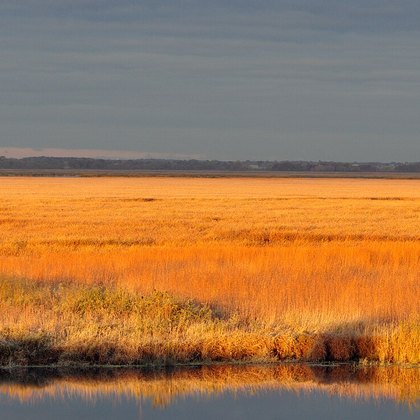
It seeks fresh water with dense shoreline vegetation: marshes, reedbeds, shallow ponds and slow streams with cattail, sedge or aquatic plants to anchor its floating nest. It avoids open, plant-free lakes as well as fast rivers and the open sea. Outside the breeding season it also turns up on larger, more open water and occasionally in brackish coastal lagoons.
Where the bird is most often found, arranged by the USNVC — the vegetation classification of the United States and Canada — and CMECS for sea and coast.


Range and movements
It breeds across nearly all of the United States and southern Canada, from British Columbia to Nova Scotia, and is resident across the southern United States, Mexico, Central America and the Caribbean south into much of South America. Northern breeders leave as soon as their waters freeze over and winter further south, often not far from the breeding grounds. The range has changed little over the past century; the species remains dependent on the health of inland marshes.
- Resident
- Breeding (summer)
- Winter
- Passage
- dark = core range, pale = thinly spread
Where and when to look
Look for it in early morning along the edge of a vegetated pond or a quiet lake, and listen before you look: the cackling carries far while the bird itself can stay hidden among the plants for hours. If you do flush one, it does not fly off but sinks silently underwater until only the head shows.
Conservation
Widespread and listed as Least Concern (LC), though its secretive habits make it hard to census and trends remain uncertain. The main threat is the slow loss of small, vegetated freshwater marshes to drainage and shoreline development. It is not hunted and locally benefits from constructed fish ponds and treatment wetlands.
Scientific name
Podilymbus podiceps | (Linnaeus, 1758)
Linnaeus described the species in 1758 as Colymbus Podiceps, in the genus then used for loons; Lesson placed it in the new genus Podilymbus in 1831, a blend of Podiceps (the grebe genus) and Colymbus (loon) — hence the parentheses around author and year. The species name podiceps comes from Latin podex ('rump') and pes ('foot'), referring to the far-back leg placement shared by all grebes. The type locality was originally given as 'Carolina'; in 1931 the American Ornithologists' Union restricted it to South Carolina.