All species › Woodpeckers and allies › Woodpeckers › Lewis's Woodpecker
Lewis's Woodpecker | Melanerpes lewis
Lewis' specht | Carpintero de Lewis
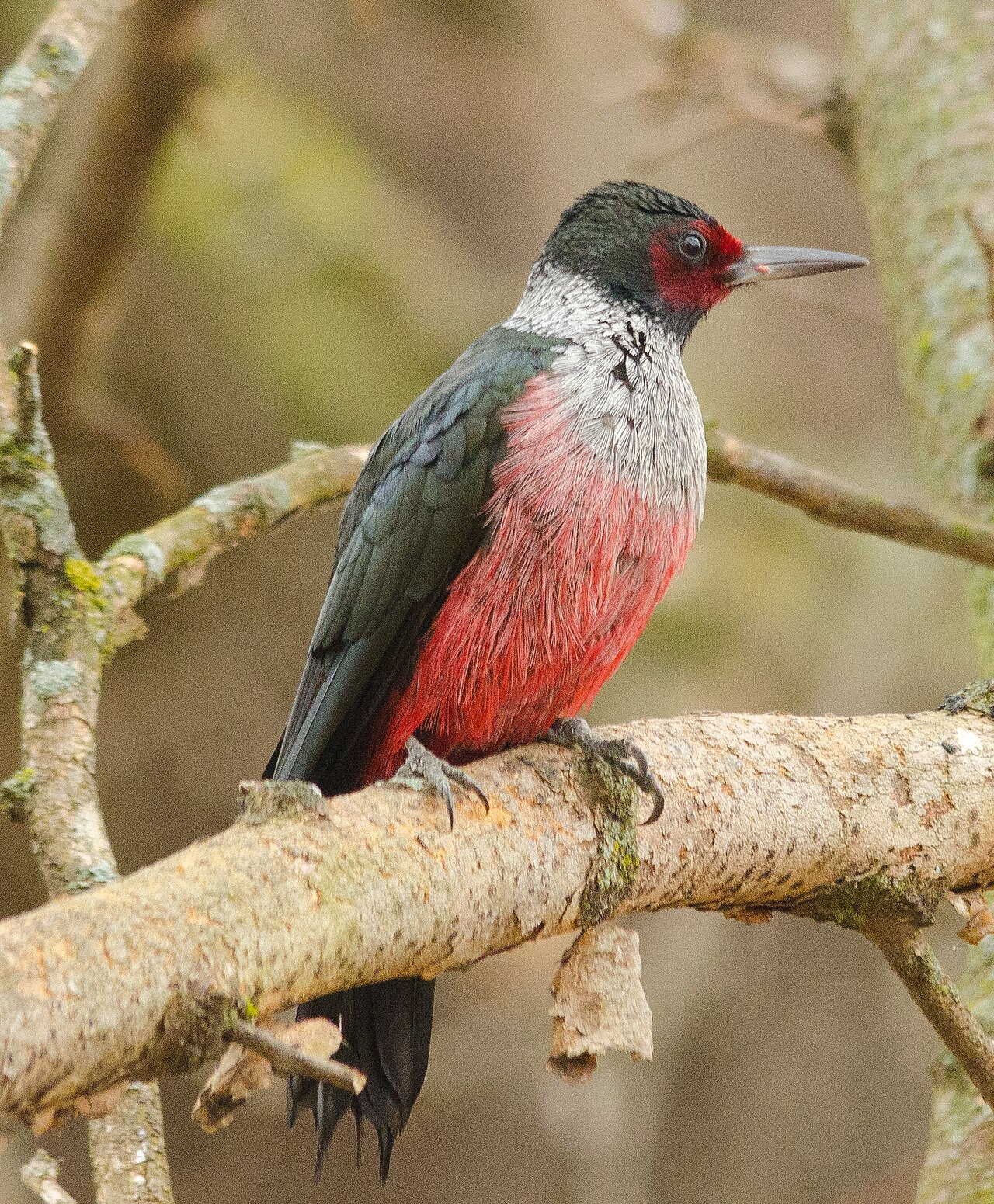
Lewis's Woodpecker differs from other North American woodpeckers: dark glossy green with a red face, a silvery-grey collar and a pink belly, and with behaviour more reminiscent of a flycatcher or a crow. It often sits in full view on top of a dead tree or a wire and makes long sallies from there after flying insects. In autumn it lays in stores of acorns and nuts, which it defends against intruders all winter.
Voice
For a woodpecker, Lewis's Woodpecker is quiet. The most frequently heard sound is a harsh, rather rasping churr, which the male gives in short series in the breeding season, especially at the nest and in disputes with neighbours. The drum is weak and short, and far less audible than in most other woodpeckers; in autumn the tapping of birds wedging nuts into bark crevices is more noticeable.
Recording: Ed Pandolfino — CC BY-NC-SA 4.0 · Deer Creek Hills Preserve, Sacramento County, California, United States · xeno-canto
Identification
A large woodpecker of 26 to 28 centimetres with glossy dark green, almost black upperparts, a dark red face, a silvery-grey collar that continues across the upper breast, and a pink to rosy-red belly. Male and female are alike. The wings are broad and rounded, and the flight is slow and direct with regular beats, more like a crow's than the undulating flight of other woodpeckers. Young birds are browner, without the red face and grey collar.
Confusion species
In silhouette and flight it is mistaken at a distance for an American Crow or even a small raptor, but the pink belly and grey collar are decisive in good light. Acorn Woodpecker shares the oak woodlands of California and the south-west and also stores acorns, but has a black, white and red clown face and white wing and rump patches. Red-headed Woodpecker, which sometimes comes close on the Great Plains, has an entirely red head and large white wing panels.
Habitat
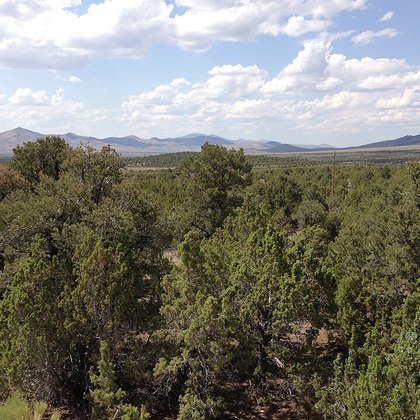
Open woodland with scattered trees and much standing dead wood: above all open ponderosa pine forest, burned conifer forest with a high density of dead trunks, and riparian cottonwood woodland. The nest is usually an existing cavity or a hole in soft, decayed wood, as it excavates less well than other woodpeckers. In winter it wanders to oak woodland, cottonwood groves along rivers, orchards and nut plantations, where food for storing can be found.
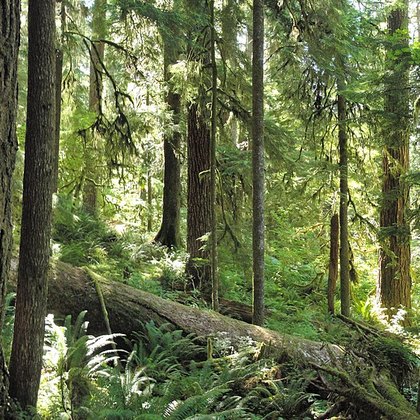
Where the bird is most often found, arranged by the USNVC — the vegetation classification of the United States and Canada — and CMECS for sea and coast.

Range and movements
Breeds in western North America, from the southern interior of British Columbia through Washington, Oregon, Idaho and Montana south to California, Colorado, Arizona and New Mexico. Northern birds move away in winter; the winter range extends from Oregon and California to northern Mexico, and both summer and winter distribution vary greatly with the food supply. As a vagrant it has been seen far into the eastern United States.
- Resident
- Breeding (summer)
- Winter
- Passage
- dark = core range, pale = thinly spread
Where and when to look
In summer look for it in a burned ponderosa forest, where it sits on top of a blackened trunk and repeatedly flies up to snatch an insect in mid-air before gliding back. In winter, in Californian oak woodland and orchards, watch for a bird that keeps returning to the same tree: that is often its storage tree, with acorns and nuts in the bark crevices, which it defends against other birds.
Conservation
The IUCN rates the species as Least Concern (LC). Even so, Lewis's Woodpecker is on the Partners in Flight Yellow Watch List: the population, estimated at about 82,000 breeding birds, has declined by some 67 per cent since 1970. The main cause is the loss of open ponderosa forest through fire suppression, grazing and logging, together with the removal of dead trees and competition for nest cavities with the European Starling. In Canada the species is listed as threatened.
Scientific name
Melanerpes lewis | (Gray, 1849)
Alexander Wilson described the species in 1811 as Picus torquatus, from a specimen brought back by the Lewis and Clark expedition; the type locality lies in Montana. That name turned out to be already in use for a South American woodpecker, and George Robert Gray replaced it in 1849 with Picus lewis. Because the species now stands in Melanerpes, a genus introduced by William Swainson in 1832, Gray and the year are in parentheses. Melanerpes is from Greek melas 'black' and herpēs 'creeper'; the species name and the common names honour Meriwether Lewis.