All species › Passerines › Tyrant flycatchers and allies › Least Flycatcher
Least Flycatcher | Empidonax minimus
Kleine feetiran | Mosquero Mínimo
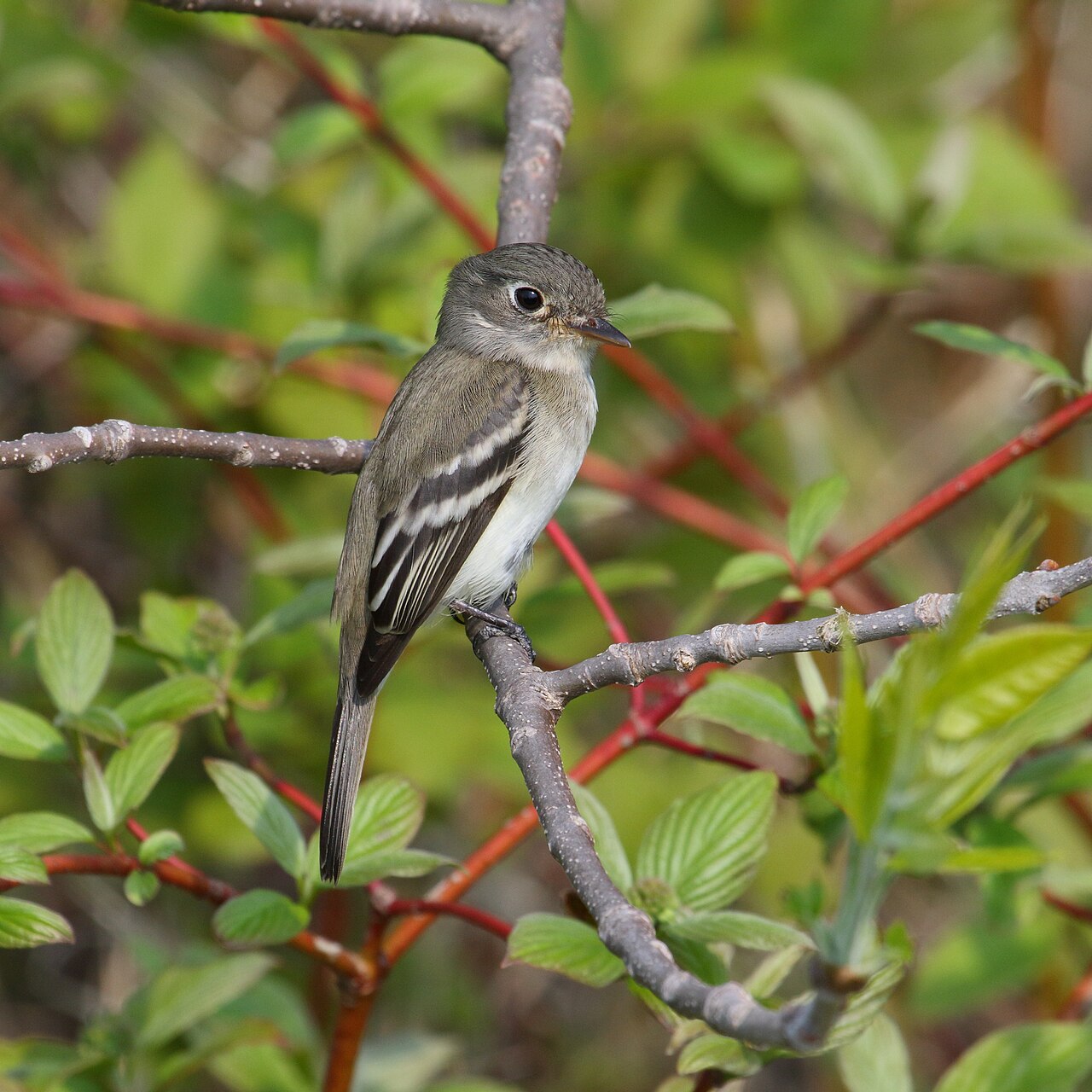
Least Flycatcher is the empid of eastern North American deciduous woodland and the smallest of the group. It breeds from Yukon to the Maritime Provinces and south to the Appalachians, and winters from Mexico to Panama. In a genus where plumage rarely settles anything, this is the species the song names fastest: an incessant che-BEK.
Voice
The song is a short, two-syllable explosion, che-BEK, with the stress and the force on the second syllable. Males repeat it through the morning at a high rate, up to about sixty times a minute, for hours on end; that rate and that emphasis identify the bird on their own, since none of the other empids sings so briefly and in such quick succession. The call is a dry whit, hard to separate from that of Dusky Flycatcher. Females rarely sing and give a chweep note.
Recording: Stanislas Wroza — CC BY-NC-SA 4.0 · La Côte-de-Beaupré (near La Barrière-du-Maurice), Capitale-Nationale, Québec, Canada · xeno-canto
Identification
Small and compact, with a large round head, a short tail and a short bill whose lower mandible is almost wholly pale. Grey-olive above, dingy white below with a light grey breast wash, two white wingbars and a broad, round white eye-ring that stands out on the face. The primary projection is short. It is restless, changing perch constantly and flicking wings and tail upward as it does so. The shape of the eye-ring and the head proportions help, but give no certainty; within this group the voice is the only character an identification can rest on.
Confusion species
Dusky Flycatcher gives the same dry whit call, but a three-parted song (prll-it — prrdrrt — pseet) against the two-syllable che-BEK; it also has a longer tail, a narrower eye-ring, and breeds in western mountain brush rather than eastern deciduous woodland. Hammond's Flycatcher calls a sharp, high peek instead of whit and sings three hoarse parts with a low ending; it stays high in old conifer forest. Gray Flycatcher sings a two-parted chu-wip … cheep, lowers its tail, and has a longer bill; it lives in sagebrush (grey-green scrub of the dry western interior) and juniper. Buff-breasted Flycatcher sings chee-lick and has a buff breast. Outside the song period, and on migration when all five can meet in the Southwest, a large share of birds is better left unidentified.
Habitat
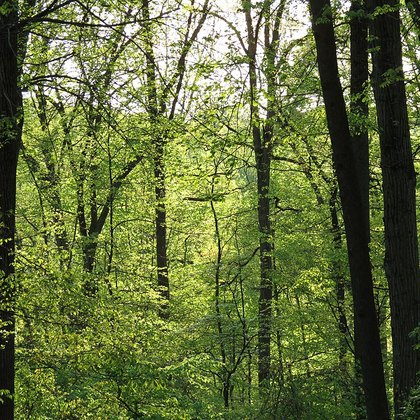
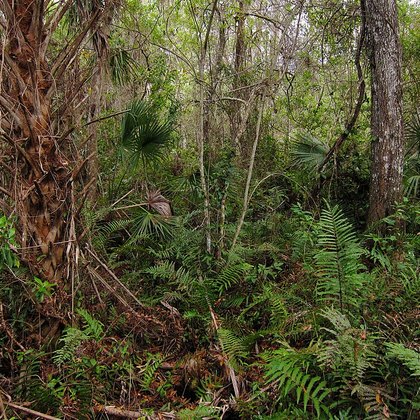
Semi-open deciduous and mixed woodland of all ages, often with gaps and edges: aspen groves, orchards, shade trees, coppice and regrowth after logging. Breeding males sit close together in loose clusters, with territories that abut one another. It forages from the middle of the tree into the canopy, shifting perch rapidly. In winter it uses woodland edges, forested ravines and scrub, mostly below about 1500 metres.
Where the bird is most often found, arranged by the USNVC — the vegetation classification of the United States and Canada — and CMECS for sea and coast.




Range and movements
The breeding range runs from Yukon and the southern Northwest Territories east through the boreal and temperate forest of Canada to Newfoundland and the Maritime Provinces, and south to Montana, the Dakotas, the Great Lakes, New England and along the Appalachians to North Carolina. In autumn it moves through the East and the Gulf Coast to Mexico and Central America; it winters from Sinaloa and Veracruz south to Panama, thus largely outside the guide area, with its core on the Caribbean slope.
- Resident
- Breeding (summer)
- Winter
- Passage
- dark = core range, pale = thinly spread
Where and when to look
Look for it in June in an aspen grove with openings: one singing male usually gives away a cluster of neighbours within earshot. The che-BEK carries far and keeps up all morning, while views of the bird itself stay short. After mid-July the song stops, and a bird without a voice is barely separable from the other empids.
Conservation
The species is listed worldwide as Least Concern (LC); Partners in Flight puts the world population at about 27 million birds and gives 11 out of 20 on the Continental Concern Score. The Breeding Bird Survey indicates a decline of roughly 1 per cent a year, some 43 per cent in total between 1966 and 2019; the species is on the Common Birds in Steep Decline list. It responds sensitively to disturbance that opens the forest or alters the understorey, such as logging and heavy deer browsing.
Scientific name
Empidonax minimus | (Baird; Baird, 1843)
The brothers William M. Baird and Spencer F. Baird described the species in 1843 as Tyrannula minima, from material near Carlisle, Pennsylvania; because it was later moved to another genus, authors and year stand in parentheses. Minimus is Latin for 'smallest' and refers to its size within the genus. That genus, Empidonax, was introduced in 1855 by Cabanis, from Greek empis, empidos 'gnat' and anax 'ruler'. The name chebec, used in parts of Canada, comes straight from the song.