All species › Waders, gulls and terns › Skimmers, noddies, terns and gulls › Iceland Gull
Iceland Gull | Larus glaucoides
Kleine burgemeester | Gaviota polar
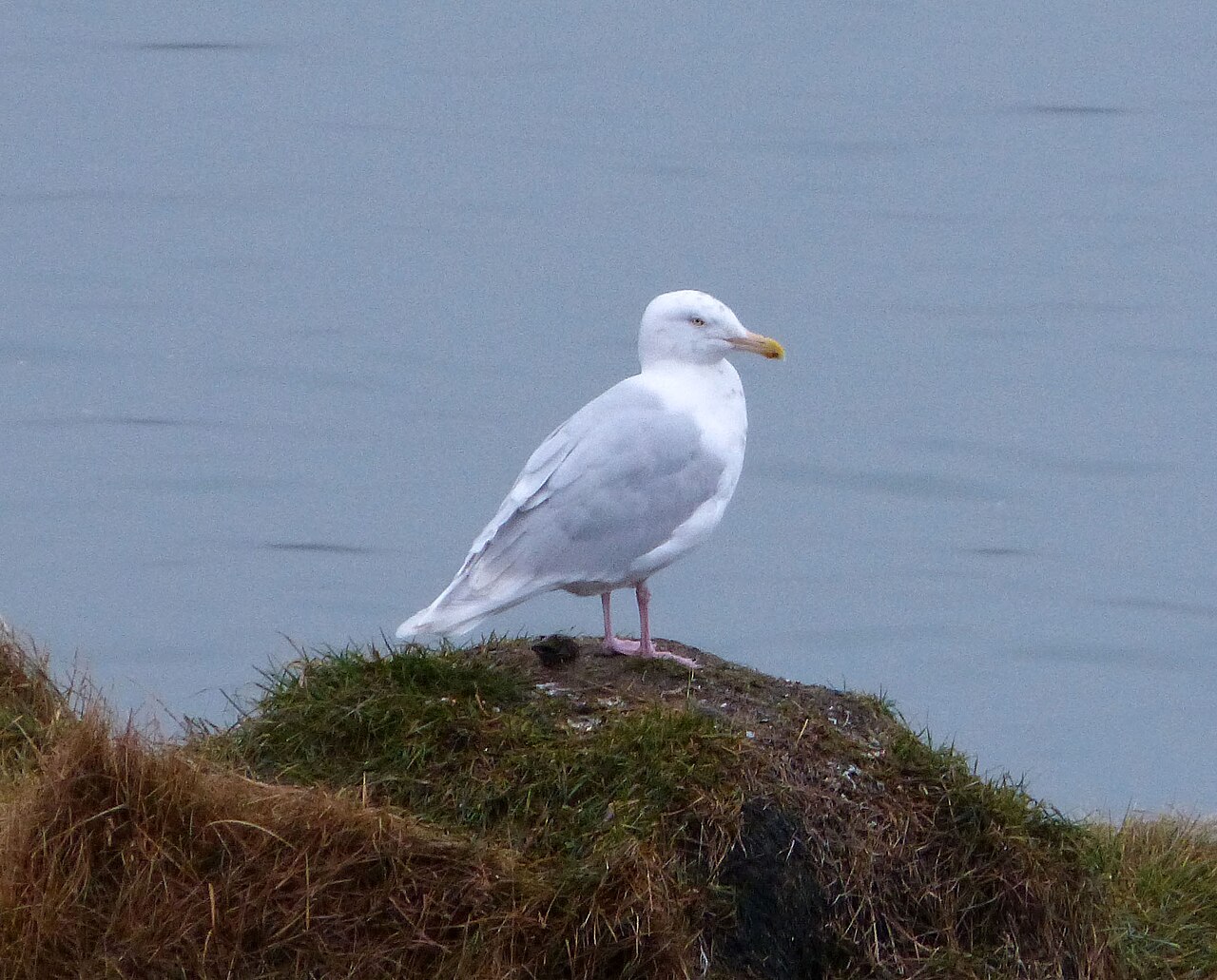
Iceland Gull is the slender counterpart of Glaucous Gull: a medium-sized gull with a rounded head, a short bill and wings so long that the tips project well beyond the tail on a perched bird. It breeds on the sea cliffs of Greenland and the Canadian Arctic and winters along both coasts of the continent. Since 2017 three forms once kept apart have stood under this one name — from birds with snow-white wingtips to birds with almost black ones.
Voice
At the colony the commonest sound is a repeated, two-parted kee-ya, which serves as an alarm and can put a whole cliff front into the air at once. The long call has the same shape as that of American Herring Gull but is clearly shriller and thinner, as though the same bird had come out a size smaller. There are also short barking and mewing notes on taking flight and on settling onto the nest ledge. In the wintering areas it is usually silent: in a screaming crowd of gulls on a harbour mole it is often the one bird saying nothing.
Recording: Frank Roos — CC BY-NC-SA 4.0 · Amsterdam, Amsterdam, Noord-Holland, Netherlands · xeno-canto
Identification
Medium-sized and gentle in expression, with a rounded head, a small eye and a short, fairly slender bill; perched, the wingtips reach far past the tail, often by more than a bill's length, so that the rear end looks pointed and light. Adults have a pale grey mantle, pink legs and a yellow bill with a red spot, and in winter a finely brown-streaked head. The wingtip differs by form: Greenland birds have pure white tips with no black at all, Baffin Island birds a variable grey pattern, and the western form a dark grey to nearly black tip with white mirrors. Young birds are pale coffee to almost cream with fine mottling, with a mostly dark bill and a pale inner hand that lights up from below in flight. Adult plumage comes in the fourth year.
Confusion species
Glaucous Gull (Larus hyperboreus) also has a white wingtip but is far bigger and heavier, with a large bill that on young birds is pink with a crisply cut black tip, and with wings barely reaching past the tail. Glaucous-winged Gull (Larus glaucescens) is bulkier and has grey, not white, tips and a dark eye. American Herring Gull (Larus smithsonianus) is heavier built, with a thicker bill carrying a clear angle and black wingtips of high contrast, and its young are darker and more coarsely marked. Confusion arises mainly with the western birds with a dark tip: these are regularly taken for American Herring Gull, and the difference lies not in colour but in the smaller, rounder head, the slimmer bill, the longer wing projection and the largely pale hand seen from below.
Compare gulls: legs, head, bill and wing tip side by side
Habitat
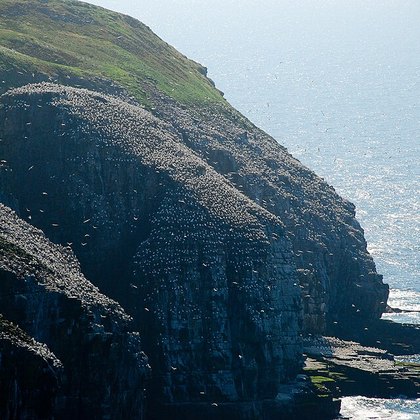
Breeds in colonies of fifty to a hundred pairs on narrow ledges of steep sea cliffs, which may be hundreds of metres high and sometimes lie tens of kilometres inland up a fjord. Outside the breeding season it is a bird of the shoreline: harbours, fishing quays, river mouths and the water just off the beach, over which it flies low and lightly, picking food from the surface without landing. Further south it belongs with landfills, sewage outfalls and the open patches in the ice of the Great Lakes. Fields and pastures it visits only when there is something to be had; open ocean far from land it avoids.
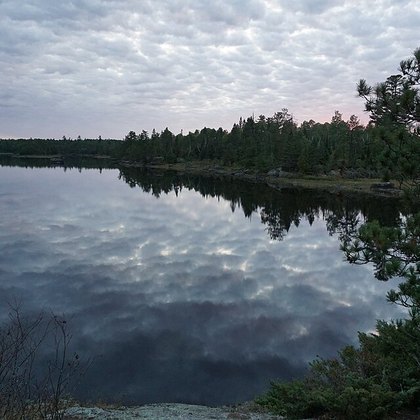
Where the bird is most often found, arranged by the USNVC — the vegetation classification of the United States and Canada — and CMECS for sea and coast.



Range and movements
Breeds in west and east Greenland and on the Canadian arctic islands; the dark-tipped form breeds in the western part of that range, from Baffin Island west to Banks and Victoria Islands. In winter the range splits in two: eastern birds move to Iceland, the British Isles, Newfoundland and the coast of New England, western birds to the Great Lakes, the interior west and the Pacific coast from southern Alaska to Baja California. In southwest Greenland part of the population stays all year, as long as the fjords hold open water. Despite the English name it does not breed in Iceland: there it is only a winter visitor.
- Resident
- Breeding (summer)
- Winter
- Passage
- dark = core range, pale = thinly spread
Where and when to look
In January and February scan a harbour mole, a fishing quay or a landfill for a gull that looks smaller and gentler than the American Herring Gulls around it, with a dove-like round head and a long, tapered rear end. Only then go to the wingtip: in this species it may be anything from snow white to nearly black, so build the identification on structure and proportions rather than on colour. Birds whose wingtip falls exactly between the forms are left by experienced counters at nothing more precise than 'Iceland Gull'.
Conservation
The world population is put at about two hundred and twenty thousand birds and the species is listed as Least Concern (LC). Because it takes its food from the water surface it is sensitive to oil at sea — a single spill in a wintering area reaches many birds at once. Colonies in Greenland were once heavily hunted for eggs and meat; most now lie so remote that isolation does most of the protecting. On the wintering grounds the open landfills that helped feed it are being closed.
Scientific name
Larus glaucoides | Meyer, 1822
The German physician and ornithologist Bernhard Meyer described the species in 1822 as Larus glaucoides; it still stands in the same genus, and for that reason author and year carry no parentheses. Larus is the Latin form of Greek laros, an unspecified seabird in the classical writers. glaucoides means 'resembling glaucus', the old scientific name of Glaucous Gull — literally, then, the gull that looks like the glaucous one. No type locality is recorded for this name. The English name points to Iceland, where the bird only winters, and the Dutch name makes the same comparison as the Latin one.