All species › Waders, gulls and terns › Sandpipers and allies › Hudsonian Whimbrel
Hudsonian Whimbrel | Numenius hudsonicus
Amerikaanse regenwulp | Zarapito Trinador Americano
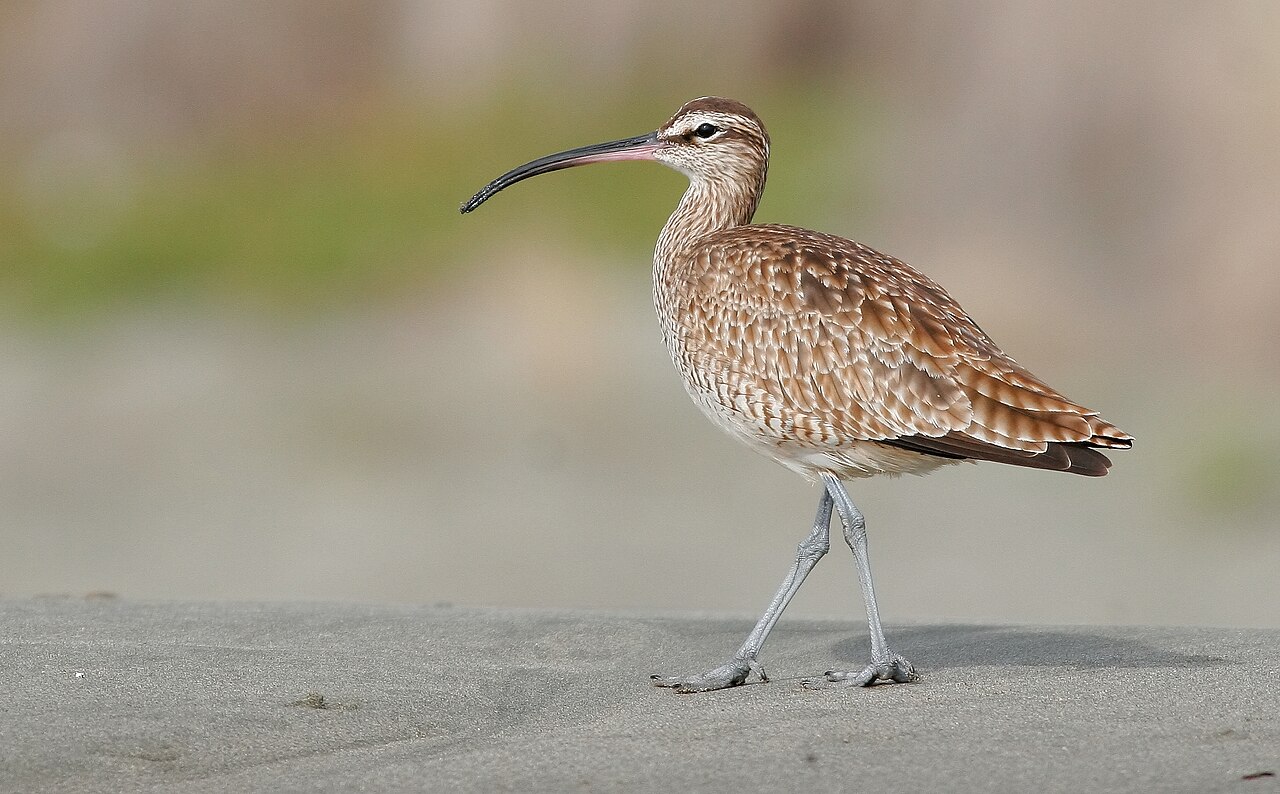
The Hudsonian Whimbrel is the curlew of the North American coast: a large brown wader with a long, kinked, down-curved bill and a striped head, walking the mudflats after fiddler crabs. In autumn it gathers on the Atlantic shore and flies from there in one stretch across the open ocean to South America. Until recently it was counted with the Eurasian Whimbrel; since 2024 it has stood as a species in its own right, and the Red List has therefore not yet assessed it.
Voice
The identifying mark is the flight call: an even, rattling series of five to seven short whistles on one pitch, pi-pi-pi-pi-pi-pi, which starts fast and stops just as fast. Over the flats and along the coast that sound is nearly always the first sign of the bird, at night over land as well. On the breeding tundra the male gives a long bubbling trill in a slow display flight, swelling and dying away again. Alarm at the nest brings a hard, repeated kweek. Unlike Bristle-thighed Curlew it never calls with a clear two-syllable whistle.
Recording: JAYRSON ARAUJO DE OLIVEIRA — CC BY-NC-SA 4.0 · Carnaubinha Praia Resort - Luís Correia, Piauí, Brazil · xeno-canto
Identification
A large, solid wader with a long down-curved bill that makes a kink rather than an even arc; it is dark, with a fleshy base to the lower mandible. The head is sharply striped: a dark brown crown split by a pale central stripe, and a dark eyeline below a pale supercilium. The upperparts are grey-brown with pale feather edges, the underparts dull buff with neat dark streaks on neck and breast and barring on the flanks. The rump is brown and no paler than the back, and the underwing is grey-brown and barred. Male and female look alike; the female is larger and has the longest bill. Birds from Alaska and north-western Canada are darker and warmer in tone than those from Hudson Bay.
Confusion species
Eurasian Whimbrel (Numenius phaeopus) is a rare guest on both coasts and separates at once in flight: it shows a white wedge up the back and a white underwing, where Hudsonian Whimbrel stays brown. Bristle-thighed Curlew is the same size and as striped about the head, but is warmer and more coarsely spotted, with a plain pale belly and a bright cinnamon rump, and its call is a clear two-note whistle. Long-billed Curlew is distinctly larger, with a far longer bill, a plain unstriped head and a cinnamon underwing. Marbled Godwit has a long, straight to slightly upturned bill and is warm cinnamon below.
Compare sandpipers, snipes and allies: bill, legs, wing bar and rump
Habitat
Breeds on open subarctic tundra and on the shrubby edges of peatland, usually within a few kilometres of the coast or of a river. Outside the breeding season it is a coastal bird: mudflats, salt marsh, mangrove, rocky shores, sandy beaches and flooded pasture just behind the sea wall. In the south it lives largely on fiddler crabs, which it draws from their burrows with the curved bill, and on the tundra it switches before departure to crowberries and blueberries. It avoids inland country away from water, except as a short stop on passage.
Where the bird is most often found, arranged by the USNVC — the vegetation classification of the United States and Canada — and CMECS for sea and coast.





Range and movements
There are two breeding areas: western Alaska with north-western Canada, and the coasts of Hudson Bay and James Bay in Manitoba and Ontario. The wintering grounds lie along the coasts, from California and the Gulf of Mexico south through Mexico, Central America and the Caribbean to Brazil and Chile; that southern part falls outside the area covered by this guide. In spring it moves north along the Atlantic and Pacific coasts, with great gatherings in South Carolina and Virginia; in late summer part of the population leaves the coast of eastern North America and crosses the open ocean in one flight, so that hurricanes sometimes drive them ashore in hundreds. Nineteenth-century shooting at the staging grounds cut the numbers hard; they have partly recovered since, but counts over recent decades point downward again.
- Resident
- Breeding (summer)
- Winter
- Passage
- dark = core range, pale = thinly spread
Where and when to look
From late July to September go to a large area of mudflat on a rising tide and wait at the high-water roost: the birds come in in small parties and give themselves away with the rattling whistled series before they are in view. In May the sandbars of South Carolina and the eastern shore of Virginia are the best places, with evening arrivals of thousands. Look at the back of every bird that flies off: a white wedge up the back means the Eurasian species, and on this side of the ocean that is a find.
Conservation
The species was recognised as separate only in 2024 and has therefore not yet been assessed for the Red List. The North American total has been put at about sixty-six thousand birds — roughly twenty-six thousand in the west and forty thousand in the east — and counts point to a decline. The pressure points are the staging grounds: loss and disturbance of the large estuaries where the birds put on fat, coastal development, and, at some Caribbean and South American wintering sites, hunting that still goes on.
Scientific name
Numenius hudsonicus | Latham, 1790
Latham described the species in 1790 as Numenius hudsonicus, and because it has stayed in that same genus ever since, author and year stand without parentheses. The description appeared in the second volume of his Index ornithologicus, from a bird taken at Hudson Bay, which is what the epithet refers to. The genus Numenius was introduced by Brisson in 1760 and goes back to Greek noumenios, 'of the new moon', after the crescent shape of the bill. For almost the whole of the twentieth century the bird was treated as a subspecies of the Eurasian Whimbrel; in 2024 it regained its old rank as a species.