All species › Passerines › New World warblers › Hooded Warbler
Hooded Warbler | Setophaga citrina
Monnikszanger | Chipe encapuchado
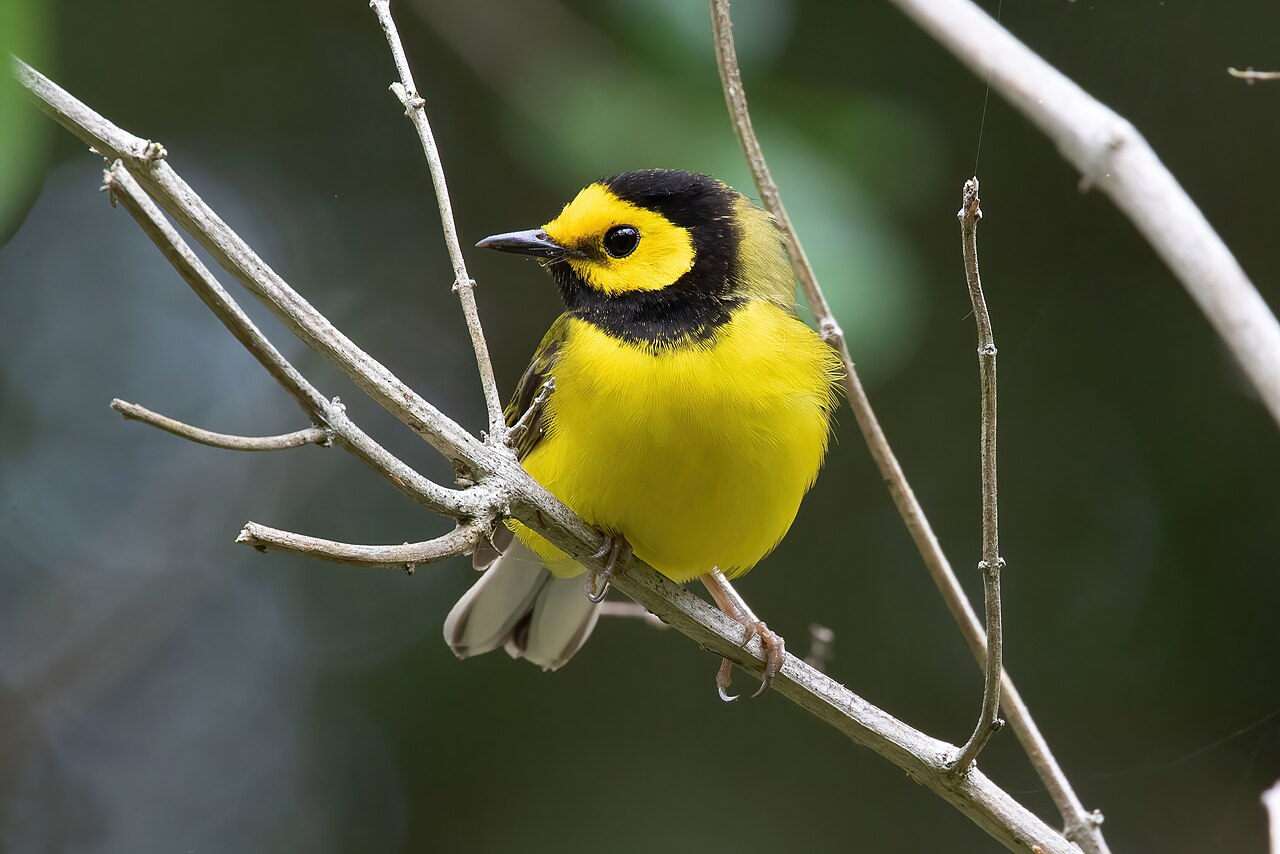
The Hooded Warbler is a bird of the dark shrub layer: a yellow warbler that stays low in the undergrowth of mature eastern deciduous forest and fans its tail open again and again. The male wears a black hood that completely encloses a yellow face, a pattern no other North American warbler shows.
Voice
The song is a clear, whistled series of five to seven notes ending in a downslurred flourish, rendered in English as weeta weeta wee-TEE-yo. It is fuller and more musical than the buzzes of most warblers and carries far through closed forest. The call is a hard, metallic chink, louder and sharper than that of related species; on migration a thin high zeep is given at night. The female does not sing but calls at the nest.
Recording: Jim Berry — CC BY-NC-SA 4.0 · Carroll (near Frewsburg), Chautauqua County, New York, United States · xeno-canto
Identification
Olive-green above, plain yellow below. The male has a black hood over crown, nape, chin and throat, within which the forehead and cheeks stay sharply bordered yellow. The female usually lacks the hood entirely or shows only a dark shadow along the crown and the edge of the throat; older females may carry an almost complete hood. Both sexes have large white patches in the outer tail feathers and a large dark eye. The tail is flicked open sideways almost constantly, flashing the white each time — that behaviour often betrays the species before the colour does.
Confusion species
Wilson's Warbler has a black cap on an otherwise yellow face but no black throat, and its tail is plain dark without white. Females of the two are much alike: Hooded is larger, has a heavier pink-horn bill and shows white with every movement of the tail. Yellow Warbler is also yellow, but has yellow rather than white tail spots and, in the male, chestnut streaks on the breast. Canada Warbler has a blue-grey back and a necklace of black streaks across the breast.
Habitat
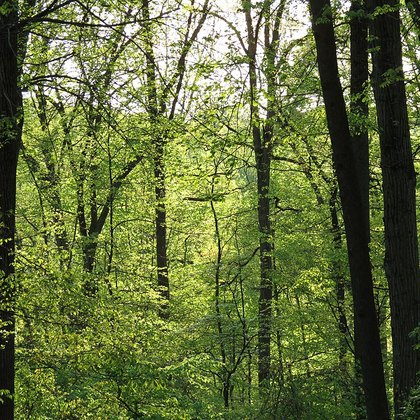
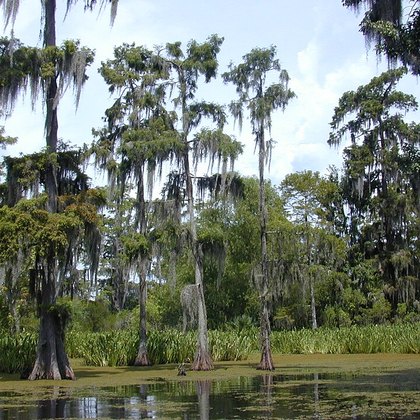
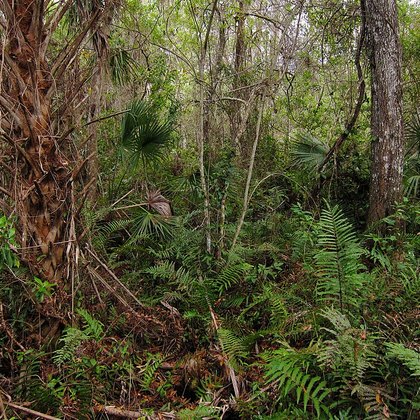
Mature deciduous forest with a dense shrub layer: ravines, stream valleys, the edges of swamp forest and gaps where bramble, rhododendron or young trees form a tangle. It breeds by preference in unbroken forest of hundreds of hectares; in fragmented woodland the Brown-headed Cowbird lays in its nests. In winter the sexes separate by habitat: males hold territories in closed tropical lowland forest, females more often in scrub, young growth and abandoned fields.
Where the bird is most often found, arranged by the USNVC — the vegetation classification of the United States and Canada — and CMECS for sea and coast.

Range and movements
A breeding bird of the eastern United States, from east Texas and Missouri to the Atlantic coast, north to Michigan, New York and southern Ontario and south to the Gulf Coast and northern Florida. The range shifted northward during the twentieth century as forest returned. It crosses the Gulf of Mexico and winters from southeastern Mexico to Panama, with small numbers in Cuba and the Bahamas. Migrants arrive in April and leave in August and September.
- Resident
- Breeding (summer)
- Winter
- Passage
- dark = core range, pale = thinly spread
Where and when to look
Look for it in May in a shaded ravine with dense undergrowth and follow the sound: the song comes from the layer between half a metre and three metres up, rarely higher. Watch for the flashing white in the tail — in the gloom of the shrub layer it shows better than the yellow, and it separates the bird at once from Wilson's Warbler.
Conservation
Partners in Flight puts the breeding population at about 5.2 million birds; the Breeding Bird Survey shows an increase of roughly one per cent a year between 1966 and 2019 and the species is listed as Least Concern (LC). The gain goes with the return of forest on abandoned farmland in the east. The pressures are fragmentation of breeding forest, which raises the rate of nest parasitism and predation, and loss of lowland forest in the wintering range.
Scientific name
Setophaga citrina | (Boddaert, 1783)
Boddaert described the species in 1783 as Muscicapa citrina, that is, in the flycatcher genus; because it was later moved to Setophaga, author and year stand in parentheses. The genus Setophaga comes from Ancient Greek ses 'moth' and phagos 'eating', hence 'moth-eater'. The species name citrina is Latin for 'citron-yellow', after the underparts. The English name and the Dutch monnikszanger both refer to the male's black hood. The specimen described came from Louisiana.