All species › Pelicans, herons and ibises › Herons, egrets and bitterns › Grey Heron
Grey Heron | Ardea cinerea
Blauwe reiger | Garza real
The Grey Heron, so familiar in Europe, is in North America a rare vagrant: the odd individual that has crossed the Atlantic, usually turning up on the east coast or in the Aleutians. It closely resembles its much commoner American counterpart but is smaller and paler. There is no evidence the species has ever bred in North America.
Voice
In its Eurasian breeding range the call is a loud, croaking fraaank, with all manner of hoarse and gurgling sounds at the colony; a hard schaah signals aggression, a soft gogogo unease. Vagrants in North America are usually alone and out of the breeding season, and rarely call; the odd vocalisation heard is generally the harsh alarm note given on flushing.
Recording: David Darrell-Lambert — CC BY-NC-SA 4.0 · Spurn Bird Observatory, Kilnsea, United Kingdom · xeno-canto
Identification
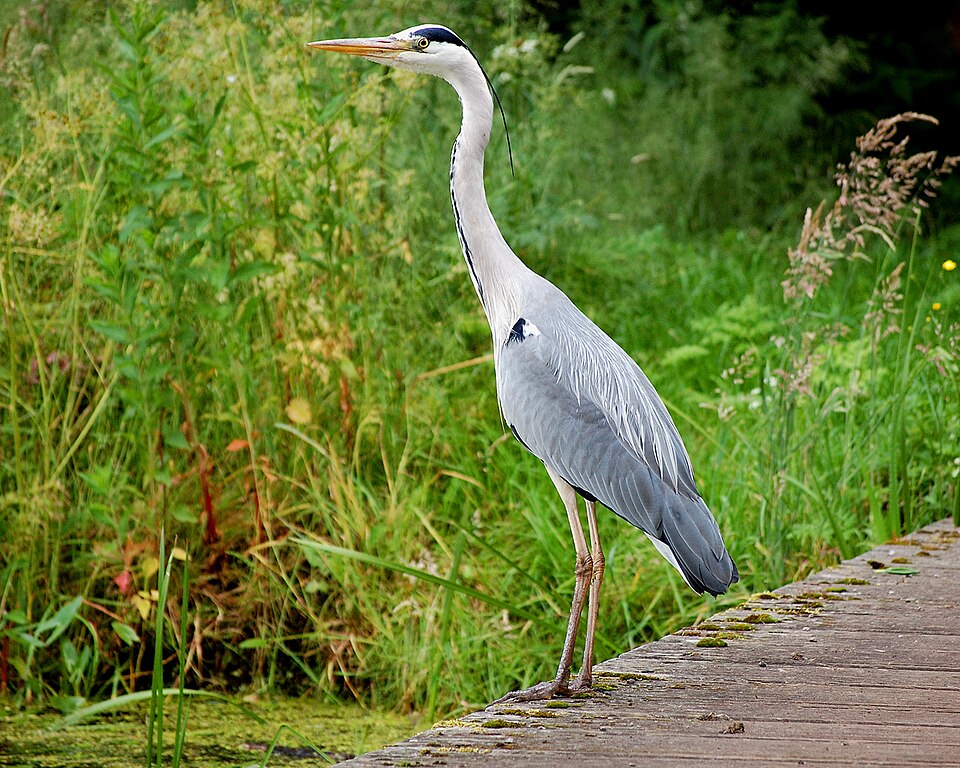
The Grey Heron is a large, ash-grey heron with a white head and neck, a broad black stripe running from the eye to the black crest, and black on the flanks against otherwise greyish-white underparts. The bill is pinkish-yellow, brighter during courtship, and the legs are brown. Young birds show a grey rather than black eye-stripe and a paler face, with only a small, dark grey crest. In flight the neck is retracted into an S-shape, with slow wingbeats — as in all herons, and unlike storks, cranes and spoonbills.
Confusion species
By far the greatest confusion is with the much commoner American counterpart, Ardea herodias, which is larger and has chestnut-brown thighs and a rusty-tinged neck with black-and-white streaking, against the Grey Heron's plain grey neck and legs and black rather than chestnut flanks. In the Aleutians a Grey Heron can also be mistaken for a Great Egret in flight, until its colour and heavier build become clear. Because the two species are rarely seen side by side, caution with one's own memory is warranted: always compare against a field guide, not against the last Great Blue Heron seen.
Habitat
Where it occurs naturally the Grey Heron uses almost any shallow water: lakes, rivers, marshes, tidal mudflats and coastal water. The occasional vagrant in North America turns up for the same reason along the coast and on large lakes — mudflats, river mouths and sheltered bays — places not fundamentally different from its habitat in Europe. The species has not established a lasting population in North America.
Where the bird is most often found, arranged by the USNVC — the vegetation classification of the United States and Canada — and CMECS for sea and coast.





Range and movements
The Grey Heron breeds across Europe, Asia and Africa, where it is a common resident or short-distance migrant over a large range. In North America it is a rare vagrant, recorded from Newfoundland to Virginia along the Atlantic coast and from the Aleutian Islands in Alaska; Newfoundland and Labrador count it among the birds recorded three times or fewer. None of these sites sees any regular return, and the species breeds nowhere in North America.
Where and when to look
You will not find a Grey Heron in North America by searching for one, but by staying alert to a heron that looks not quite right: smaller and paler than the familiar American counterpart, with plain grey rather than chestnut thighs. The best chance is along the Newfoundland coast or the western Aleutians, where Asian and European vagrants turn up more often than anywhere else in North America.
Conservation
Worldwide the Grey Heron is not threatened, with a large and, over the long term, increasing population across Europe, Asia and Africa. Its status as a vagrant in North America says nothing about the health of that global population: these are stray individuals from a thriving species, not a fringe population under pressure.
Scientific name
Ardea cinerea | Linnaeus, 1758
Linnaeus described the species in 1758 as Ardea cinerea, and unlike many herons it has remained in the same genus ever since, so author and year carry no parentheses. The genus Ardea is Latin for 'heron'; the epithet cinerea is Latin for 'ash-coloured', after the grey upperparts. The type locality was at first simply 'Europe'; Hartert restricted it to Sweden in 1920.