All species › Passerines › Tyrant flycatchers and allies › Greater Pewee
Greater Pewee | Contopus pertinax
Grote piewie | Pibí Tengofrío
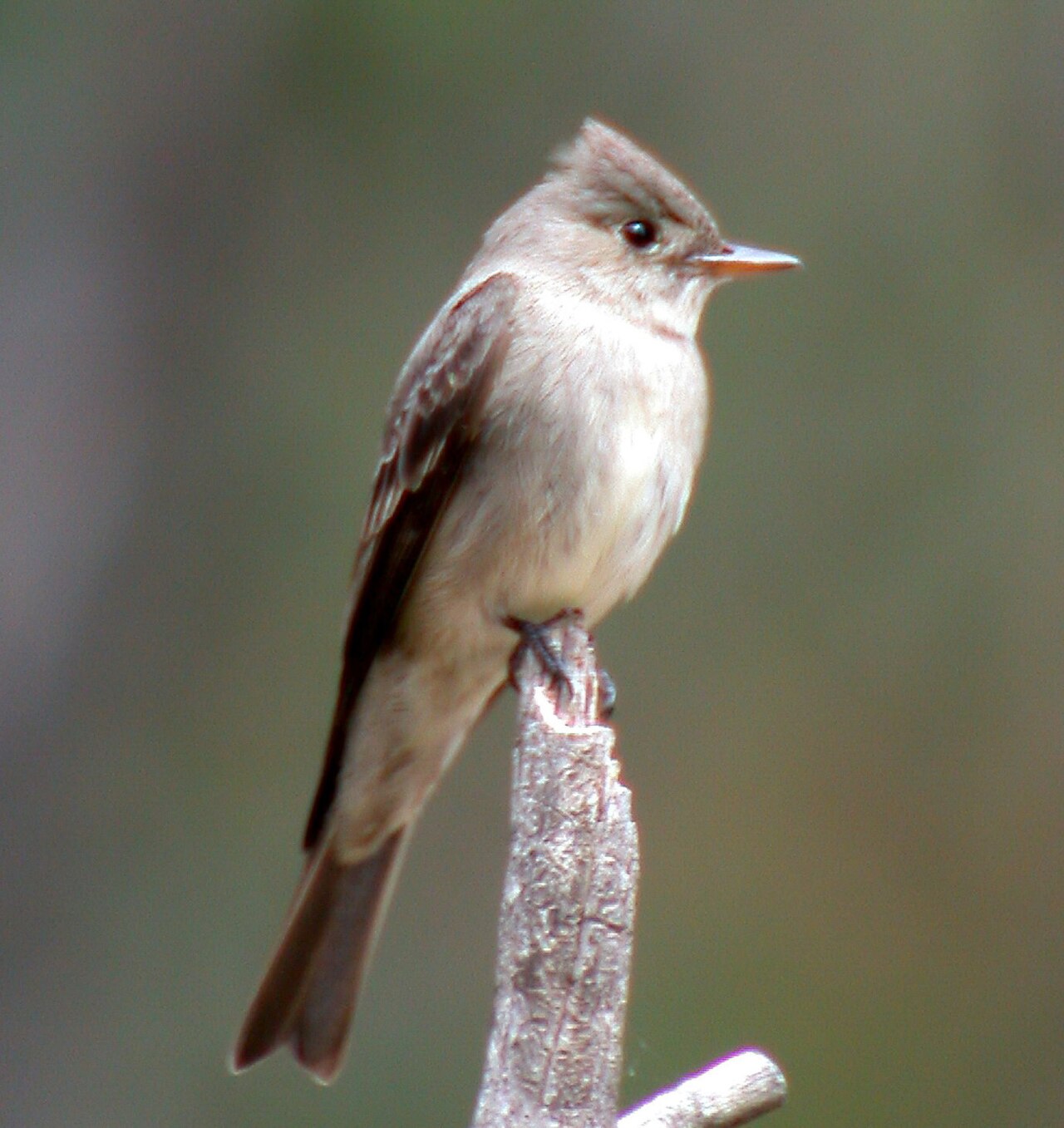
The Greater Pewee is a large, plain grey flycatcher of pine and pine-oak forest, with a pointed crest and an entirely orange lower mandible. In the United States it breeds only high in the mountains of Arizona and western New Mexico; further south it is resident as far as Nicaragua. Its song is three drawn-out whistles heard in Mexico as the name José María.
Voice
The song is a plaintive, drawn-out whistle of three or four syllables: ho-SAY — ma-REE-a, with a sustained second note and a falling final note. That slow, stretched pewee tone carries far through open pine forest and is usually the first sign that the species is present. The call is a series of short, clear pip notes, often three to six in a row, speeding up when an intruder approaches. It sings from the first warm days of April into August, including through the midday heat.
Recording: Manuel Grosselet — CC BY-NC-SA 4.0 · La Nevería, San Pablo Cuatro Venados, Oaxaca, Mexico · xeno-canto
Identification
Almost as large as Olive-sided Flycatcher, but nearly uniform olive-grey below: the breast sides are no darker than the centre, so the waistcoat pattern is absent. The head carries a short, pointed crest that makes the rear crown angular; the lores are pale and there is no eye-ring. The lower mandible is orange along its whole length, without a dark tip. The wings are dark with faint, ill-defined wingbars; the tail is longer than in Olive-sided. The sexes are alike.
Confusion species
Olive-sided Flycatcher is the same size but has sharply set-off dark sides against a white central stripe, a shorter tail and a dark-tipped lower mandible, and sings three separate notes rather than a drawn-out ho-SAY ma-REE-a. Western Wood-Pewee is considerably smaller, lacks the crest, shows clear wingbars and has only the base of the lower mandible yellow. Dusky-capped Flycatcher has a yellow belly and a grey-black cap. When the bird is silent, head shape and the wholly orange lower mandible are the most usable marks.
Habitat
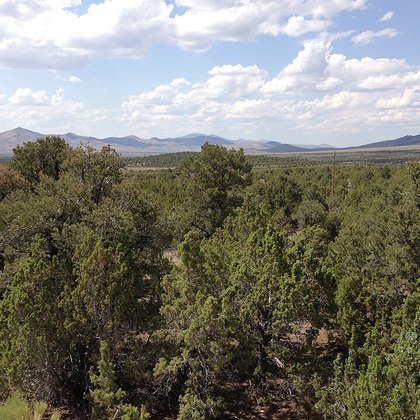
Open pine and pine-oak forest of mountains and canyons, with tall trees and an open understorey, in the subtropical and temperate zones roughly between 900 and 3400 metres; in the north of the range mainly between 2100 and 3000 metres. It hunts from high projecting branches above clearings and along streams with Arizona sycamore and maple. The few birds that stay through winter in Arizona and southern California use lowland groves, parks and riparian woodland.
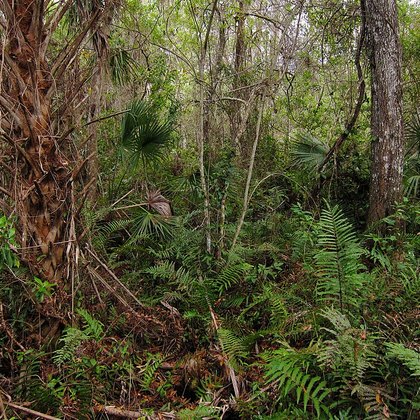
Where the bird is most often found, arranged by the USNVC — the vegetation classification of the United States and Canada — and CMECS for sea and coast.



Range and movements
Resident across almost all of the Mexican highlands and through the highlands of Guatemala, Belize, Honduras, El Salvador and Nicaragua. In the United States it breeds only in the mountains of central and southeastern Arizona and locally in western New Mexico, where it is a summer bird that largely withdraws to Mexico in winter. A few birds do winter in the lower parts of southern Arizona and in southern California. The northern nominate form and the smaller minor east of the Isthmus of Tehuantepec also differ in song.
- Resident
- Breeding (summer)
- Winter
- Passage
- dark = core range, pale = thinly spread
Where and when to look
Go to Mount Lemmon near Tucson, Madera Canyon or the Chiricahua Mountains in May or June and listen above 2000 metres for the slow ho-SAY ma-REE-a; the sound carries further than binoculars reach. Then scan the highest bare branch of a ponderosa pine. On a perched bird, check the lower mandible from the side: wholly orange means Greater Pewee, orange with a dark tip means Olive-sided Flycatcher.
Conservation
The Red List keeps the species in the Least Concern (LC) category; the world population is put at about two million mature birds, with a slightly declining trend. No immediate threats have been identified. The loss of large old pines to logging and to stand-replacing fire reduces the supply of nest trees and hunting perches. The United States share of the population is small and confined to a handful of mountain ranges, so local fires there take effect at once.
Scientific name
Contopus pertinax | Cabanis; Heine, 1860
Jean Cabanis and Ferdinand Heine described the species in 1860 already within the genus Contopus, so authors and year stand without parentheses. The genus Contopus had been introduced by Cabanis in 1855, from Greek kontos 'short' and pous 'foot'. The species name pertinax is Latin for 'persistent, stubborn'. The specimen described came from Xalapa in Veracruz, Mexico. The Spanish name tengofrío, like José María, renders the song in words.