All species › Waders, gulls and terns › Jaegers and skuas › Great Skua
Great Skua | Stercorarius skua
Grote jager | Págalo grande
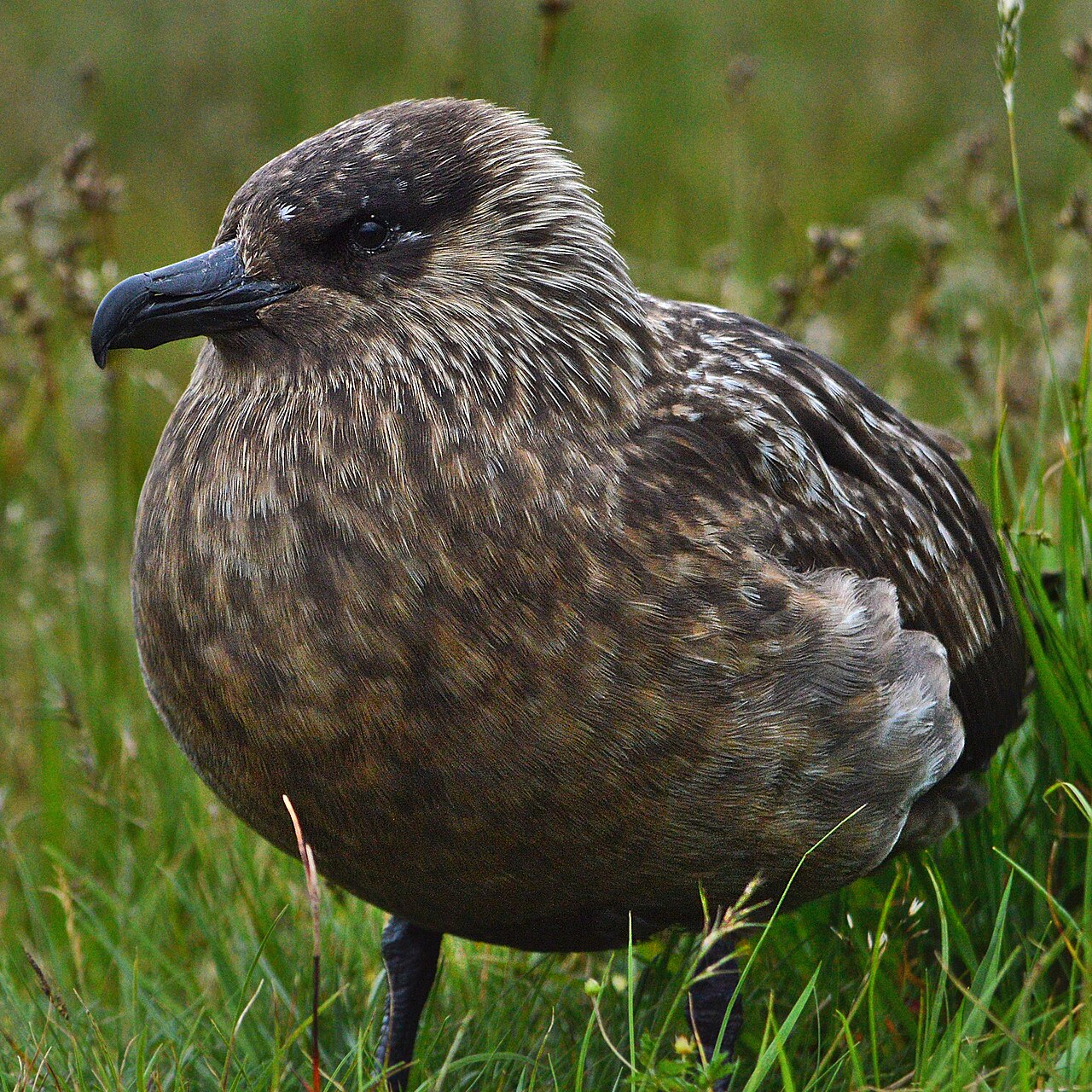
The Great Skua is the heaviest of the skuas: a brown, thickset seabird with a short tail and a bold white wing flash, built to take the catch from other seabirds. It does not breed in North America — it arrives in winter, far offshore, from colonies in Iceland, the Faroes and Scotland.
Voice
At sea it is almost always silent. At the colony it gives a harsh barking hah-hah-hah-hah, together with quacking and croaking notes that suggest a duck rather than a gull. Anyone who gets one across the bow in North American waters is unlikely to hear it at all; the only sound is usually the screaming of the gulls it is chasing.
Recording: Stanislas Wroza — CC BY-NC-SA 4.0 · Eastern Region, Iceland · xeno-canto
Identification
A heavy, broad-built seabird with a barrel chest, broad wings and a short tail that hardly projects. The plumage is warm greyish brown, lightly streaked and mottled throughout, with a dark cap; each wing carries a large white flash at the base of the primaries that lights up with every beat. Male and female look alike, though females average heavier. Juveniles are a warmer, more rufous brown and lack the streaking below. The bill is heavy, black and hooked at the tip, and the flight is slow and laboured until it sights prey, when it turns sharp and fast in an instant.
Confusion species
South Polar Skua (Stercorarius maccormicki) is the most similar: it is a colder grey-brown and unstreaked, with a pale nape standing out against the dark wings, and it is in North American waters in the summer half of the year while Great Skua is there in winter. Pomarine Jaeger (Stercorarius pomarinus) has a slimmer body, a white belly with a dark breast band, and a far narrower white wing flash. Dark Pomarine Jaegers are the closest match at a distance, but their flight is lighter and more gull-like, and adults carry twisted, spoon-shaped central tail feathers. Size helps: a Great Skua recalls an American Herring Gull in silhouette, a Parasitic Jaeger (Stercorarius parasiticus) a tern.
Habitat
Outside the breeding season it lives entirely on the open sea, often over the shelf edge and around fishing vessels, following trawlers for their discards. In North America it almost never comes within sight of land; to see one you have to go out to sea. It breeds far from here, on low heath and grassland on islands in the northern Atlantic, usually near the seabird colonies it lives off. It avoids harbours, bays and inland water.
Where the bird is most often found, arranged by the USNVC — the vegetation classification of the United States and Canada — and CMECS for sea and coast.


Range and movements
It breeds in Iceland, the Faroes, Norway including Svalbard, the Scottish islands and northwestern Russia, and crosses the Atlantic after the breeding season. From October to February it is regular far off Newfoundland, Nova Scotia and New England, and in smaller numbers south to the Gulf Stream off North Carolina; the odd non-breeder stays at sea all summer. The breeding population grew strongly during the twentieth century, when fisheries threw large quantities of discards overboard. That growth has reversed: discards are declining and avian influenza has hit the colonies hard.
Where and when to look
Take a pelagic trip out of Cape Cod, Nova Scotia or the edge of the Gulf Stream in November or December, and watch for the moment a raft of gulls suddenly scatters: that is where it is. Look at the white wing flash — on a Great Skua it is broad and equally bright above and below, and at long range it is often all you will see. From the beach the chances are slight; it rarely comes within sight of land.
Conservation
The species is listed as Least Concern (LC), but the breeding population is small and heavily concentrated: by far the most pairs breed in Scotland, Iceland and the Faroes. The avian influenza outbreak of 2022 hit hard: at Hermaness the count fell from 955 pairs in 2018 to 220 in 2024, and at Noss from 476 to 80. The decline in fishery discards works against it as well, because it fed heavily on them in summer.
Scientific name
Stercorarius skua | (Brünnich, 1764)
Brünnich described the species in 1764 as Catharacta skua; because it was later placed in Stercorarius, author and year stand in parentheses. Stercorarius is Latin for 'of dung' — skuas were once taken for birds that ate the droppings of the seabirds they chased, when in fact they take the fish those birds bring up. skua comes from the Faroese skúgvur, and is the only Faroese bird name to have come into ordinary use in other languages. Brünnich gave the Faroes and Iceland as the type locality.