All species › Owls › Owls › Great Grey Owl
Great Grey Owl | Strix nebulosa
Laplanduil | Cárabo lapón
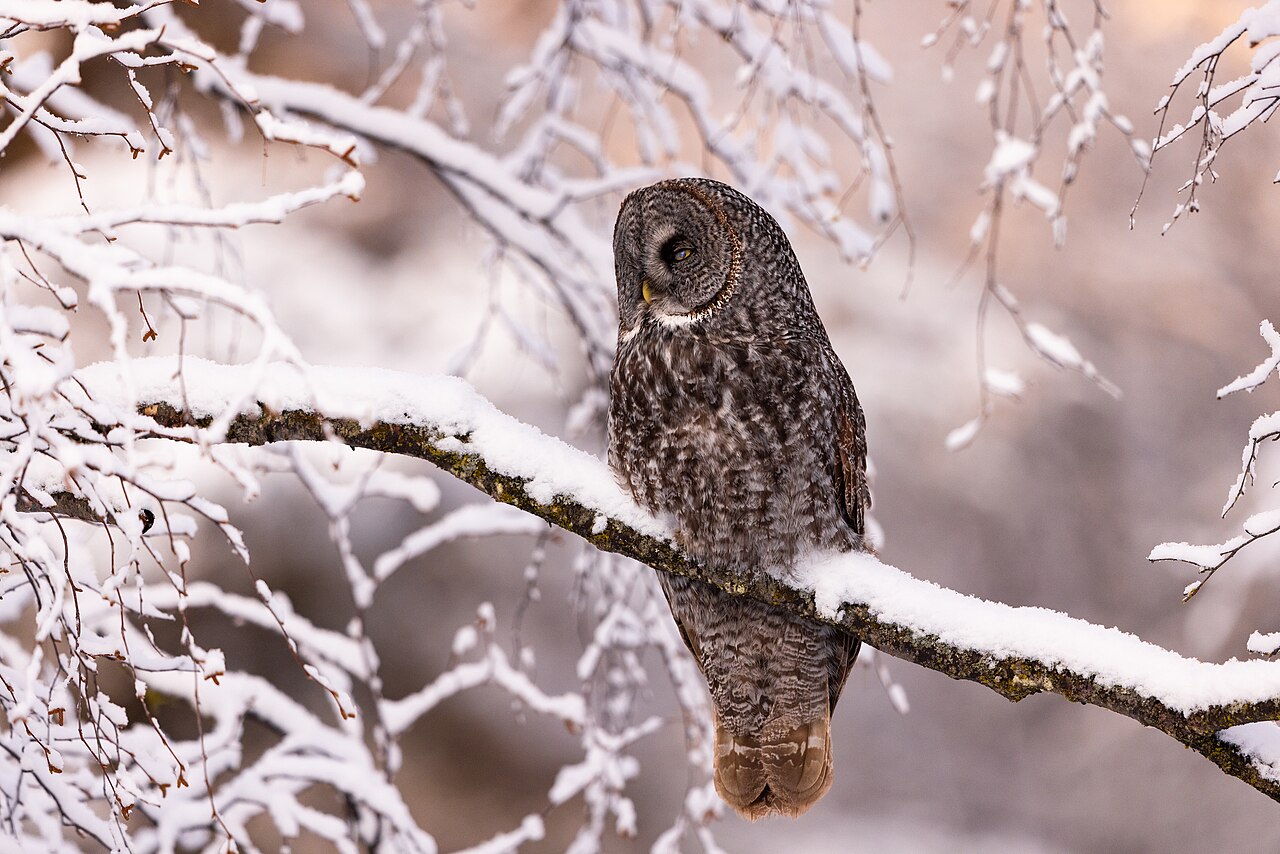
The Great Grey Owl is the longest owl in North America, with the largest facial disc of any raptor and small yellow eyes set deep within it. It looks heavier than a Great Horned Owl but weighs less: most of its bulk is feather. By ear alone it finds voles under half a metre of snow.
Voice
The song is a series of ten to fifteen low, resonant hoos that sinks in pitch and volume over six to eight seconds, with about half a minute of silence between deliveries. The male sounds deeper than the female; both sing, mainly from March to July. Near the nest and when passing prey there is a soft double hoot. The pitch is so low that at a distance it is felt rather than heard, and in still conifer forest it carries more than a kilometre.
Recording: Eric Lewenhaupt — CC BY-NC-SA 4.0 · Aneby Municipality, Jonkoping County, Sweden · xeno-canto
Identification
Grey, finely streaked and vermiculated, with a big round facial disc of concentric dark rings and no ear tufts. The eyes are small and yellow, and below the bill a black throat patch sits between two white crescents — together the 'white bow tie' that identifies the bird. The sexes look alike; the female is clearly larger. Juveniles are darker and woollier, with a vaguer disc. In flight the broad wings, long tail and light, slow wingbeat stand out.
Confusion species
Great Horned Owl is more compact, with ear tufts, large yellow eyes and a white throat without the black chin; in silhouette the head shape settles it. Barred Owl is smaller and browner, with black eyes and a far smaller disc. Snowy Owl is white and belongs to open tundra, not forest. Juvenile Great Greys are taken for Barred Owls on a brief view; look for the yellow eyes and the white bow tie under the bill.
Habitat
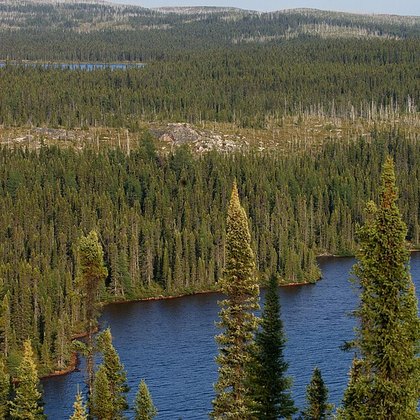
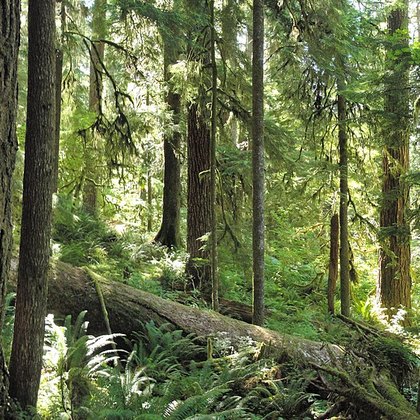
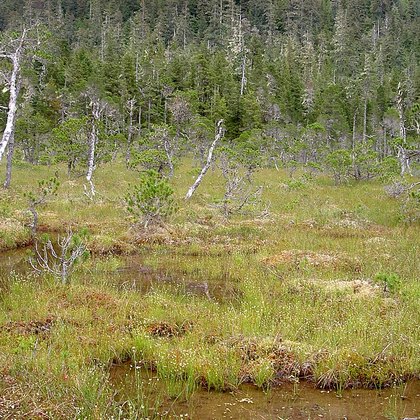
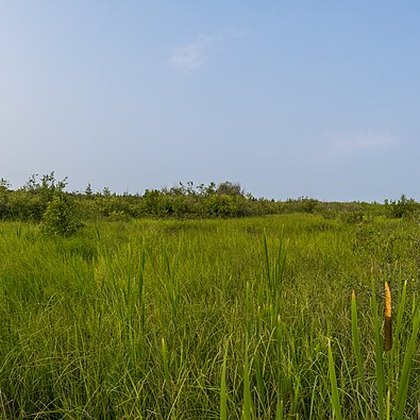
Boreal and montane conifer forest of spruce, pine and larch, always near openings: bogs, muskeg (boggy spruce peatland typical of boreal Canada), wet sedge meadows, cutovers and mountain meadows to hunt over. The forest supplies old raptor or raven nests and broken-topped snags to breed on, the opening supplies voles and pocket gophers. In the western United States it occupies roughly 800 to 2,300 metres. Closed forest without clearings and wholly open country are both avoided.
Where the bird is most often found, arranged by the USNVC — the vegetation classification of the United States and Canada — and CMECS for sea and coast.

Range and movements
Resident from central Alaska east through Yukon, the Northwest Territories and the Canadian boreal forest to Quebec, and south in the mountains of Washington, Oregon, Idaho, Montana, Wyoming and California; Minnesota holds the main population east of the Rockies. It has no fixed migration but wanders: in winters of low vole numbers large numbers shift south and east into Wisconsin, Michigan, North Dakota and occasionally New England. The irruption of the winter of 2004–2005 brought thousands of birds into Minnesota, the largest on record. Mountain populations drop into lower valleys for the winter.
- Resident
- Breeding (summer)
- Winter
- Passage
- dark = core range, pale = thinly spread
Where and when to look
Look along the edge of a clearing in conifer forest around sunrise and sunset; unlike most owls it also hunts in daylight, especially in winter and while feeding young, and then sits in plain view on a low post or dead branch. Watch for the round grey head above the grass at the forest edge: it drops from a low perch and punches through the snow crust. In irruption winters it pays to drive roads through peatland, but keep your distance — weakened birds are often hit by cars.
Conservation
Assessed as Least Concern (LC); Partners in Flight puts the world population near 120,000 breeding birds, most of them in the boreal forest. Numbers swing widely with the vole supply, which makes any trend hard to measure. Locally the loss of thick, broken-topped nest trees to logging matters, and in irruption winters many birds die of collisions and starvation. In California the small Sierra Nevada population is listed as endangered by the state.
Scientific name
Strix nebulosa | Forster, 1772
Johann Reinhold Forster described the species in 1772 as Strix nebulosa, from material sent home from the Hudson Bay trading posts; because it has stayed in the same genus ever since, author and year stand without parentheses. Strix is Latin for a bird of the night, taken from Greek strinx, and was introduced by Linnaeus in 1758. nebulosa means 'clouded' or 'misty', from nebula, 'mist', after the grey, cloudily marked plumage. The specimen described came from the Severn River on Hudson Bay.