All species › New World vultures › New World vultures › California Condor
California Condor | Gymnogyps californianus
Californische condor | Cóndor Californiano
The California Condor is the largest wild bird in North America, with a wingspan of nearly three metres and a weight of seven to ten kilograms. It soars for hours without a wingbeat and covers hundreds of kilometres in a day looking for carcasses. Every free-flying bird is numbered, tagged and tracked.
Voice
New World vultures have no syrinx, the organ with which other birds sing, so the condor produces no song and no call. What it makes are air sounds: hisses, forced breaths and a low grunting, heard at a carcass, in disputes over a place at the kill, and at the nest. Chicks in the nest cavity hiss at intruders. At any distance the bird is entirely silent; the only audible thing is the wind through the primaries as it passes low along a cliff.
No recording with a suitable Creative Commons licence has been found for this species yet; what to listen for is described below.
Identification
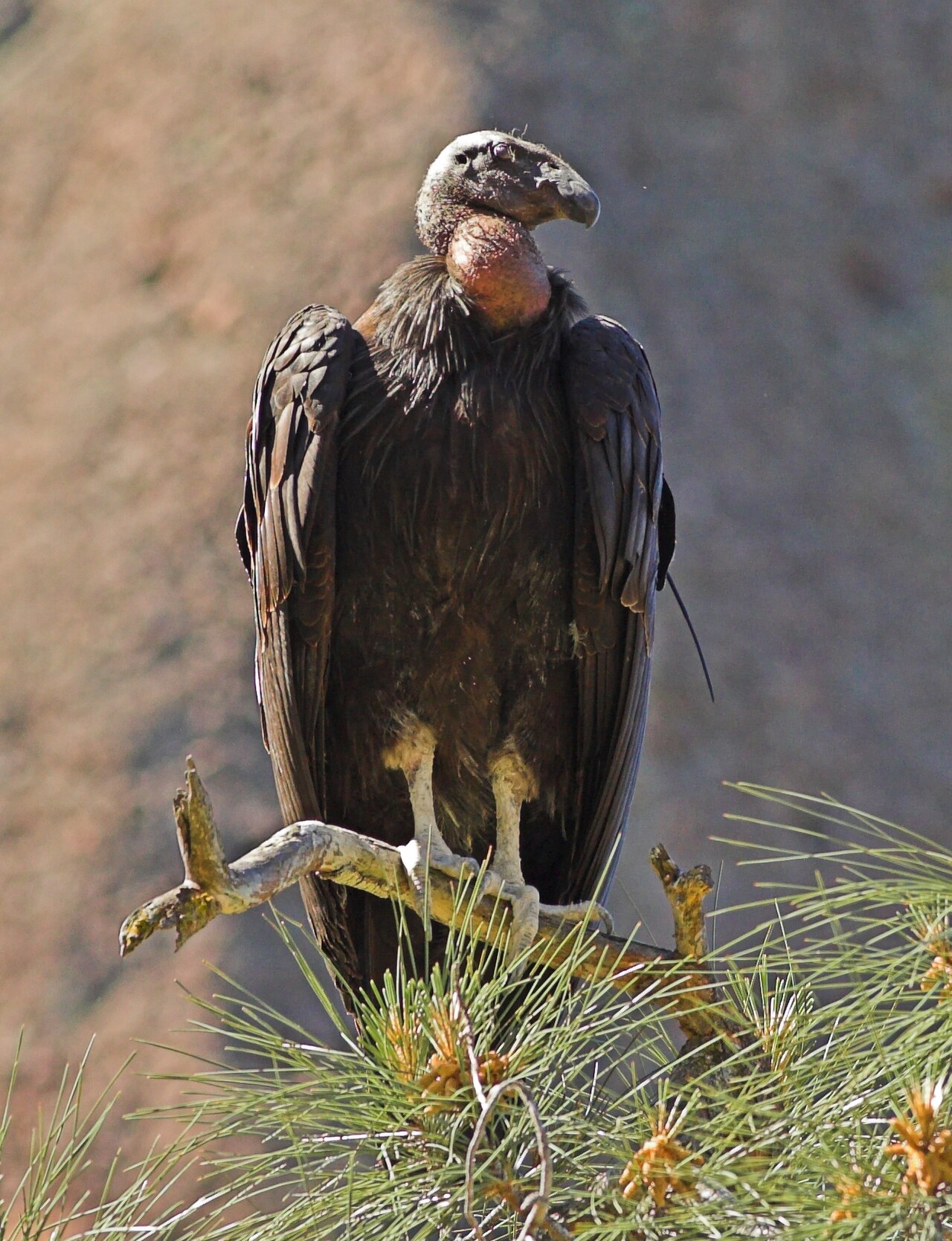
Adults are black, with a large, sharply bounded white triangle along the leading part of the underwing. Head and neck are bare and orange-yellow to pink, ringed by a collar of black feathers; the bill is pale and heavy. Immatures have a dark grey-black head and dull grey mottled underwing panels, and take six to eight years to reach adult plumage. The sexes look alike. The silhouette is massive: long broad wings with finger-like spread primaries, a small head and a short tail, held almost flat.
Confusion species
Turkey Vulture is far smaller, holds its wings in a V and rocks in the thermal, and shows a silvery-grey trailing edge to the whole wing rather than a white panel at the front. Black Vulture is smaller and more compact still, with only white 'stars' at the wingtips and a short, flapping wing action. Immature Bald and Golden Eagles are the most similar species: they have feathered heads, a larger tail and flap regularly, which the condor almost never does. Immature condors lack the white underwing panel and at distance are frequently taken for eagles.
Habitat
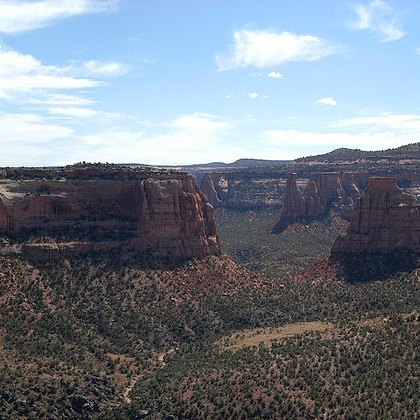
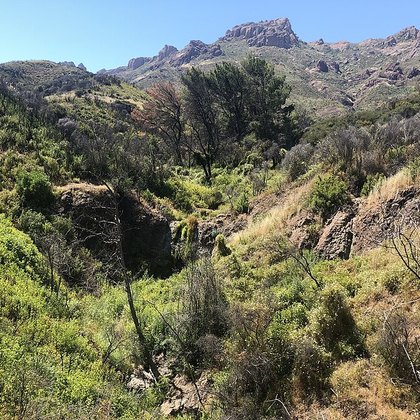
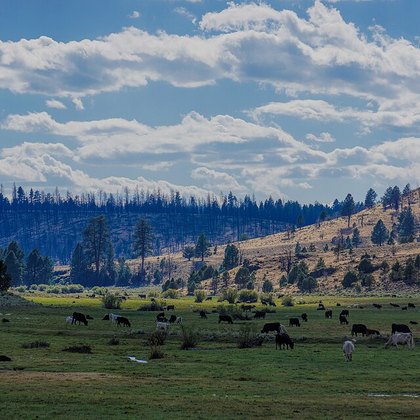
Mountains and hill country with cliffs, from chaparral (dense evergreen shrubland of dry hillsides) and oak savanna to conifer forest, up to about 1,800 metres, with open ground and reliable rising air for take-off. Breeding is in natural cavities and caves in rock faces, occasionally in the hollow trunk of a giant redwood; roosting is on bare branches and ledges. Foraging is over grazing land, ranch country and the coastal strip, where dead deer, cattle, sea lions and whales lie. Closed forest without an outlook and still lowland air are both avoided.
Where the bird is most often found, arranged by the USNVC — the vegetation classification of the United States and Canada — and CMECS for sea and coast.
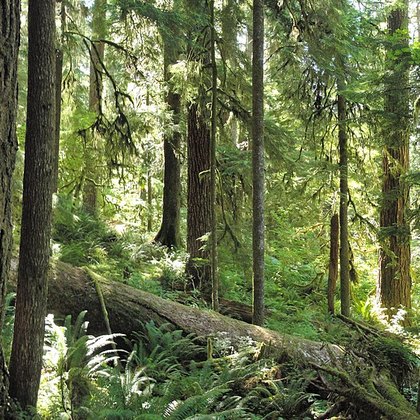
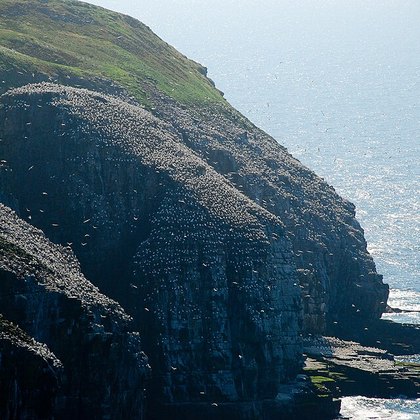
Range and movements
Into the nineteenth century the species ranged along most of the western seaboard of North America; by 1987 the wild stock was gone. Released birds now fly in southern California around Los Padres and Sespe, in central California at Pinnacles and Big Sur, in northern California on Yurok land, in northern Arizona and southern Utah around the Grand Canyon and Zion, and in the Sierra de San Pedro Mártir in Baja California. It does not migrate but ranges widely: Arizona birds reach Utah regularly, and Californian birds fly hundreds of kilometres along the coast. The sub-populations remain largely separate.
- Resident
- Breeding (summer)
- dark = core range, pale = thinly spread
Where and when to look
The best places are fixed lookouts with rising air: Navajo Bridge at the Grand Canyon, the coast road at Big Sur, and the ridges of the Sespe country, in the middle of the day once the thermals are working. Judge the wing attitude first — flat, without rocking — and only then look for the white panel under the wing. Nearly every bird carries numbered wing tags; reading that number and reporting it is more use to the management of the population than the sighting itself.
Conservation
Critically Endangered (CR). In 1987 the last free-flying birds were trapped, leaving the entire species at 27 birds in captivity; captive-bred birds have been released since 1992. At the end of 2025 the species stood at 607 birds, 392 free-flying and 215 in captivity, spread over five release areas. Lead poisoning is the leading cause of death — condors swallow lead fragments from carcasses left by hunters, and lead accounts for half of all deaths of known cause since 1992 — alongside power line collisions, shooting, swallowed litter and, in 2023, avian influenza. Nearly all free-flying birds are trapped twice a year for a blood test and treated where needed with a drug that binds lead; they carry numbered wing tags and a radio or GPS transmitter, and California has banned lead ammunition for hunting statewide since 2019.
Scientific name
Gymnogyps californianus | (Shaw, 1797)
George Shaw described the species in 1797 as Vultur californianus, among the Old World vultures; because it was later moved to another genus, author and year stand in parentheses. The genus Gymnogyps was introduced by Lesson in 1842 and is built from Greek gymnos, 'naked', and gyps, 'vulture' — after the unfeathered head and neck. californianus means 'of California'. The specimen described came from the coast of California.