All species › Passerines › Mockingbirds and thrashers › Gray Catbird
Gray Catbird | Dumetella carolinensis
Katvogel | Pájaro gato gris
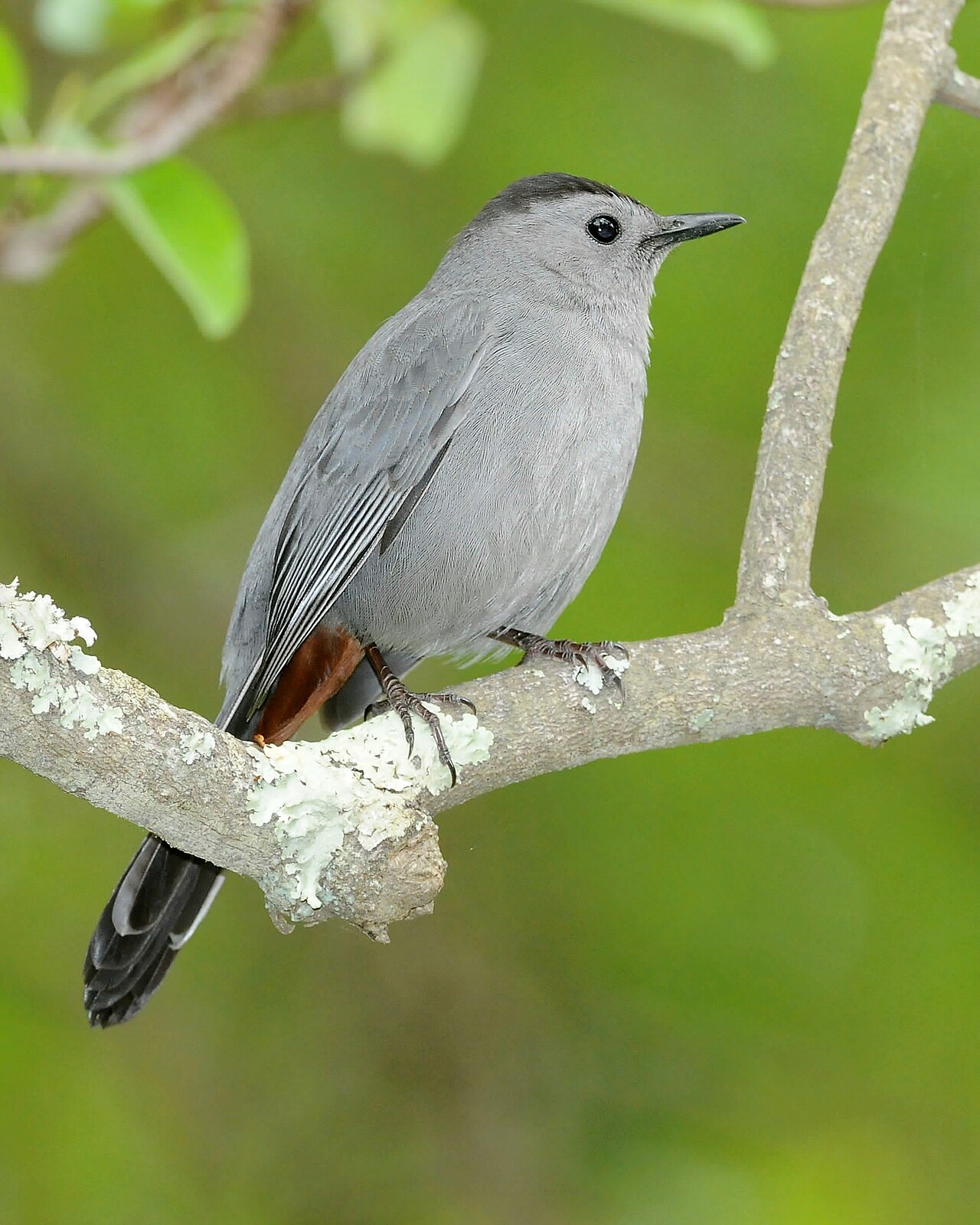
The Gray Catbird is a plain slate-grey songbird with a black cap and a rufous patch under the tail, almost always keeping to dense scrub. Its name comes from the call: a drawn-out, plaintive mew from inside a bramble while the bird itself stays out of sight.
Voice
The song is a long, irregular series of gurgling, squeaking and grating notes, interspersed with imitated fragments of other species. Unlike Northern Mockingbird, which repeats each phrase three or more times in a row, the catbird sings most phrases only once. It usually sings hidden in scrub, seldom from an open perch, and sometimes for minutes without a break. The call is the catlike mew that gives it its name, alongside a hard, short chek.
Recording: Scott Olmstead — CC BY-NC-SA 4.0 · Crane Pond Wildlife Management Area, Essex County, Massachusetts, United States · xeno-canto
Identification
Uniform slate grey over the whole body, with a sharply defined black cap and a long, rounded black tail that is often flicked up or down. Under the tail lies a rufous patch, visible only when the bird raises the tail. The bill is narrow, straight and black, the legs dark. Male and female are alike; young birds are duller with a less distinct cap.
Confusion species
No other songbird in eastern North America is entirely slate grey without wingbars. Northern Mockingbird is paler grey, has white wing patches and white outer tail feathers that show in flight, and repeats its song phrases. Brown Thrasher is rusty brown with a heavily streaked breast and a yellow iris. Flycatchers of the genus Empidonax are much smaller, have wingbars and sit upright on an open branch.
Habitat
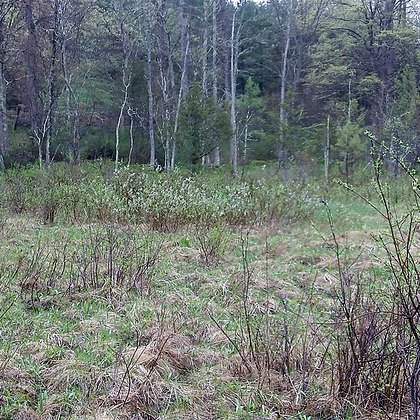
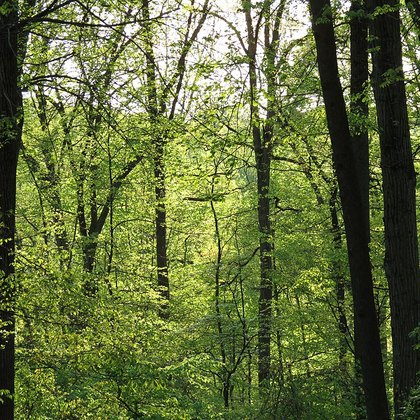
Dense, low scrub: woodland edges, rank old fields, abandoned orchards, hedgerows, thorn thickets and bramble-rich streamsides, and in towns overgrown gardens and park shrubbery. It avoids closed forest and conifer stands. In winter it seeks berry-rich thicket, often close to water, and in Central America and the Caribbean also the edges of mangrove and tropical scrub.
Where the bird is most often found, arranged by the USNVC — the vegetation classification of the United States and Canada — and CMECS for sea and coast.



Range and movements
It breeds in temperate North America east of the Rocky Mountains, from southern British Columbia and the Canadian prairies to Nova Scotia and south to the Gulf states, with scattered breeding sites in New Mexico and Utah. Migration runs from March to May and from late August to November. It winters in the southeastern United States, along the Mexican Gulf Coast and the Pacific coast of Mexico, in Central America and on the Caribbean islands. Increasingly, birds also stay through the winter in more northern states such as Ohio. Bermuda holds a resident population.
- Resident
- Breeding (summer)
- Winter
- Passage
- dark = core range, pale = thinly spread
Where and when to look
The catlike call is the quickest handle: walk a rank woodland edge in May or June and wait after the first mew — the bird usually comes to the top of the scrub within half a minute. In August and September a fruiting elderberry or black cherry is the best place.
Conservation
The species is listed as Least Concern (LC) and is numerous across its range; the scrub of abandoned fields and woodland edges works in its favour. It actively removes Brown-headed Cowbird eggs from the nest, so brood parasitism has little effect. Collisions with windows and lit buildings on migration and predation by cats are the main direct causes of mortality. The Bermuda population has declined sharply through clearance and introduced predators.
Scientific name
Dumetella carolinensis | (Linnaeus, 1766)
Linnaeus described the species in 1766 as Muscicapa carolinensis; because it was later moved to another genus, author and year stand in parentheses. The original text gives the type area as 'in Carolina', but it is now referred to Virginia. The genus name Dumetella is a diminutive of Latin dumetum 'thorn thicket', from dumus 'thornbush', and so means 'small dweller of the thicket'. The species name carolinensis means 'from Carolina'. The English and Dutch names both refer to the mewing call.