All species › Passerines › New World sparrows › Eastern Towhee
Eastern Towhee | Pipilo erythrophthalmus
Roodflanktowie | Rascador espalda negra
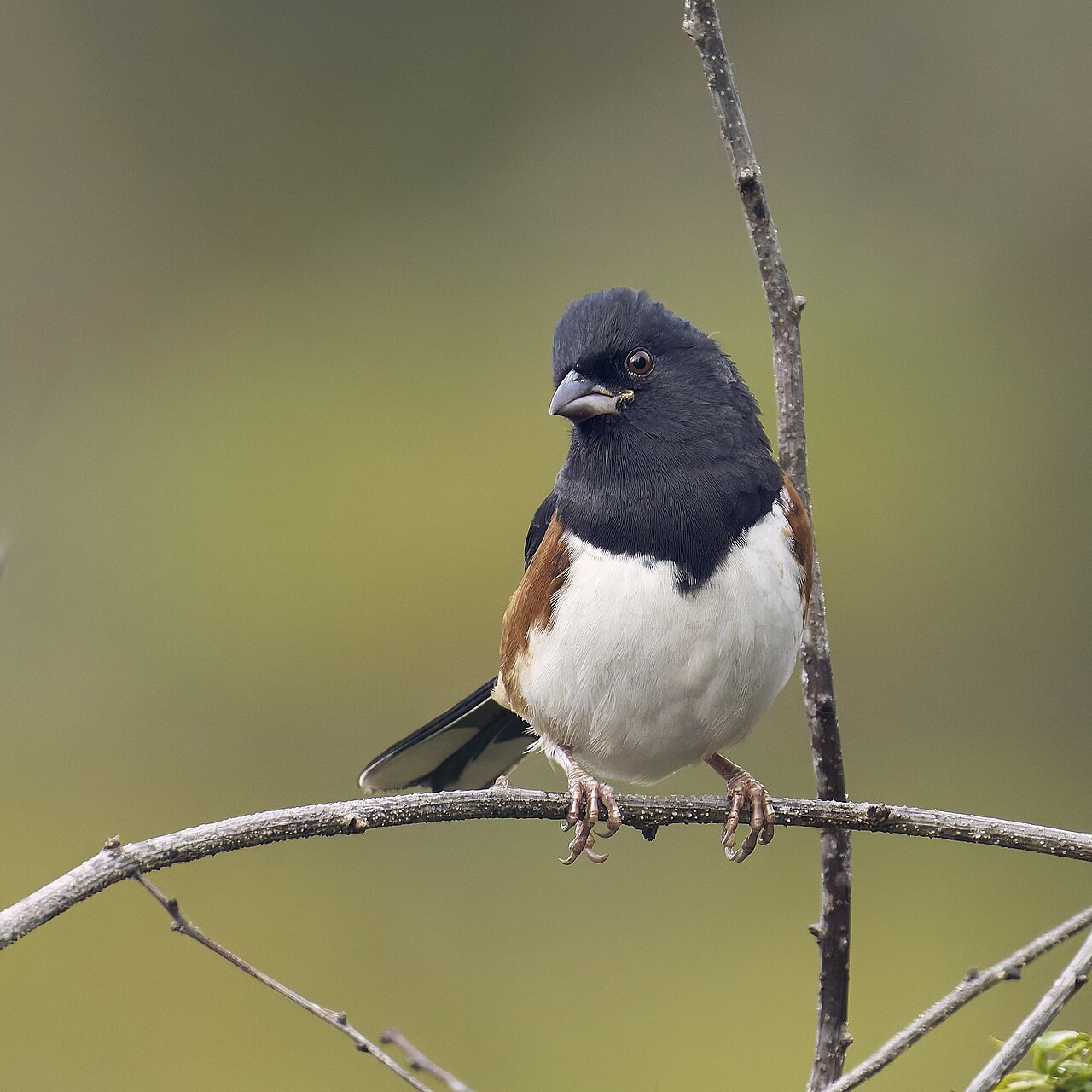
The Eastern Towhee is a large, long-tailed sparrow of dense scrub in eastern North America. The male is black from head to tail, with rufous sides and a white belly; the female shows the same pattern in warm brown. It lives on the ground, scratching backwards through the leaf litter with both feet at once.
Voice
The song is two or three clear whistles followed by a thin trill and lasts about a second; it is written as drink your teeeea. The call is a rising, nasal too-wheee, the source of the name towhee; in Florida and the Georgia coastal plain that call is often a short, hoarse chewink instead. Pairs in the scrub keep contact with a high, thin seee. The scratching in the leaves makes a loud rustle that usually betrays the bird before it is seen.
Recording: Jeff Stewart — CC BY-NC-SA 4.0 · Cavan-Monaghan (near Millbrook), Peterborough County, Ontario, Canada · xeno-canto
Identification
The male has a jet-black head, breast, back and tail, rufous sides and a white belly; a small white patch sits at the bend of the wing, and the outer tail feathers carry white corners that flash as the bird flies off. The female repeats the pattern in warm chocolate brown. The iris is red over most of the range but straw-yellow to white in birds of Florida and the adjacent coastal plain. Juveniles are brown and heavily streaked all over for their first weeks, with only the white tail corners to go on.
Confusion species
The Spotted Towhee of the west is nearly identical in shape but has white spots on the scapulars and wing coverts and white streaking across the black back; the Eastern has an unmarked black upperside and at most a white patch at the wing base. Where the two meet on the Great Plains intermediates occur, and there the call note is more reliable than the plumage. The brown female is taken for a large thrush or for Fox Sparrow; the long rounded tail with white corners, the conical bill and the sharply bounded rufous flanks settle it.
Habitat
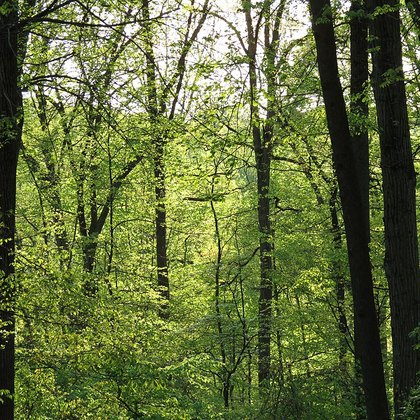
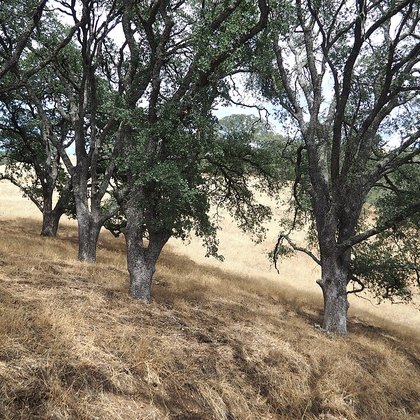
Dense low scrub with an open floor of leaf litter: abandoned farmland growing in, clearcuts, forest edges, powerline rights-of-way, coastal dune thickets and the shrubby understorey of open oak woodland. Closed, tall forest without an understorey it does not use, and bare grassland no more. In the Appalachians it reaches about 2000 metres, favouring warm south-facing slopes. In gardens with shrub clumps and an unraked floor it is a regular visitor.
Where the bird is most often found, arranged by the USNVC — the vegetation classification of the United States and Canada — and CMECS for sea and coast.



Range and movements
The range covers the eastern United States from the Gulf Coast to southern Ontario and southern Quebec, west to eastern Texas, eastern Kansas and the Great Plains. From roughly Massachusetts and Iowa southward it is present all year; birds of the northern edge and of the Canadian provinces leave in October and winter in the southeast and in eastern Texas. The species has declined sharply in the north and along the Atlantic coast as abandoned farmland has grown back into forest.
- Resident
- Breeding (summer)
- Winter
- Passage
- dark = core range, pale = thinly spread
Where and when to look
Look not in the tree but in the lowest half metre of a dense thicket, and follow the sound of rustling leaves. In April and May the male does sing from an exposed branch above the scrub; that is the moment to see it in the open. As it flies off, watch for the three white corners flashing at the tail tip.
Conservation
The species is listed as Least Concern (LC); Partners in Flight puts the breeding population at about 29 million birds. The Breeding Bird Survey shows a decline of roughly 60 per cent since 1966, placing the species on the American tipping-point list; the loss is steepest along the Atlantic coast and in the northeast. The cause lies mainly in the disappearance of young, shrubby ground: abandoned fields grow on into forest and scrub is built over. Management that holds openings, clearcuts and utility corridors at a shrub stage produces breeding habitat directly.
Scientific name
Pipilo erythrophthalmus | (Linnaeus, 1758)
Linnaeus described the species in 1758 as Fringilla erythrophthalma from a specimen taken in South Carolina; because it was later moved to another genus, author and year stand in parentheses. The genus Pipilo was introduced in 1816 by Louis Pierre Vieillot, from Latin pipilare 'to chirp'. The species name comes from Greek eruthros 'red' and ophthalmos 'eye', after the red iris. The English name towhee renders the call; the Dutch name names the rufous flanks.