All species › Trogons › Trogons › Eared Quetzal
Eared Quetzal | Euptilotis neoxenus
Geoorde trogon | Trogón Orejón
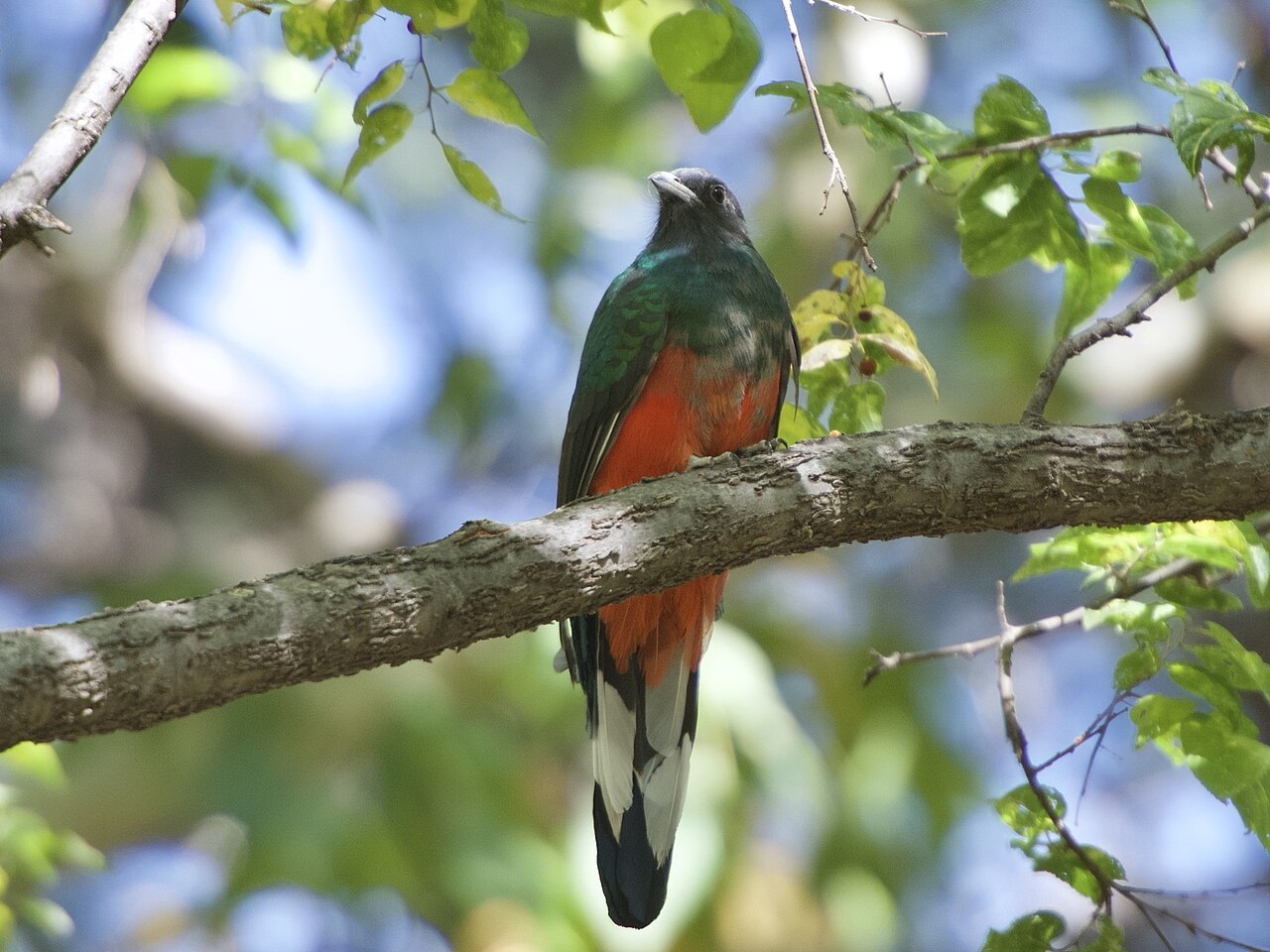
Eared Quetzal is a bird of the pine-oak forests of Mexico's Sierra Madre Occidental that occasionally, mostly in late summer and autumn, turns up in the same mountain canyons of southeastern Arizona and southwestern New Mexico where Coppery-tailed Trogon breeds. The male has a black head, a metallic green back and breast and a vivid red belly; distinctive are the narrow, plume-like feathers behind the eye that give the species its name. Unlike Coppery-tailed Trogon it does not breed there regularly: in 45 years of records only one nesting attempt is known.
Voice
The male's song is a series of whistled notes that gradually swell in volume, followed by squealing and chattering sounds; in flight the bird gives a shrill, rattling scream, much higher and sharper than the hoarse call of Coppery-tailed Trogon. Observers in Arizona often recognise the species by this high-pitched sound before they see it, especially in dense, tall conifer stands where the bird itself stays hidden for long spells.
Recording: Pat Goltz — CC BY-NC-SA 4.0 · Chiracahua Mountains, United States · xeno-canto
Identification
The male has a black head and throat, a glossy metallic green back, breast and upper tail, and a vivid red belly and undertail that is noticeably brighter than in Coppery-tailed Trogon. Behind the eye, a few narrow, elongated feathers project backward, forming an ear-like tuft when seen from the side. The female has a grey rather than black head, breast and upper belly and a less extensive but equally bright red lower belly; she too carries the green upperparts. Both sexes are considerably larger than Coppery-tailed Trogon, with a grey rather than yellow bill. The flight is stronger and more direct than in the smaller trogon species, with the broad tail clearly visible.
Confusion species
Coppery-tailed Trogon, which breeds in the same canyons, is smaller, has a yellow bill, a white breast band that Eared Quetzal lacks, and a hoarse, croaking call rather than the high squealing of this species; the ear tufts are entirely absent in Coppery-tailed Trogon. In Mexico the range overlaps with Mountain Trogon (Trogon mexicanus), which is likewise red-and-green but stays clearly smaller and lacks the characteristic ear tufts. Because Eared Quetzal is rare outside Mexico and is often looked for in the same places as Coppery-tailed Trogon, a confused report of one species for the other is cited as the main source of error; the ear tufts and the grey bill settle any doubtful case.
Habitat
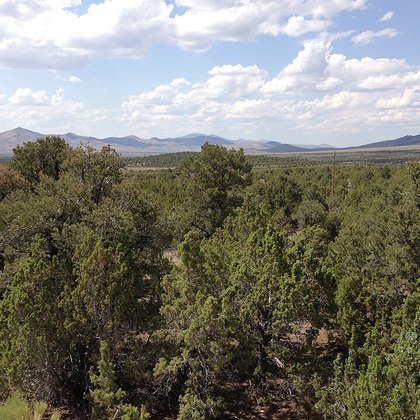
Mature pine-oak and conifer forest of the higher mountains, generally between about eighteen hundred and three thousand metres, favouring narrow, forested canyons with a permanent stream. In Arizona the species has consistently been found in the same high-elevation conifer forests with native fruit-bearing trees such as hackberry and madrone that the birds use for food; open, dry scrub and lowland habitat is avoided entirely.
Where the bird is most often found, arranged by the USNVC — the vegetation classification of the United States and Canada — and CMECS for sea and coast.



Range and movements
The core range lies in the Sierra Madre Occidental of Mexico, from northern Sonora and Chihuahua south to western Michoacán. From 1977 to 2021, 66 records were documented in Arizona and New Mexico, spread across 27 of the 45 years surveyed, with the Chiricahua, Huachuca and Santa Rita mountains as the three main areas; the northernmost record came from Chevelon Canyon on the Mogollon Rim, over three hundred and twenty kilometres north of the Mexican border. Records peak in late summer and autumn (August to November), with a smaller second peak in winter; breeding has been confirmed only once, in 1991 in Ramsey Canyon, where the clutch failed after an early snowstorm. Whether the birds crossing the border are searching for new breeding habitat or simply wandering off course has never been established with certainty.
Where and when to look
In late summer and autumn, search high-elevation conifer forest with brambles, hackberry or madrone along a stream, and listen for the high, squealing call before looking for a flash of colour; the bird often sits still, high and concealed in the canopy. The Chiricahua, Huachuca and Santa Rita mountains produce the most records, but a visit is no guarantee: the species turns up unpredictably and can linger for days or weeks at one site, or vanish again just as suddenly.
Conservation
Least Concern (LC) worldwide; the core range in the mountain forests of Mexico is large and the species is not considered rare there, though thorough surveys of its exact numbers are scarce. Within the United States and Canada the species is by definition a vagrant with no established breeding population, so conservation attention focuses on the Mexican habitat: protecting mature pine-oak forest along mountain streams from logging, and the effect of climate change on the timing of autumn movements.
Scientific name
Euptilotis neoxenus | (Gould, 1838)
Gould described the species in 1838 as Trogon neoxenus and himself placed it in the new genus Euptilotis in 1858; hence the parentheses around author and year. The genus is built from Greek eu, 'good' or 'fine', ptilon, 'feather', and the suffix -otis, 'eared', after the elongated feathers behind the eye that give the species its English name, Eared Quetzal. neoxenus combines Greek neos, 'new', with xenos, 'stranger' or 'guest' — a reference to the bird's status as an unexpected, rare visitor outside its Mexican core range.