All species › Waterfowl › Ducks, swans and geese › Common Pochard
Common Pochard | Aythya ferina
Tafeleend | Porrón europeo
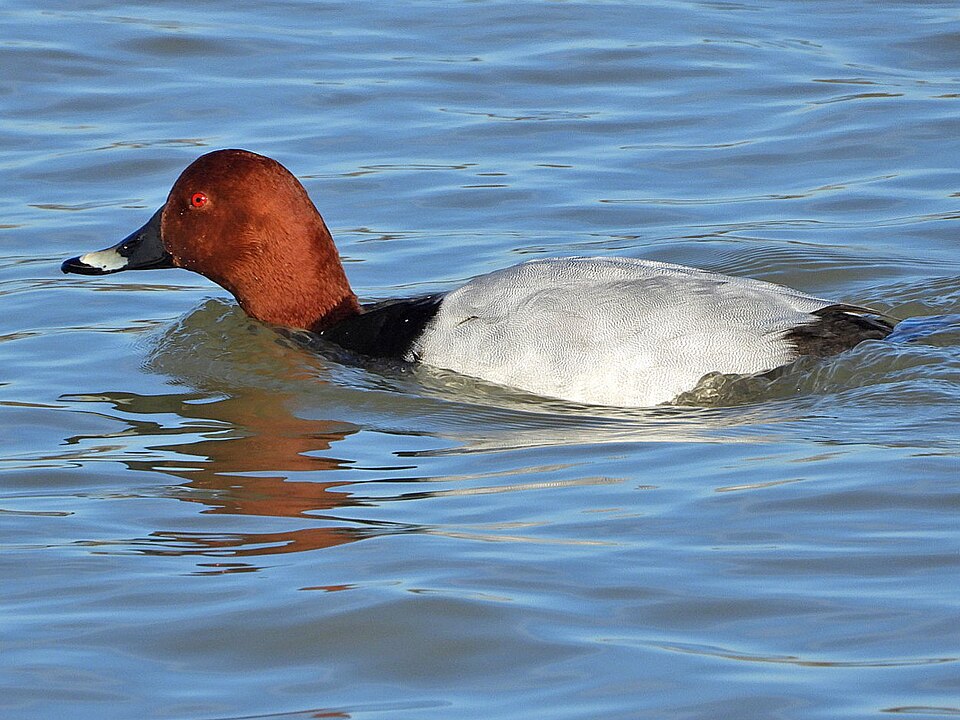
Common Pochard is a special case in this guide: an utterly ordinary duck across Europe and Asia, but in North America a rare wanderer found almost only in the western Aleutian Islands. The male has a rounded chestnut head, a grey body marked with such fine wavy lines that it looks plain pale grey at a distance, and a black breast and stern. Wherever it turns up in Alaska, it is usually mixed in among flocks of wintering diving ducks.
Voice
Common Pochard is a quiet duck. During display the male gives at most a soft whistle, barely louder than a sigh. When flushed the female answers with a soft, growling krrr, the only call most observers ever hear from this species. Beyond those two sounds, the species is usually silent in groups.
Recording: Stanislas Wroza — CC BY-NC-SA 4.0 · Etang de Beauregard, France · xeno-canto
Identification
The male has a rounded chestnut head, lacking the sloping profile of Canvasback, a black breast and stern, and a grey body marked with such fine wavy lines that it looks plain pale grey from a distance. The bill is grey with a broad black tip and a pale grey band between, and the eyes are red. The female is dull grey-brown on head and breast, with a faint pale patch around the base of the bill and a less distinct bill pattern. In flight Common Pochard shows a grey wing stripe and a compact, rounded silhouette.
Confusion species
In North America the key comparison is with Canvasback (Aythya valisineria): that species is larger, with a clearly sloping forehead running in one line into a long black bill, and a paler, whiter body than Common Pochard, whose head stays rounded and whose bill is much shorter. The female Common Pochard is also duller in colour and lacks the sharp pale facial markings some other diving ducks show. Because the species is so rare in North America, any record away from the western Aleutians is normally scrutinised carefully before it is accepted.
Habitat
In its core range across Europe and Asia, Common Pochard breeds on shallow, nutrient-rich lakes, slow rivers and artificial waters with abundant submerged vegetation, diving mainly for seeds, rhizomes and water plants. In winter it forms large, dense flocks on open water, often alongside other diving ducks. The occasional bird that turns up in North America is nearly always found on lakes and sheltered bays in the Aleutians, among flocks of other diving ducks.
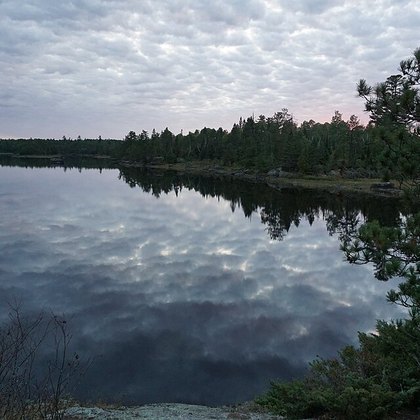
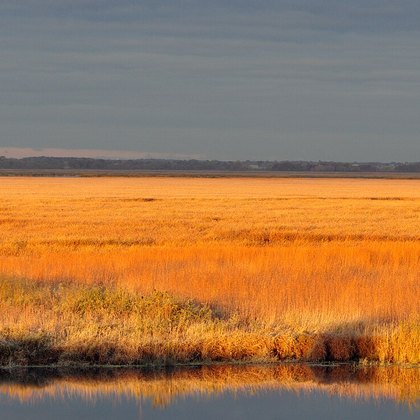
Where the bird is most often found, arranged by the USNVC — the vegetation classification of the United States and Canada — and CMECS for sea and coast.


Range and movements
Across Europe and Asia, Common Pochard breeds from the British Isles to Siberia and winters further south, reaching North Africa and Southeast Asia. In North America it reaches the guide area only as a wanderer, with most records from the western Aleutians of Alaska, where it is seen in roughly three years out of ten; occasional birds have also been reported in British Columbia, Saskatchewan and California. There is no regular wintering or passage population within the guide area.
Where and when to look
If you are in the western Aleutians, look for it among flocks of wintering diving ducks on open water; it stands out mainly through its plain grey body among species with sharper contrasts. Outside Alaska the chance of finding a Common Pochard in North America is so small that any record is immediate national news among birders.
Conservation
Common Pochard is listed as Vulnerable (VU) worldwide, mainly because of a steep decline in the large wintering population of western Europe: in the United Kingdom, wintering numbers fell by seventy-two per cent between 1998 and 2023. Causes include declining water quality, competition from non-native fish, and the disappearance of gull colonies that once protected pochard nests from predators. In North America itself the species is too rare to speak of a population of its own.
Scientific name
Aythya ferina | (Linnaeus, 1758)
Linnaeus described the species in 1758 as Anas ferina, among the ducks; because it was later placed in another genus, author and year stand in parentheses. The genus Aythya was introduced by Boie in 1822, after aithuia, a name Aristotle used for a seabird that cannot be identified with certainty. ferina is Latin for 'of game' or 'venison', referring to the pochard's long tradition as a hunted and eaten duck in Europe — the same tradition behind its Dutch name, 'tafeleend' ('table duck'). The type locality lies in Europe, restricted by Linnaeus himself to Sweden in 1761.