All species › Waterfowl › Ducks, swans and geese › Common Merganser
Common Merganser | Mergus merganser
Grote zaagbek | Serreta grande
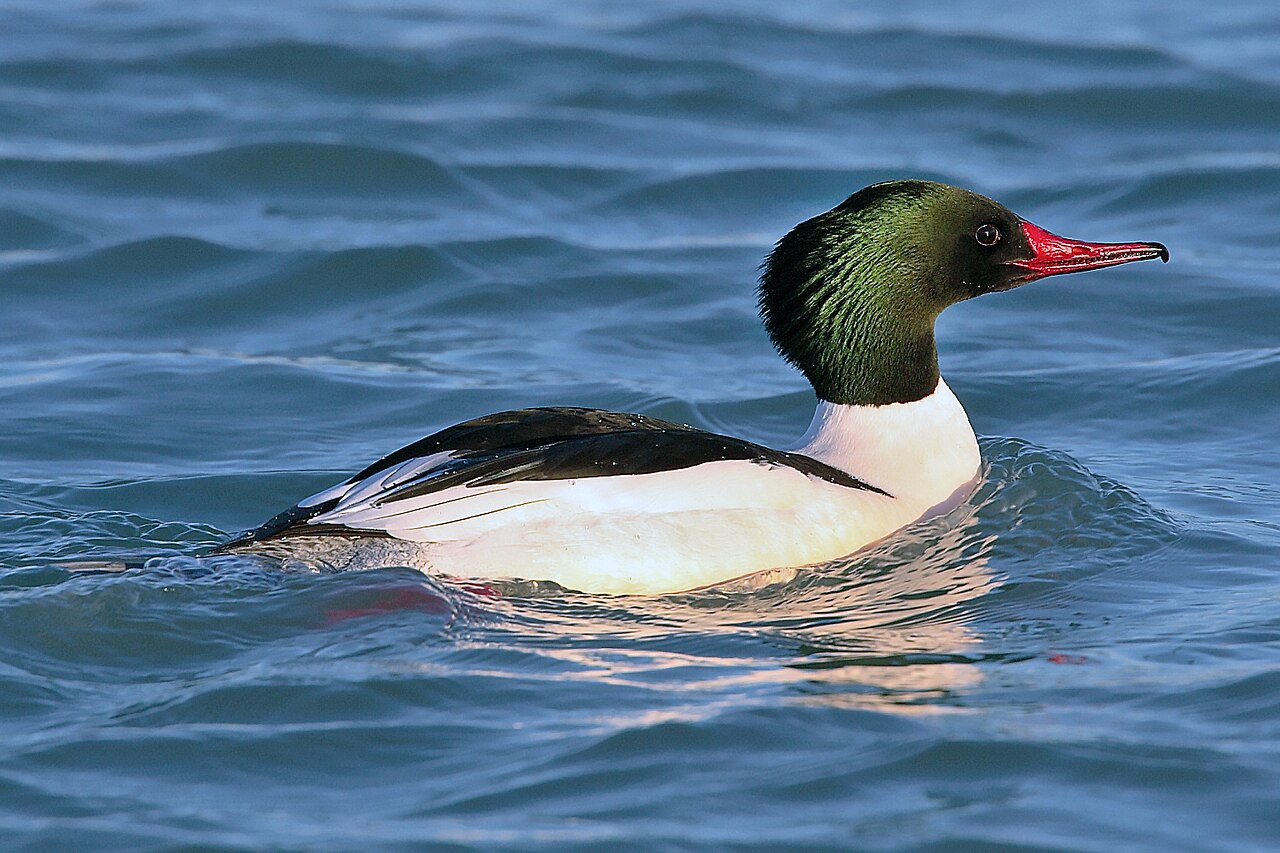
Common Merganser is the largest and heaviest merganser in this guide, built with the heavy, streamlined bulk of a true fish hunter. The male has a smooth, glossy dark green head with no crest, a pure white body with a faint salmon-pink flush, and a long, thin, orange-red bill with a sharp serrated edge. It breeds along fast-flowing rivers and clear lakes in coniferous forest, and is often the last waterbird to leave in autumn and the first to return in spring.
Voice
Outside the breeding season Common Merganser is largely silent. The female calls her ducklings together with a high, rapid cro-cro-cro, and gives a hoarse gruk when threatened. The male gives a hoarse call when alarmed and produces a bell-like or twanging sound during courtship. In flight the wings make a hollow, rushing sound audible from a distance.
Recording: Stanislas Wroza — CC BY-NC-SA 4.0 · Tolpanniemi, Finland · xeno-canto
Identification
The male has a smooth, glossy dark green head with no crest, a white body with a faint salmon-pink flush, a black back and a long, thin, orange-red bill with a sharp serrated edge. The female is grey with a rich rust-brown, sleek crest and a sharply defined white throat patch that meets the head abruptly — a clear difference from Red-breasted Merganser. Both sexes have red eyes and the same thin, saw-edged bill. Common Merganser is heavily built with a thick neck, flying low over the water in straight lines with a fast, powerful wingbeat.
Confusion species
The female is most often confused with that of Red-breasted Merganser (Mergus serrator): in Common Merganser the rust-brown head meets a clean white throat patch along a sharp line, while in Red-breasted Merganser that border fades gradually. Common Merganser is also heavily built with a thick neck, against the slimmer build of Red-breasted Merganser. Hooded Merganser (Lophodytes cucullatus) is much smaller and has a short, dark bill lacking the long serrated edge of the other two mergansers.
Habitat
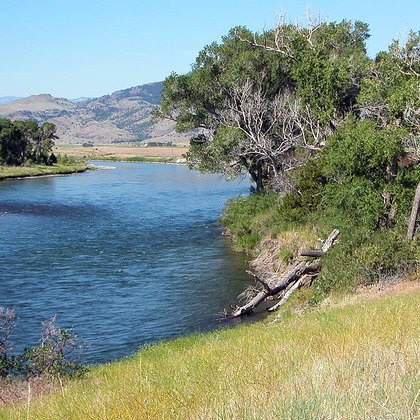
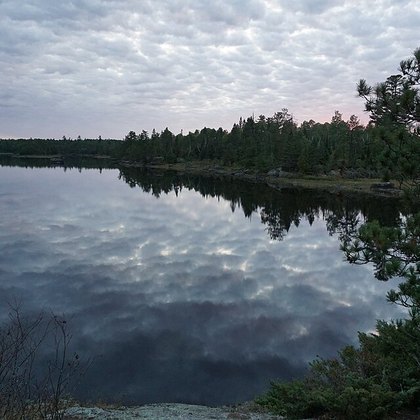
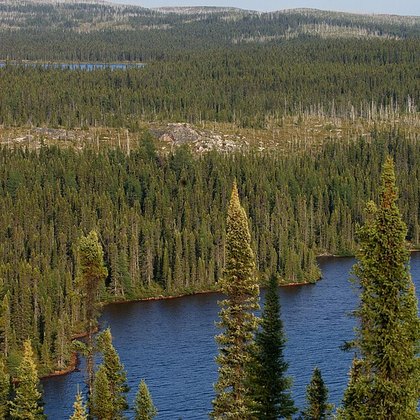
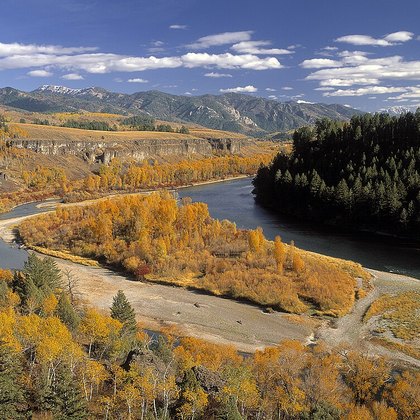
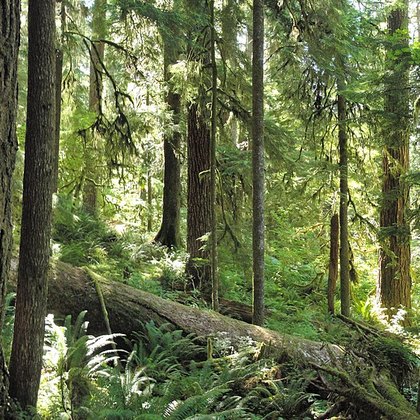
It breeds along fast-flowing rivers and clear lakes in mature coniferous forest, where old trees with cavities are essential for the nest site. It hunts mainly fish — salmon and trout foremost — supplemented with aquatic insects, frogs and occasionally small mammals or birds. In winter it gathers on large, ice-free lakes, rivers and reservoirs, favouring fresh water over salt, though along the coast it also uses sheltered bays.
Where the bird is most often found, arranged by the USNVC — the vegetation classification of the United States and Canada — and CMECS for sea and coast.
Range and movements
Breeds across nearly the whole boreal reach of North America, from Alaska to Newfoundland, south into the mountains of the western United States. Along the west coast, from British Columbia to California, it is largely resident; inland, most birds leave as soon as their water freezes over, heading for large, ice-free waters in the southern United States and northern Mexico. Coastal birds move only short distances in this way, while interior birds can travel much further.
- Resident
- Breeding (summer)
- Winter
- Passage
- dark = core range, pale = thinly spread
Where and when to look
Look for it on clear rivers and large lakes in coniferous forest, where small groups often swim single file downstream, hunting fish together. In winter large flocks concentrate on the last ice-free waters, sometimes only once almost everything around them has frozen over.
Conservation
Partners in Flight estimates the North American population at nearly 1.9 million breeding birds, with steady numbers between 1966 and 2019 — the species is listed as Least Concern (LC). Because it depends on old trees with cavities along clean, fish-rich rivers, forestry that leaves that kind of streamside woodland standing remains important to it.
Scientific name
Mergus merganser | Linnaeus, 1758
Linnaeus described the species in 1758 as Mergus Merganser, in the same genus it still occupies, hence no parentheses around author and year. Mergus is Latin for 'diver', a name already used by the Roman writer Pliny for a diving waterbird; merganser is a contraction of mergus and anser, Latin for 'goose' — literally 'diving goose', after the bird's heavy build. The type locality lies in Europe, restricted by Linnaeus himself to Sweden in 1761.