All species › Gamebirds › Partridges, pheasants, grouse and allies › Chukar
Chukar | Alectoris chukar
Aziatische steenpatrijs | Perdiz chukar
Chukar is originally a bird of the dry mountains between Greece and the Himalaya, but in North America it is best known as the partridge of the American West: released as a gamebird since the 1930s, it has become firmly established across ten western states and parts of British Columbia. On the steepest, barest rock slopes of the Great Basin it is now the commonest gamebird to be found.
Voice
The name is the call: a loud, fast-repeated chuk-chuk-chukar-chukar, which rings out over the canyons from rocks and hilltops morning and evening and gave the bird its English name. When flushed a shrill, excited cackling breaks out as the covey drops downhill on short, whirring wingbeats. Outside the breeding season small groups keep in touch with a softer, muffled chuckling. Early in spring, as males stake out territory, the call is heard most persistently.
Recording: Stanislas Wroza — CC BY-NC-SA 4.0 · Lesvos - Haramida, Greece · xeno-canto
Identification
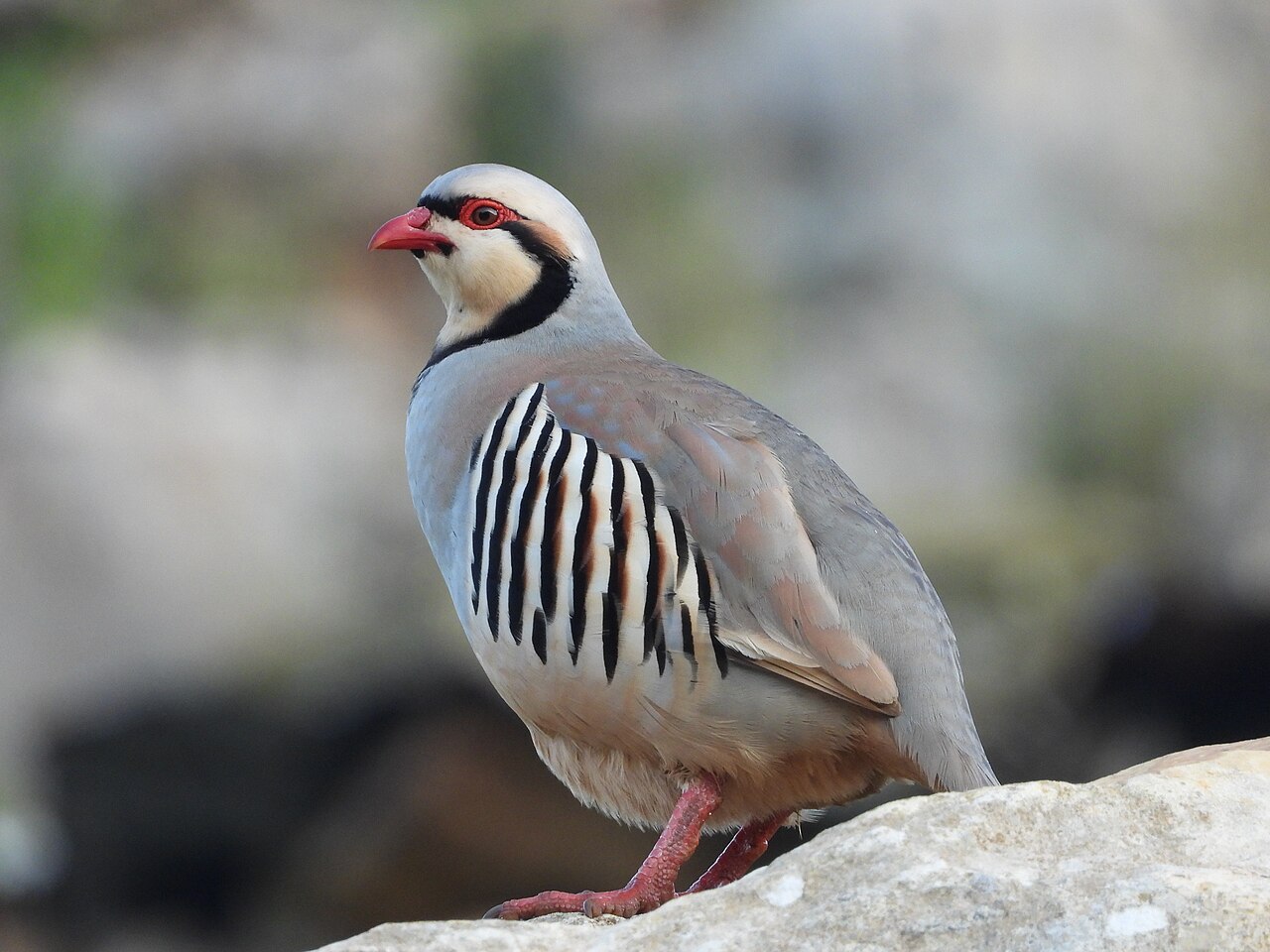
A stocky, sandy-coloured gamebird with a sharp black band running from the forehead through the eye to the neck, enclosing a creamy throat patch. The flanks are boldly barred black, white and chestnut, the bill and eyering are coral red, and the legs share that colour. Male and female look almost alike, though the male is slightly larger and carries a small spur. Young birds lack the sharp head band and are vaguely marked. On the ground it would rather walk or run than fly, and when danger comes it drops down the slope with a shrill cry and short, fast wingbeats.
Confusion species
Rock Partridge (Alectoris graeca), its closest relative in southern Europe, does not occur in North America and is therefore no source of confusion here; the two are nearly identical and are told apart mainly by call and range. Within its North American range it is most often confused with Gray Partridge (Perdix perdix), which is smaller and rounder, has a plain brown head without the black eye-band, and carries a horseshoe-shaped belly patch. Himalayan Snowcock, which shares the same ranges in Nevada, is far larger and plain grey without the sharp black-and-white head pattern. Released Ring-necked Pheasants (Phasianus colchicus) share the edge of its habitat but are much bigger, with a long pointed tail that Chukar lacks.
Habitat
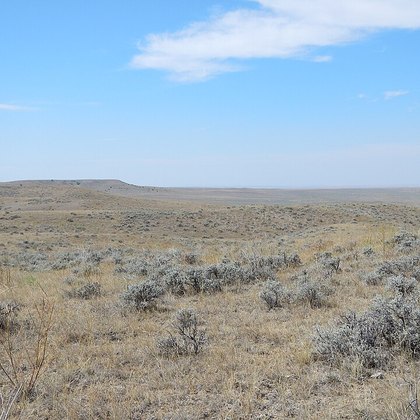
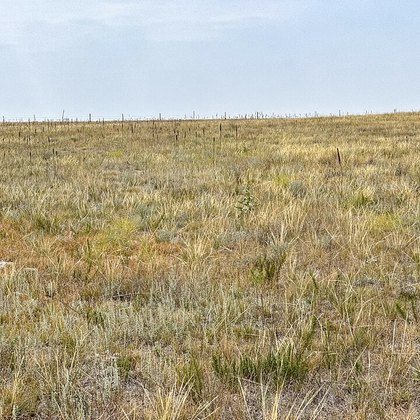
It seeks dry, steep, rocky slopes with scattered shrubs and grasses, especially where sagebrush steppe gives way to bare rock faces and scree. Water need not be within daily reach, but in summer it is rarely far from a spring or a stream in a ravine. It avoids dense forest, closed grassland and farmland alike; what it needs is cover among the rocks combined with an open view of its surroundings. On Hawaii it occupies similarly dry, rocky terrain on the higher slopes of the volcanoes.
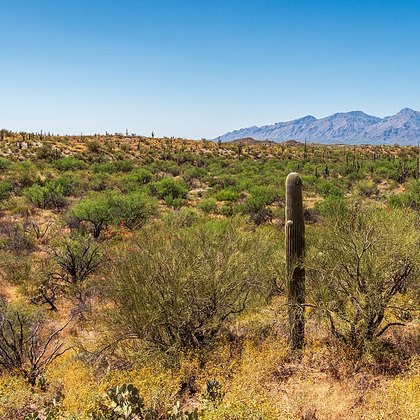
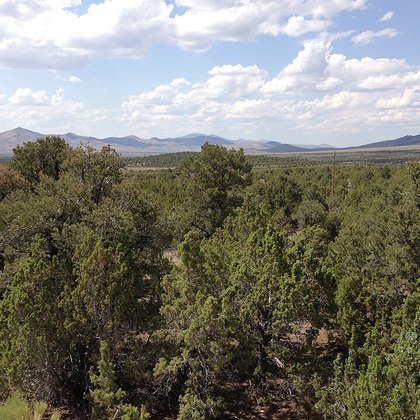
Where the bird is most often found, arranged by the USNVC — the vegetation classification of the United States and Canada — and CMECS for sea and coast.

Range and movements
Resident across the dry American West, from Washington and Oregon through the Great Basin — Nevada, Idaho and Utah foremost — to California, Colorado and Wyoming, with an established population also in southern British Columbia, plus the higher, dry slopes of Hawaii. The first introductions, with birds from Pakistan, date to 1893 and failed; only the releases between 1931 and 1970 took hold, bringing the species to a self-sustaining population across ten western states. It does not migrate and disperses at most over short distances, but fills every suitable rocky slope within a district.
- Resident
- Breeding (summer)
- Winter
- Passage
- dark = core range, pale = thinly spread
Where and when to look
Look for it early in the morning on the bare, sagebrush-covered slopes of the Great Basin, and listen first: the call carries far across a ravine and betrays a covey long before you see it. A flushed covey rarely flies far — it drops downhill and vanishes again among the rocks, so a second look is often still possible.
Conservation
Not threatened worldwide (LC), with a stable population estimated at eight million birds; in North America it ranks among the most heavily hunted gamebirds of the West, and numbers have stayed stable since the 1960s. Drought and the loss of sagebrush steppe to farming and development are the chief pressures in parts of its range. Many states still release farm-reared birds each year to cushion hunting pressure.
Scientific name
Alectoris chukar | (Gray, 1830)
Gray described the species in 1830 as Perdix Chukar, among the partridges; because it was later moved to another genus, author and year stand in parentheses. The genus Alectoris comes from Greek alektoris, 'hen'. The specific name chukar is taken from Hindi cakor, itself an imitation of the call. The type locality is given as Srinagar in Kumaon, though Gray himself named only 'India'.