All species › Passerines › New World warblers › Cerulean Warbler
Cerulean Warbler | Setophaga cerulea
Azuurzanger | Reinita cerúlea
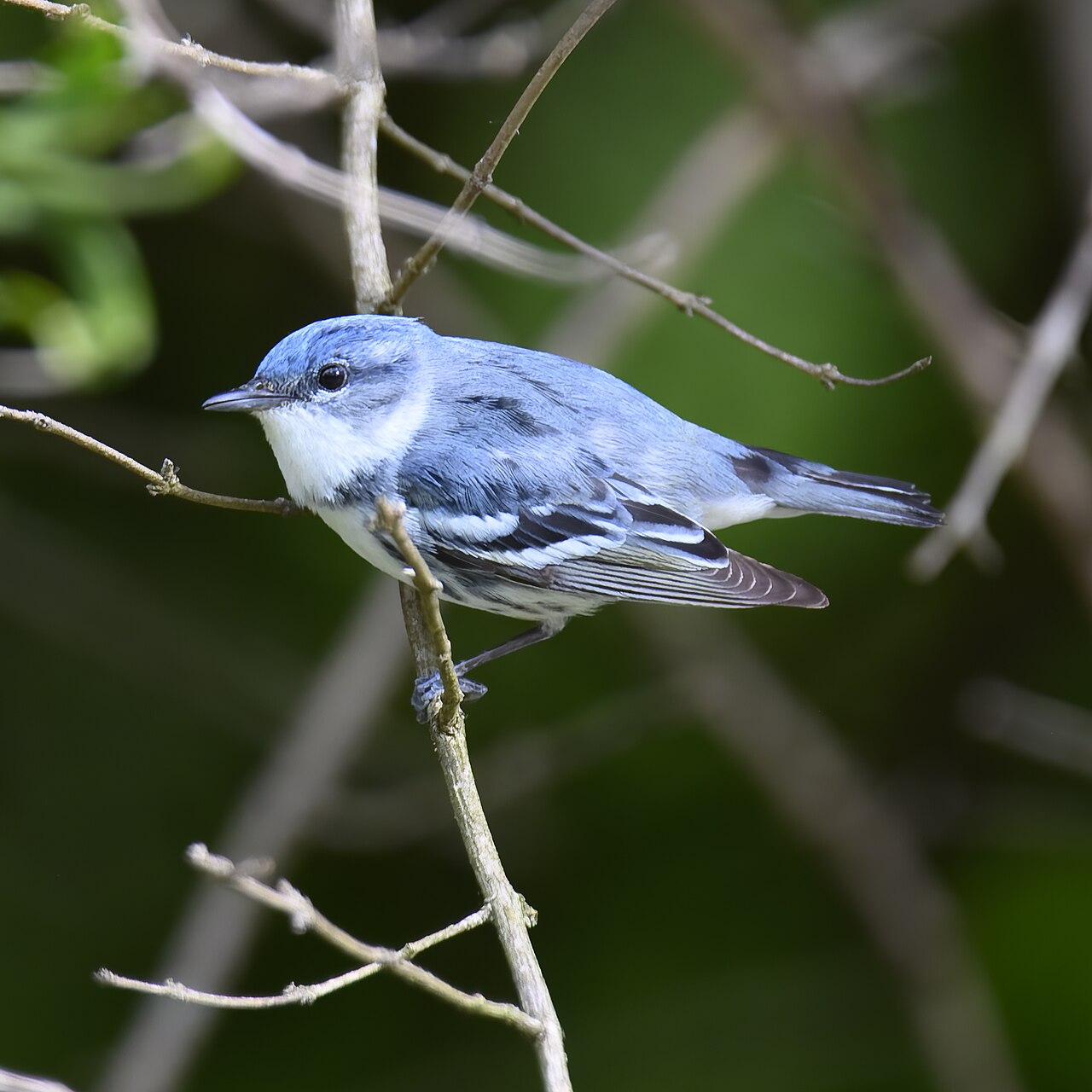
The Cerulean Warbler lives in the tops of mature deciduous forest and is therefore heard more often than seen. The male is sky-blue above and white below, with a narrow blue band across the breast. The species has declined more steeply than any other migratory songbird of the east and is listed as Near Threatened.
Voice
The song is a short, buzzy series that accelerates and ends on a single high, sustained buzz: zray zray zray zi-zi-zi zeeee. It is thin and high, and is often masked in forest with much background noise. The ending is the best mark, since the introductory notes resemble those of Northern Parula and Black-throated Green Warbler. The call is a short, flat chip; the female rarely sings but calls a great deal at the nest.
Recording: Matt Wistrand — CC BY-NC-SA 4.0 · Mississippi Palisades State Park (near Savanna), Carroll, Illinois, United States · xeno-canto
Identification
A small, short-tailed warbler. The male is bright sky-blue on crown, back and wing coverts, white on throat and belly, with a narrow blue-black band across the breast and blue-black streaks along the flanks; two broad white wing bars and white spots in the tail. The female is blue-green to turquoise above and yellowish-white below, with a pale supercilium running behind the eye and the same two white wing bars. It forages almost entirely high in the canopy and often builds its nest twenty metres or more above the ground, on a lateral branch.
Confusion species
The male Black-throated Blue Warbler is darker blue and has a black throat and black flanks rather than a blue breast band. Blue-grey Gnatcatcher has a long white-edged tail and no wing bars. Females and autumn birds are the real challenge: a female Cerulean differs from Tennessee Warbler in the two white wing bars, from autumn Blackpoll Warbler in its green-blue rather than olive back and short tail, and from Blackburnian Warbler in lacking the orange or yellowish throat and the dark cheek patch.
Habitat
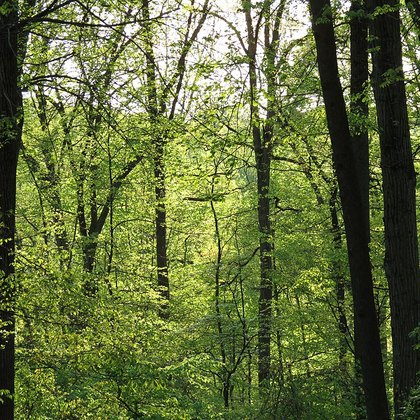
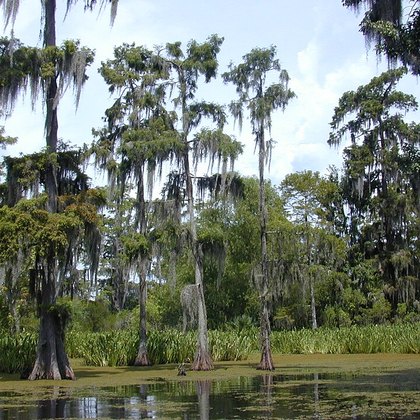
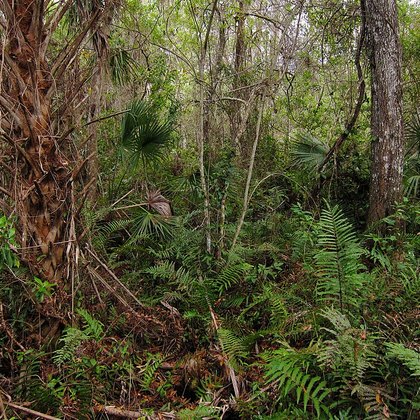
Large unbroken tracts of mature deciduous forest with tall, wide-crowned trees and a layered canopy: slope forest and ridges in the Appalachians, and floodplain and swamp forest in the Mississippi valley. Woodlands under a few hundred hectares rarely hold a population. In winter it occupies the eastern slope of the Andes, in montane forest and shade-coffee plantations roughly between 500 and 2000 metres.
Where the bird is most often found, arranged by the USNVC — the vegetation classification of the United States and Canada — and CMECS for sea and coast.
Range and movements
The breeding range lies in eastern North America, with its core in the Appalachians of West Virginia, Kentucky, Tennessee and Ohio, and further west in the Ozarks and around the Great Lakes to southern Ontario. The wintering range falls largely outside the area covered by this guide: the eastern Andes from Colombia and Venezuela south to Bolivia. On migration it passes through Texas, the Gulf coast and Central America, largely overland in spring and partly across the Caribbean in autumn. Migration is early: by July the first birds are already moving south.
- Breeding (summer)
- Winter
- Passage
- dark = core range, pale = thinly spread
Where and when to look
Look for it in the first half of May on a forested ridge or a forest road where you can look into the canopy at eye level, and listen for the high final buzz. A viewpoint over a wooded valley pays better than walking under closed forest, where the bird sits directly overhead and you see only a silhouette.
Conservation
The IUCN places the species in the Near Threatened category (NT). Partners in Flight puts the breeding population at about 530,000 birds, with a measured decline of some 68 per cent between 1966 and 2023; recent decades have run more stably and the 2025 State of the Birds report gives it a yellow alert. The causes lie at both ends of the flyway: logging and mountaintop-removal mining in Appalachian breeding forest, and conversion of shade coffee and montane forest in the Andes. A reserve has been set up for the species in Colombia; in the United States it was decided in 2006 not to list it under the Endangered Species Act.
Scientific name
Setophaga cerulea | (Wilson, 1810)
Alexander Wilson described the species in 1810 as Sylvia cerulea, from a specimen taken in Pennsylvania; its later placement in Setophaga puts author and year in parentheses. Setophaga comes from Ancient Greek ses 'moth' and phagos 'eating'. The species name cerulea goes back to Latin caeruleus 'sky-blue', the colour of the male; Wilson wrote the name with a single a and that spelling has been retained. The English, Dutch and Spanish names all three name the same colour.