All species › Passerines › Shrike-babblers, Erpornis and vireos › Cassin's Vireo
Cassin's Vireo | Vireo cassinii
Cassinvireo | Vireo de Cassin
Cassin's Vireo is the western member of the three species treated until 1997 as a single Solitary Vireo, and sits between the other two in colour: greyer than Blue-headed, greener than Plumbeous. It breeds in open, dry woodland from southern British Columbia to California and winters along the Pacific side of Mexico.
Voice
The song is a series of short, rough-whistled phrases of a few notes each, separated by about two seconds, kept up at the same pace for hours. Phrases end alternately high and low, giving a question-and-answer pattern. The tone is burrier than Blue-headed Vireo's and less hoarse than Plumbeous Vireo's, though the three overlap enough that one phrase is often not decisive. When agitated it gives a fast scolding rattle and a series of hard cha-cha-cha notes.
Recording: Scott Olmstead — CC BY-NC-SA 4.0 · Rock Corral Canyon, Santa Cruz County, Arizona, United States · xeno-canto
Identification
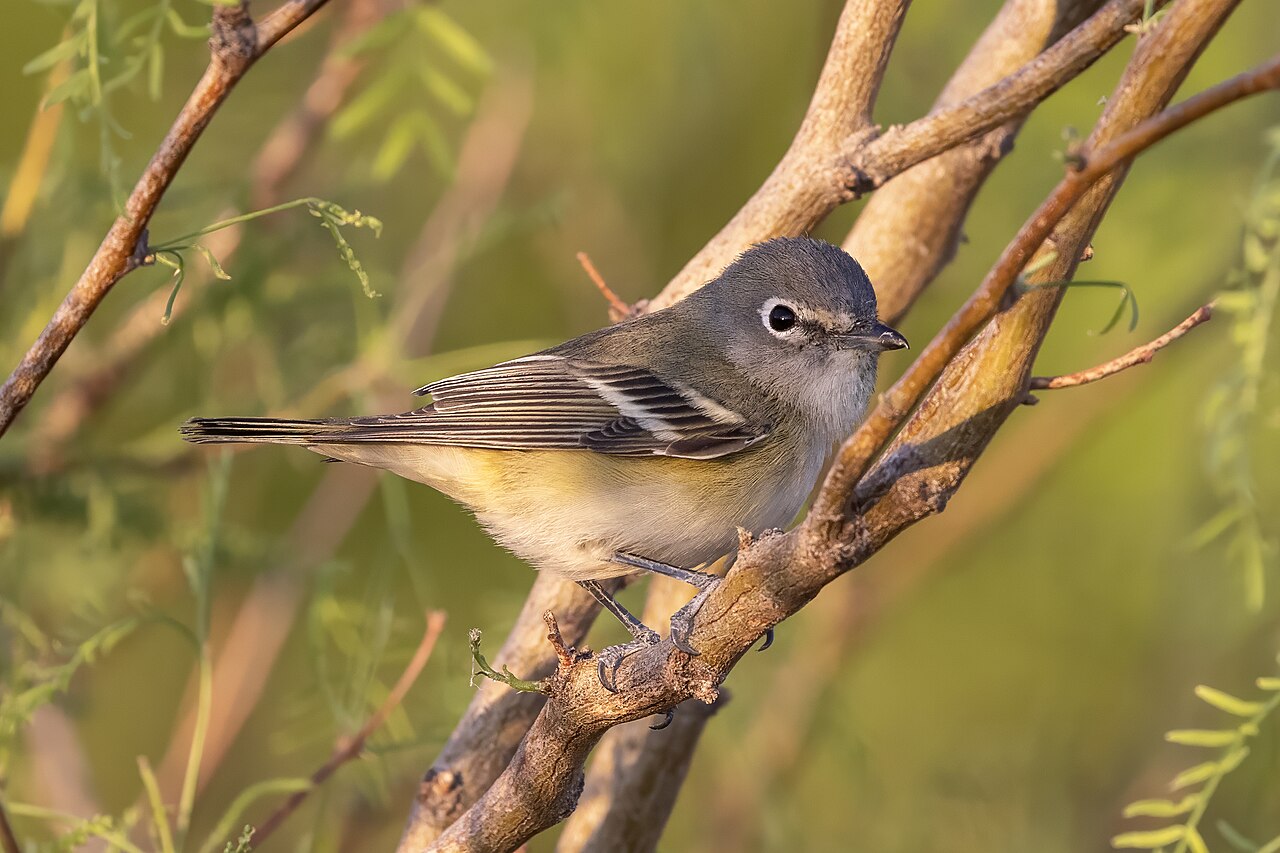
A medium-sized vireo with a thick bill and blue-grey legs. Head, nape and flanks are grey-green, throat and belly whitish, with a yellow-green wash on the flanks. White spectacles surround the eye and continue onto the lores; the contrast with the head is less sharp than in Blue-headed. The mantle is dull olive-green, the wing carries two white bars and the secondaries have pale edges. The sexes are alike; females and autumn birds average duller and greyer. It forages methodically in the lower and middle levels of the tree, gleaning leaves and twigs and occasionally hawking an insect in flight.
Confusion species
Blue-headed and Plumbeous Vireo are the immediate relatives. Cassin's has a grey-green head that contrasts only weakly with the whitish throat, while Blue-headed has a blue-grey head standing sharply against a clean white throat; Blue-headed also has brighter white spectacles and yellower flanks. Plumbeous is larger and longer-tailed, entirely grey with no olive on the mantle, with broader and whiter spectacles and at most a trace of yellow on the flanks. Range helps only partly, since in Arizona and New Mexico migrant Cassin's pass through the breeding range of Plumbeous. Hutton's Vireo is smaller, has a broken eyering instead of complete spectacles, and lacks the contrasting white throat.
Habitat
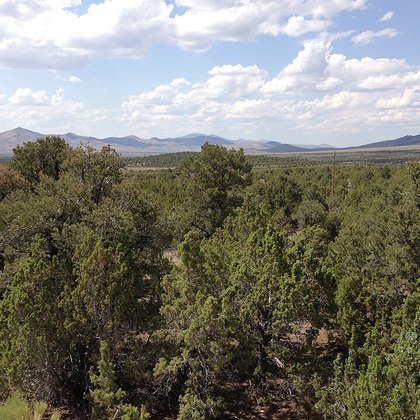
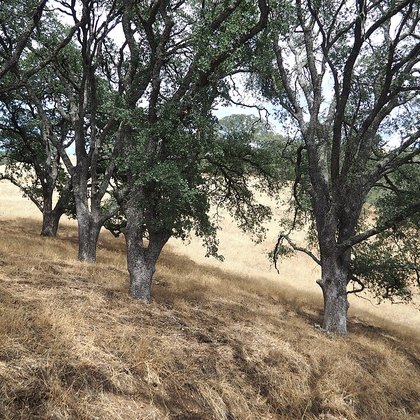
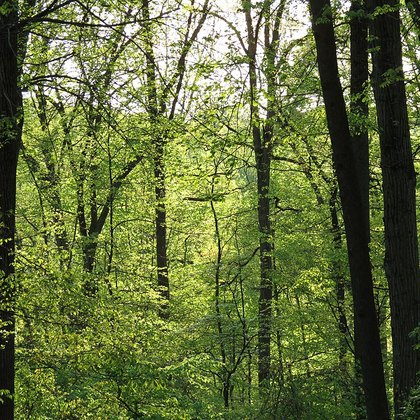
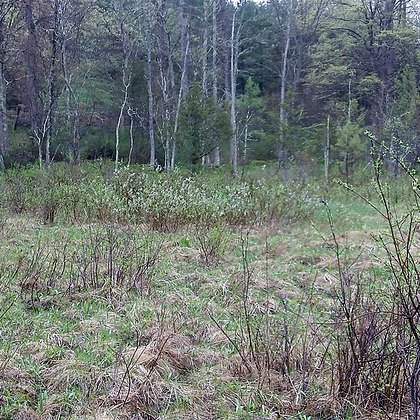
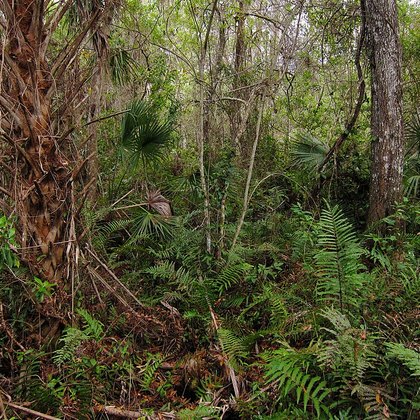
Fairly dry and open woodland in western mountains and foothills, from sea level to about 2400 metres: ponderosa pine, Douglas-fir, Oregon oak, and mixed conifer-deciduous stands along streams. Continuous dense timber is avoided in favour of stands with an open canopy and a shrub layer. In Mexico it winters in tropical deciduous forest, riparian woodland, thorn scrub and desert washes.
Where the bird is most often found, arranged by the USNVC — the vegetation classification of the United States and Canada — and CMECS for sea and coast.

Range and movements
Breeds from southern British Columbia through Washington, Oregon, Idaho, western Montana, Nevada, Utah and California to the Sierra de San Pedro Mártir of Baja California. It winters along the Pacific side and the southwest of Mexico, from Sonora and Baja California Sur south to Guerrero and Oaxaca, with smaller numbers inland in Durango and Zacatecas. Through Arizona, New Mexico, Colorado and West Texas it occurs on passage. Autumn migration is late, with many birds still moving in October.
- Resident
- Breeding (summer)
- Winter
- Passage
- dark = core range, pale = thinly spread
Where and when to look
Look for it in May in open ponderosa pine or oak woodland and go by ear: short, rough phrases with a good two seconds between them, slower and burrier than a Red-eyed Vireo's song. On a silent bird, check the throat — a soft border between head and throat means Cassin's, not Blue-headed.
Conservation
Partners in Flight puts the breeding population at about 5 million birds and gives the species a Continental Concern Score of 9 out of 20, which counts as low concern. The Breeding Bird Survey shows an increase of about 1 per cent per year between 1968 and 2015. Locally, Brown-headed Cowbird parasitism depresses breeding success, particularly in fragmented woodland; deforestation on the Mexican wintering grounds is the other pressure.
Scientific name
Vireo cassinii | Xántus, 1858
János Xántus described the species in 1858 as Vireo cassinii, from a specimen taken at Fort Tejon, California; since it has never changed genus, author and year stand without parentheses. The species name honours John Cassin, a nineteenth-century ornithologist at the Academy of Natural Sciences in Philadelphia. Until 1997 the bird was treated as a subspecies of Vireo solitarius. The genus Vireo was introduced in 1808 by Vieillot, from Latin vireo, the name of a green bird.