All species › Passerines › Crows, jays and magpies › California Scrub-Jay
California Scrub-Jay | Aphelocoma californica
Westelijke struikgaai | Chara californiana
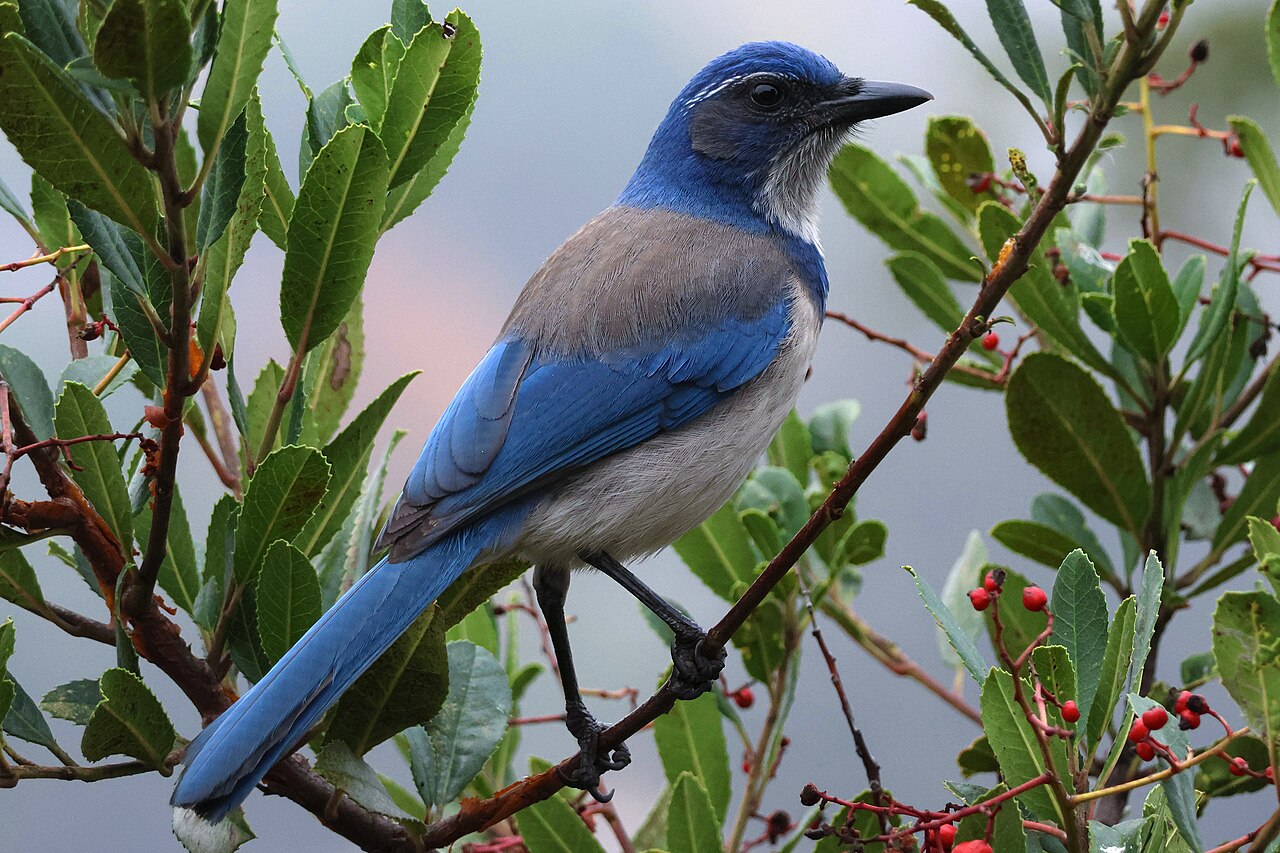
The California Scrub-Jay is the jay of the dry Pacific lowlands, from Washington to Baja California. It is crestless, blue with a grey-brown back, and comes into gardens and parks. The species stores acorns in thousands of separate caches and recovers them months later.
Voice
The commonest sound is a harsh, rasping shreek, usually in series of three to six and rising in pitch. There is also an upslurred weep, a dry rattle, and a soft, prolonged murmur audible only at close range. About twenty distinct call types have been described, including a separate call given on sighting a raptor. There is no true song.
Recording: Bobby Wilcox — CC BY-NC-SA 4.0 · Apple Orchard Spring, Washoe County, Nevada, United States · xeno-canto
Identification
A slim, long-tailed jay without a crest. Head, wings and tail are deep blue, the back grey-brown, the underparts pale grey with a white throat enclosed by a blue necklace. A white eyebrow runs above the eye, a dark mask through it. The breast band is well developed and usually almost continuous. The bill is heavy and hooked at the tip — a shape that allows acorns to be broken open. In flight it alternates rapid wingbeats with short glides and holds the tail long and straight.
Confusion species
Until 2016 this species, Woodhouse's Scrub-Jay and the Island Scrub-Jay were treated as one species, the Western Scrub-Jay. Woodhouse's is paler and duller blue, has greyer underparts, barely any breast band and a straighter, more pointed bill; its calls are higher pitched. The two meet in western Nevada, where careful looking is needed; elsewhere range settles it, since Woodhouse's lies east of the Sierra Nevada. The Island Scrub-Jay is larger, deeper blue and heavier-billed, and occurs only on Santa Cruz Island. Steller's Jay has a black crested head. Pinyon Jay is uniformly grey-blue without white throat or breast band, and short-tailed.
Habitat
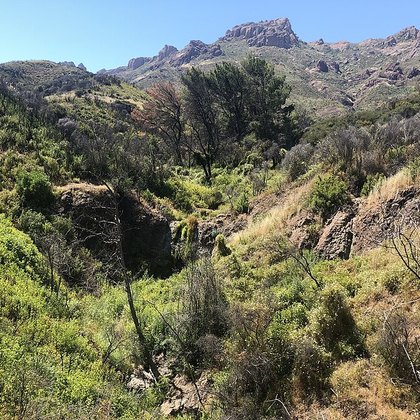
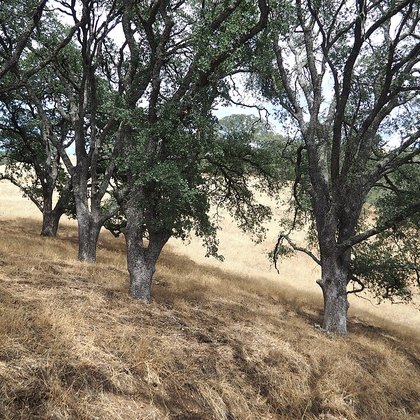
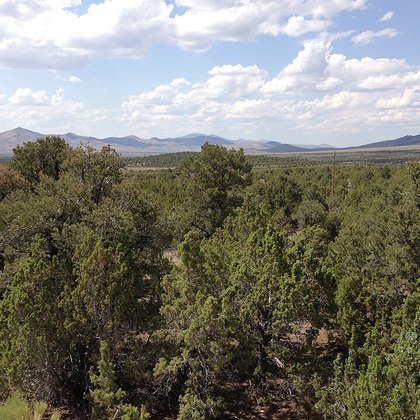
Dry scrub, chaparral (dense, hard-leaved scrub of California's Mediterranean climate), oak woodland and the edges of mixed evergreen forest in the lowlands, and beyond that gardens, parks, street trees and orchards. Dense shrubs and small trees provide the nest; large oaks provide the food. Unbroken conifer forest at altitude it avoids; that is Steller's Jay country. In the northern half of the range it has expanded along settled land.
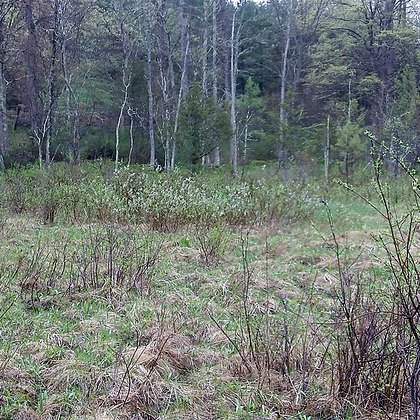
Where the bird is most often found, arranged by the USNVC — the vegetation classification of the United States and Canada — and CMECS for sea and coast.



Range and movements
Resident along the Pacific seaboard, from southwestern British Columbia and western Washington through Oregon and California into Baja California, and east to the western slope of the Sierra Nevada and western Nevada near Reno. Through the twentieth and twenty-first centuries the northern edge moved: Washington was occupied and by 2020 the species reached the Puget Sound region. There is no migration; young birds usually settle close to where they hatched.
- Resident
- Winter
- Passage
- dark = core range, pale = thinly spread
Where and when to look
In any Californian front garden with an oak or a feeder it can be found within the hour, all year. Where Woodhouse's is possible, check the breast band and the bill: a continuous blue band and a thick, hooked bill point to this species. In autumn birds carrying an acorn can be followed to the spot where they bury it.
Conservation
The species is listed as Least Concern (LC) and numbers are broadly stable or rising; the northward expansion continues. West Nile virus depressed numbers locally, especially in California's Central Valley. Clearance of oak landscape for building costs habitat, but the species holds on in suburbs with mature planting. Monitoring rests largely on the Breeding Bird Survey and the Christmas Bird Count.
Scientific name
Aphelocoma californica | (Vigors, 1839)
Nicholas Aylward Vigors described the species in 1839 as Garrulus californicus, from a specimen taken at Monterey in California; because it was later moved to another genus, author and year stand in parentheses. Aphelocoma comes from Greek apheles 'simple, smooth' and komē 'head of hair', after the plain, unbarred plumage. The species name californica is Latin for 'from California'. The English name changed in 2016 from Western Scrub-Jay to California Scrub-Jay when the species was split three ways.