All species › Tubenoses › Petrels, shearwaters and diving petrels › Buller's Shearwater
Buller's Shearwater | Ardenna bulleri
Bullers pijlstormvogel | Pardela dorsigrís
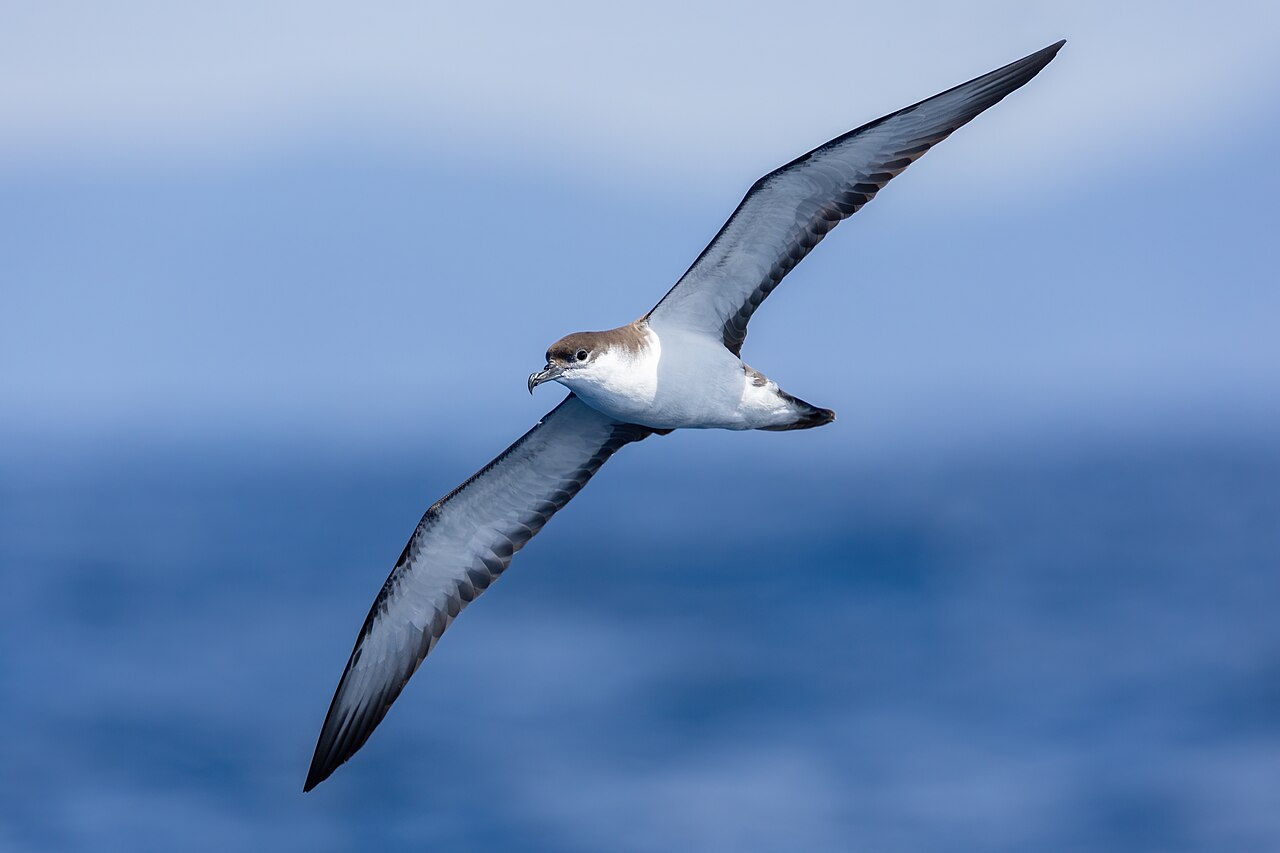
Buller's Shearwater is an elegantly patterned seabird with a sharply defined dark M across pale grey upperparts, quite unlike the uniformly toned shearwaters it often flies with. It breeds almost entirely on the Poor Knights Islands off New Zealand and, after breeding, crosses the whole Pacific to the west coast of North America. Despite a population of over a million birds it is listed as Vulnerable (VU), because in effect the whole species depends on one breeding site.
Voice
At the colony a harsh, cackling screech rises from the burrows at night, as partners find each other in the dark; by day it falls silent, since the birds are then out at sea. Outside the breeding season, including off North America, the species is essentially silent. On a boat trip the most you will hear is the soft clap of its wings lifting off the water.
Recording: Sophie Bennett — CC BY-NC-SA 4.0 · Whangarei District, Northland, New Zealand · xeno-canto
Identification
The upperparts are pale grey with a sharp dark brown pattern forming a broad M across the back and wings, a feature that stands out even at distance. The head carries a dark cap sharply set off against the white throat and underparts, and the tail is pointed and dark with a pale tip. Flight is light and buoyant, with long glides on stiffly held, slightly swept-back wings. There is no colour morph and the sexes look alike; juveniles resemble adults.
Confusion species
The main confusion is with Pink-footed Shearwater (Ardenna creatopus), which shares the same waters and season but has uniformly brownish upperparts without a sharp M pattern, along with a pink bill tipped black. At greater range the smaller Cook's Petrel can also cause confusion, but it has a much smaller, slimmer bill and a faster, fluttering flight. The sharp, high-contrast upperpart pattern remains the best mark for Buller's Shearwater.
Habitat
Outside the breeding season the species stays over open ocean water, favouring the transition zones where cold and warm currents meet and bring food to the surface. It rarely comes close to shore and is almost always seen from a boat, well out of sight of the beach. At the colony itself the habitat is steep, forested island slopes into which the birds dig their nesting burrows.
Where the bird is most often found, arranged by the USNVC — the vegetation classification of the United States and Canada — and CMECS for sea and coast.

Range and movements
The entire world population breeds on the Poor Knights Islands off the northeastern coast of New Zealand's North Island, where a recent survey counted nearly eighty thousand occupied burrows. After breeding, birds head north across the Pacific in May to the west coast of North America, where they stay from June to November with a clear peak in September and October, before returning to New Zealand in autumn. They can then be seen off the coasts of California, Oregon and Washington.
- Breeding (summer)
- Winter
- Passage
- dark = core range, pale = thinly spread
Where and when to look
Join a boat trip out of Monterey Bay or off the Washington coast in September or October and watch for the sharp, high-contrast M pattern on the back: it shows at considerable range, even among flocks of other, more uniformly toned shearwaters. The species rarely approaches close to the boat and usually keeps circling at some distance.
Conservation
With nearly eighty thousand occupied burrows on the Poor Knights Islands and an estimated world population of over a million birds, the numbers are not small in themselves, but because almost the whole species depends on one protected island group, it is listed as Vulnerable (VU): a single disaster there could affect the entire species. Fisheries bycatch along the long trans-Pacific migration route is the main known threat away from the colony.
Scientific name
Ardenna bulleri | (Salvin, 1888)
Salvin described the species in 1888 as Puffinus bulleri; because it was later moved to another genus, author and year stand in parentheses. The genus Ardenna was established by Reichenbach in 1853. The species name honours Walter Buller, a nineteenth-century New Zealand lawyer and ornithologist whose standard work on the birds of New Zealand made him the leading authority on the subject. The type locality is simply New Zealand.