All species › Swifts › Hummingbirds › Buff-bellied Hummingbird
Buff-bellied Hummingbird | Amazilia yucatanensis
Yucatankolibrie | Amazilia de Yucatán
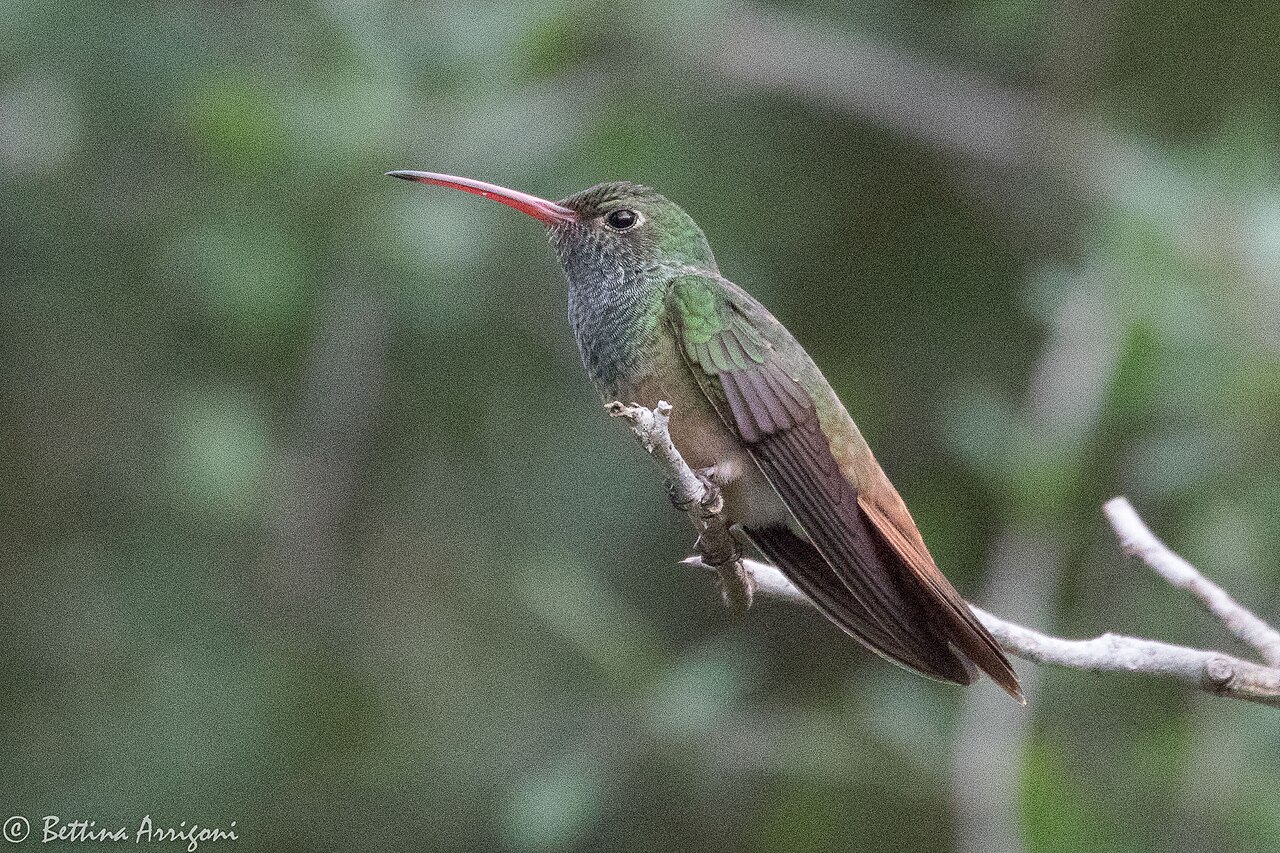
The Buff-bellied Hummingbird is the only hummingbird that stays all year in the far south of Texas and nests there. By hummingbird standards it is large and heavily built, with a coral-red bill and a pale buff belly that separate it from every other hummingbird of the Gulf Coast. Outside the breeding season part of the population moves northeast along the coast — the opposite of what one expects a hummingbird to do.
Voice
The voice is thin and clipped: a dry tik or tik-k dropped between one flower and the next, and a two-syllable tsi-wee during display flights. Driving off an intruder turns this into a long, low rattle of rapidly repeated notes. There is no true song; what passes for one at a distance is an irregular twittering from a favoured perch above the scrub. The hum of the wings is low and heavy for a hummingbird and is often the first thing noticed in a quiet garden.
Recording: Manuel Grosselet — CC BY-NC-SA 4.0 · Chemuyil predio el venado Tulum, Quintana Roo, Mexico · xeno-canto
Identification
The upperparts are metallic bronze-green, duller on the crown; throat and breast glitter yellow-green to emerald, and the belly and undertail coverts are warm buff to cinnamon — the mark that works in any light. The tail is rufous with a bronze-green tip and keeps moving while the bird hovers at a flower. The gloss on the throat is not pigment but interference colour from the layered structure of the barbules: with the light from the side that same throat is simply grey. The male has a pink to coral-red bill with a dark tip; on the female much of the upper mandible is dark, and juveniles are duller still, with a dark bill and a greyish breast.
Confusion species
Berylline Hummingbird (Saucerottia beryllina) is the same size and has a similarly reddish tail, but its underparts are green rather than buff and it shows a rufous wing panel; it also lives in the mountains of the southwest, far from this species' range. Ruby-throated Hummingbird, the only common hummingbird of the east, is much smaller, with a black bill and white underparts. Female Black-chinned Hummingbirds are likewise smaller and lack both the red bill and the rufous tail. When in doubt the combination decides: no other hummingbird in the United States puts a red bill, a rufous tail and a buff belly together.
Habitat
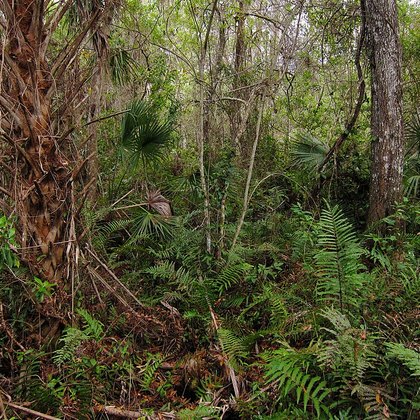
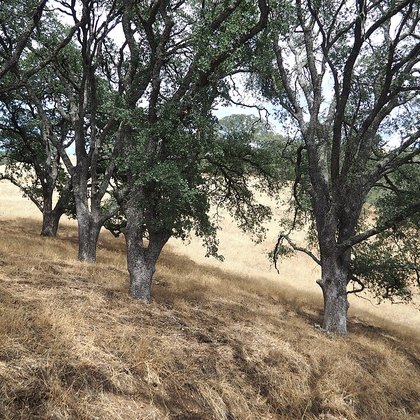
Half-open, fairly dry country: thorn scrub, hedgerows, woodland edges, the margins of denser broadleaf woodland, and to a large extent town and village gardens with flowering shrubs. In Texas it is a bird of the mesquite thorn scrub of the lower Rio Grande and of gardens with feeders. It does not use closed tall rainforest or open grassland. Water nearby is not a requirement; flowering shrubs are.
Where the bird is most often found, arranged by the USNVC — the vegetation classification of the United States and Canada — and CMECS for sea and coast.



Range and movements
Resident on the Gulf side of Mexico from Tamaulipas and southeastern Nuevo León south through San Luis Potosí, Veracruz and Tabasco to the Yucatán Peninsula, Belize and northern Guatemala, and in the far south of Texas. During the twentieth century it spread north in Texas to beyond Corpus Christi. Outside the breeding season part of the population moves north and east along the Gulf Coast, regularly as far as Louisiana, Mississippi, Alabama and the Florida panhandle — a movement away from the equator rather than towards it. Single birds reach North Carolina.
- Resident
- Breeding (summer)
- Winter
- Passage
- dark = core range, pale = thinly spread
Where and when to look
Look for it in a garden with feeders in the Lower Rio Grande Valley between November and March, when little is in flower and every hummingbird comes to sugar water. Do not go by throat colour, which switches with every turn of the head; look at the belly and the bill. Away from Texas, search coastal gardens in Louisiana in winter, where birds sometimes stay at one feeder for months.
Conservation
The species is listed as Least Concern (LC) and has been increasing since at least the 1980s, with the northern limit moving with it. Garden feeders and planted flowering shrubs along the Gulf Coast have a share in that. The thorn woodland of the lower Rio Grande, its core area in the United States, has largely been converted to farmland; what remains lies mostly in reserves.
Scientific name
Amazilia yucatanensis | (Cabot, 1845)
Samuel Cabot Jr. described the species in 1845 as Trochilus yucatanensis, from material collected in Yucatan; because it was later placed in another genus, author and year stand in parentheses. yucatanensis simply means 'of Yucatan', the type locality. The genus Amazilia was introduced by Lesson in 1843 and is named after Amazili, an Inca heroine in Jean-François Marmontel's novel Les Incas. That makes A. yucatanensis one of the few birds whose generic name goes back to a character in fiction.