All species › Passerines › New World blackbirds, troupials and allies › Bronzed Cowbird
Bronzed Cowbird | Molothrus aeneus
Roodoogkoevogel | Tordo ojirrojo
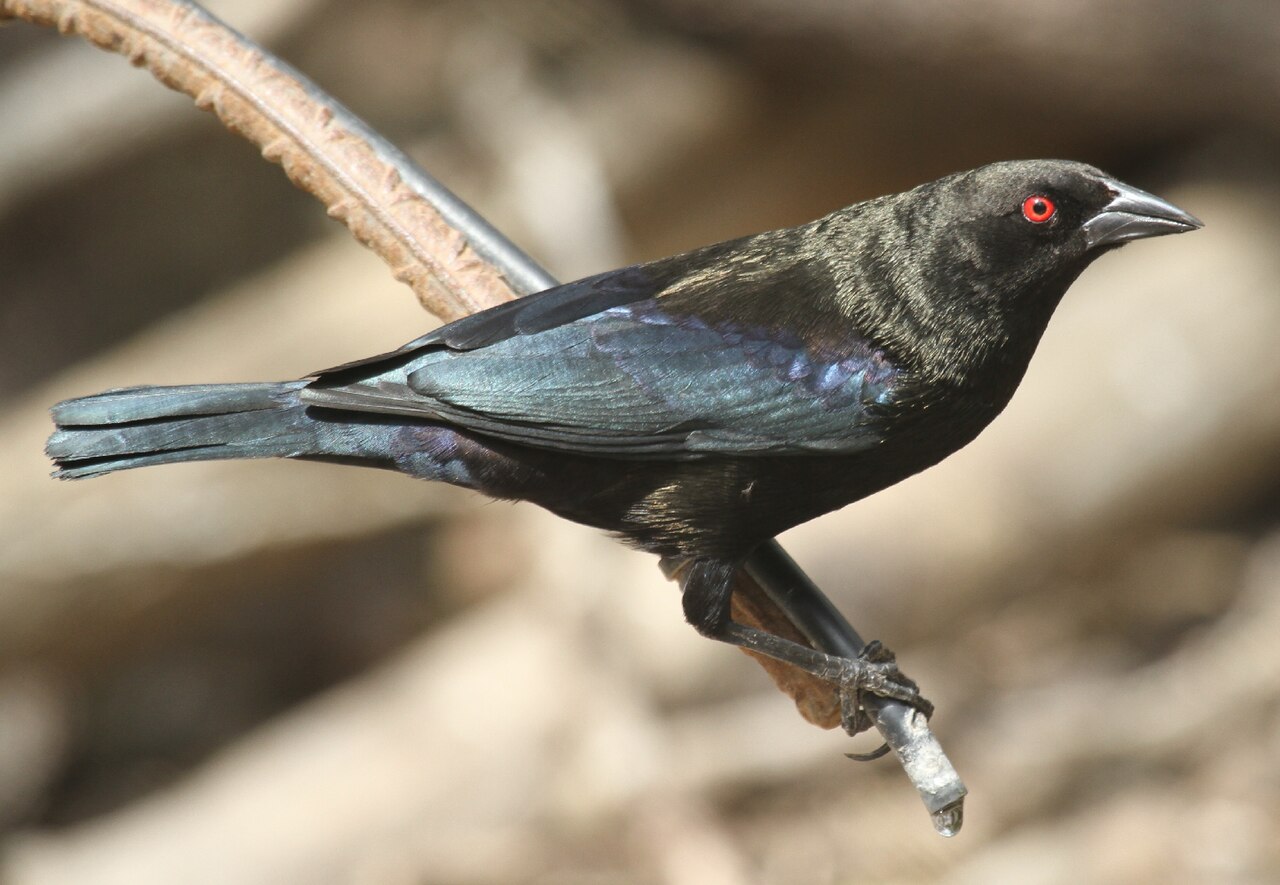
The Bronzed Cowbird is the largest of North America's three cowbirds, marked by a red eye and by the neck ruff the male can raise. It lays its eggs in the nests of other species and builds no nest of its own; orioles are its main hosts.
Voice
The male's song is a short series of high, thin, squeaky notes with a gurgling start, hard to locate and without clear melody. In flight it gives a dry, rattling chrr. The contact call is a hard check. The male sings during a display flight in which he hovers above the female on fast, shallow wingbeats.
Recording: Richard E. Webster — CC BY-NC-SA 4.0 · Minas Nuevas, Álamos, Sonora, Mexico · xeno-canto
Identification
Both sexes have a red eye, brighter in the breeding season than outside it. The male is black with a bronze-green gloss on head and body and a blue-purple gloss on the wings; the feathers of neck and mantle are elongated and form a ruff raised in display, which makes the head look small and drawn in. The bill is heavy and straight. In Texas and Mexico the female is almost as black as the male but without gloss; in Arizona and California she is greyish brown. Young birds resemble the female but have a dark eye and streaked underparts.
Confusion species
Brown-headed Cowbird is smaller, has a dark eye, a round head without a ruff and a shorter bill; its male has a brown head. Shiny Cowbird also has a dark eye, a slimmer body and a more pointed bill. Brewer's Blackbird and Common Grackle are longer-tailed and slimmer; the male Brewer's has a yellow eye, not red. On the greyish-brown Arizona females the red eye is often the only certain mark at distance.
Habitat
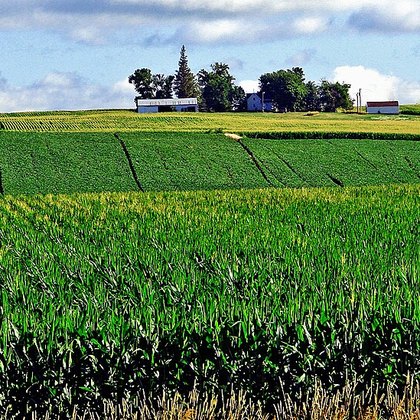
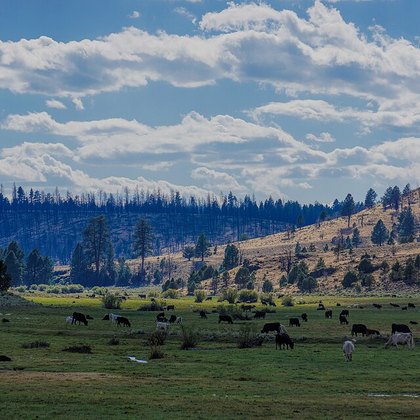
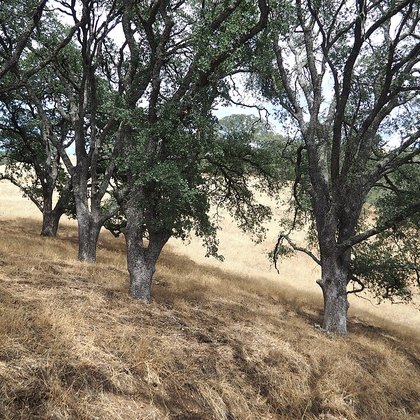
Open and semi-open lowland: feedlots, pasture, farmland, golf courses, village margins, chaparral (dense, hard-leaved scrub of California's Mediterranean climate), mesquite (a thorny pod-bearing shrub of the Southwest that forms dense thickets) scrub and woodland edge along rivers. It forages on the ground in flocks, often among cattle. Outside the breeding season it roosts in dense thickets and reedbeds. In Mexico and Central America it also occupies farmland up into the mountains.
Where the bird is most often found, arranged by the USNVC — the vegetation classification of the United States and Canada — and CMECS for sea and coast.



Range and movements
In the United States it breeds from southern California across Arizona and southern New Mexico to Texas, with an eastern arm into southern Louisiana. There it is largely a summer bird, though some winter in south Texas and southern Arizona. The range continues across nearly all of Mexico, including the Yucatán peninsula, and on through Guatemala, Belize, Honduras and El Salvador to Nicaragua and Panama. The northern limit moved north during the twentieth century with the spread of irrigated land.
- Resident
- Breeding (summer)
- Winter
- Passage
- dark = core range, pale = thinly spread
Where and when to look
Look in May and June among the cowbirds at a feedlot or picnic ground in south Texas or southeastern Arizona. Check the eye first: in good light the red stands out at tens of metres. A male raising his ruff and hovering just above a female can be named at once.
Conservation
The species is listed as Least Concern (LC) and its range expanded northward during the last century. The attention goes to its hosts: in south Texas Bronzed Cowbirds lay in a large share of the nests of Hooded and Audubon's Orioles, and the last year Audubon's Oriole bred in part of its Texas range coincided with high parasitism rates. Where threatened songbirds are protected, cowbirds are trapped locally.
Scientific name
Molothrus aeneus | (Wagler, 1829)
Wagler described the species in 1829 as Psarocolius aeneus; because it was later placed in Molothrus, author and year stand in parentheses. Molothrus was introduced by Swainson in 1832 and goes back to a Greek word for 'intruder' or 'beggar', after the brood parasitism. The species name aeneus is Latin for 'of bronze', after the bronze-green gloss of the male. The type locality was later fixed at Laguna in Veracruz, Mexico.