All species › Passerines › New World blackbirds, troupials and allies › Boat-tailed Grackle
Boat-tailed Grackle | Quiscalus major
Bootstaarttroepiaal | Zanate marismeño
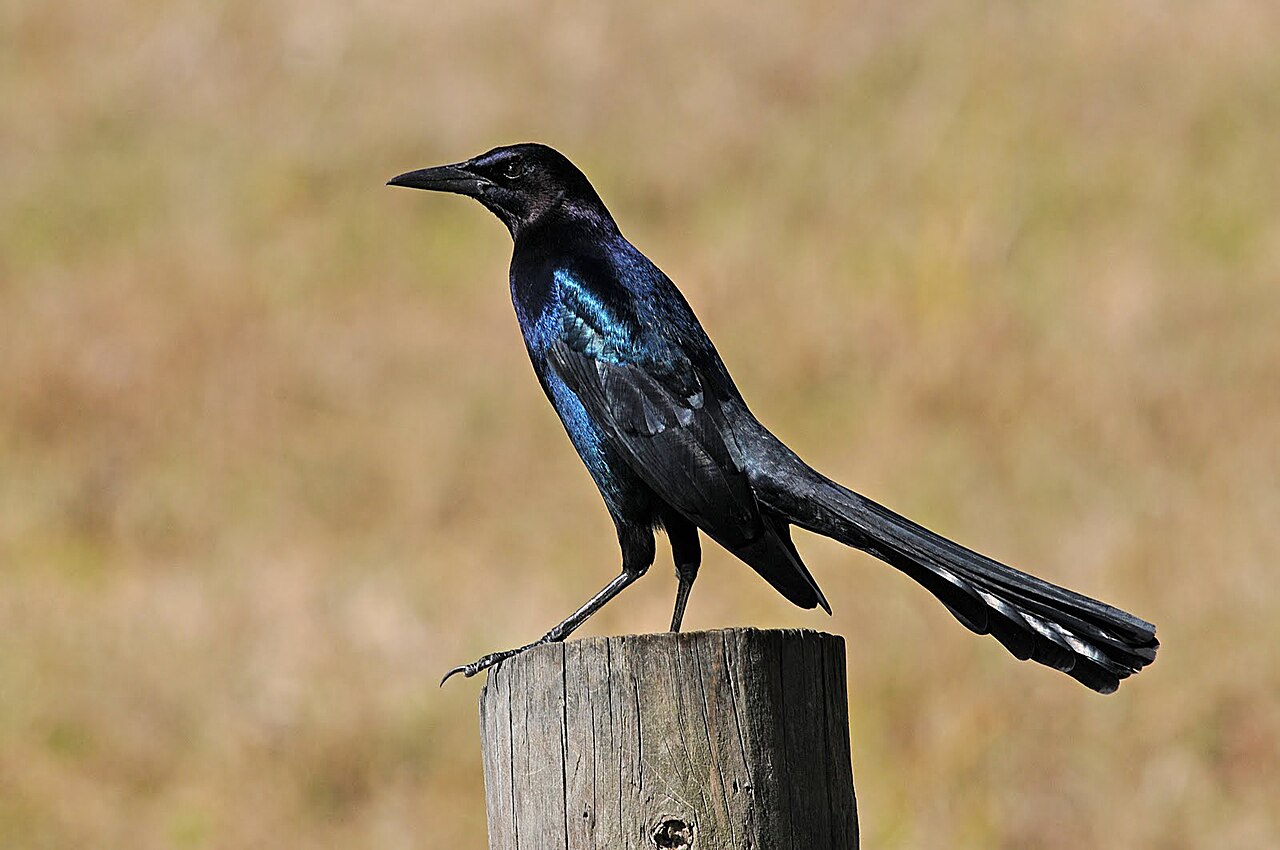
The Boat-tailed Grackle is the large grackle of the salt marshes of the southeastern United States, from Long Island to Texas. Almost everywhere it stays within a few tens of kilometres of salt or brackish water; only in Florida does it reach far inland.
Voice
The voice consists of harsh, blaring series: a repeated jeb-jeb-jeb, rattling chatter and sharp squeaks, without the clear whistles and clucking notes of the Great-tailed Grackle. A colony in the reeds produces a continuous, unordered noise. The male sings from a reed stem or post with the neck stretched and the wings quivering.
Recording: Bobby Wilcox — CC BY-NC-SA 4.0 · Delmarva Peninsula (near Ocean City), Worcester County, Maryland, United States · xeno-canto
Identification
A large grackle with a long, broad tail held keeled like an upturned boat hull — hence the name. The male is entirely black with a blue or purple-blue sheen and is considerably larger than the female, which is warm tawny brown with darker wings and tail. Iris colour varies by region: birds along the Atlantic coast have a pale yellow iris, those of the Gulf Coast and interior Florida a dark brown one.
Confusion species
Great-tailed Grackle overlaps in Louisiana and Texas: it has an even longer tail, the male shows a purple rather than blue gloss, the female is paler and leaner below, and the iris is always yellow. Voice separates the two best: Great-tailed has clear whistles and clucking notes that this species lacks. Common Grackle is clearly smaller and shows a bronze or purple gloss on the body. Females are told by size and by the tawny underparts.
Habitat
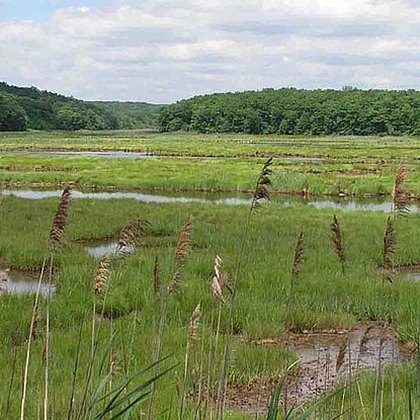
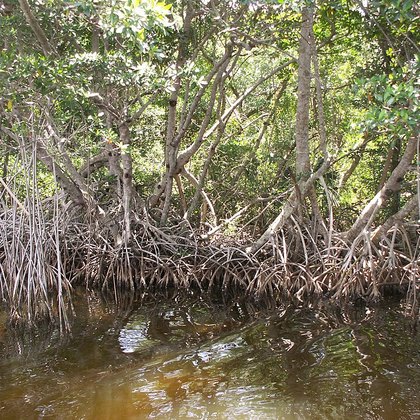
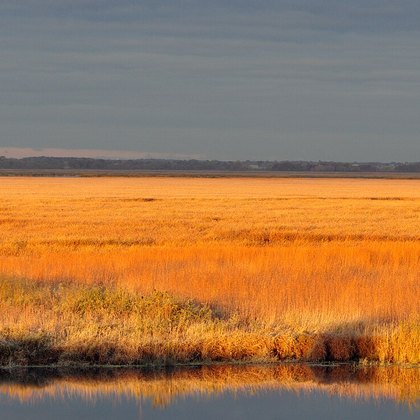
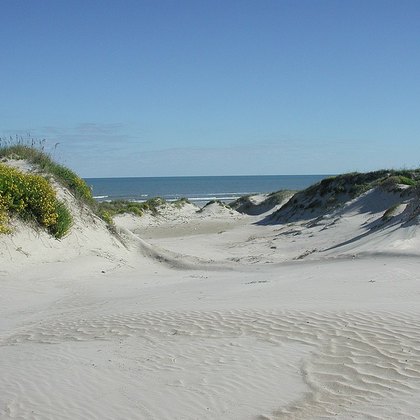
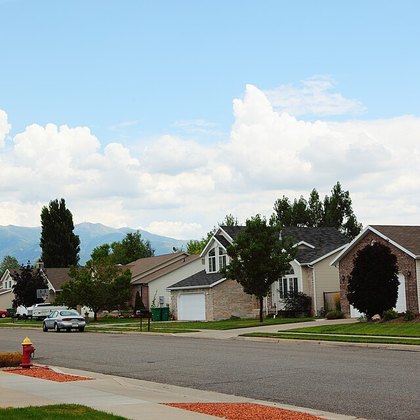
Cordgrass salt marsh, brackish reed marsh, mangrove, estuaries and lagoons, and adjoining dunes and beaches. In Florida also freshwater marsh and the shores of inland lakes. It forages along the tideline and in shallow water for crabs, shrimps and insects, and in coastal towns and ports at refuse, café tables and parking lots.
Where the bird is most often found, arranged by the USNVC — the vegetation classification of the United States and Canada — and CMECS for sea and coast.


Range and movements
Resident along the Atlantic coast from southeastern New York and New Jersey south through Delaware, Maryland, Virginia and the Carolinas to Georgia and all of Florida, and on along the Gulf Coast through Alabama, Mississippi and Louisiana into southeastern Texas. The range moved north along the Atlantic coast during the twentieth century; in Florida the species also occurs far from the coast. There is no true migration, though young birds do disperse.
- Resident
- Breeding (summer)
- Winter
- Passage
- dark = core range, pale = thinly spread
Where and when to look
Look for it on a parking lot at a beach or ferry terminal, where it walks on the ground between the cars. Check the iris first: pale yellow along the Atlantic, dark on the Gulf — that helps in comparison with Great-tailed Grackle, and note as well the absence of clear whistles.
Conservation
The species is numerous within its narrow coastal range and the IUCN keeps it in the Least Concern (LC) category; the North American Breeding Bird Survey gives a stable to slightly increasing trend. Filling and building on salt marsh reduce the breeding habitat locally, while towns, ports and marinas supply food and nest sites. Because the whole range lies in the zone flooded by hurricanes and rising sea level, the longer term is uncertain.
Scientific name
Quiscalus major | Vieillot, 1819
Vieillot described the species in 1819 as Quiscalus major; author and year stand without parentheses, as it remains in the original genus. The species name is Latin for 'the larger', separating it from the Common Grackle. The genus Quiscalus was introduced in 1816 by the same author; the origin of that name is uncertain. The Dutch and English names both refer to the keeled tail, which recalls an upturned boat.