All species › Waterfowl › Ducks, swans and geese › Blue-winged Teal
Blue-winged Teal | Spatula discors
Blauwvleugeltaling | Cerceta aliazul
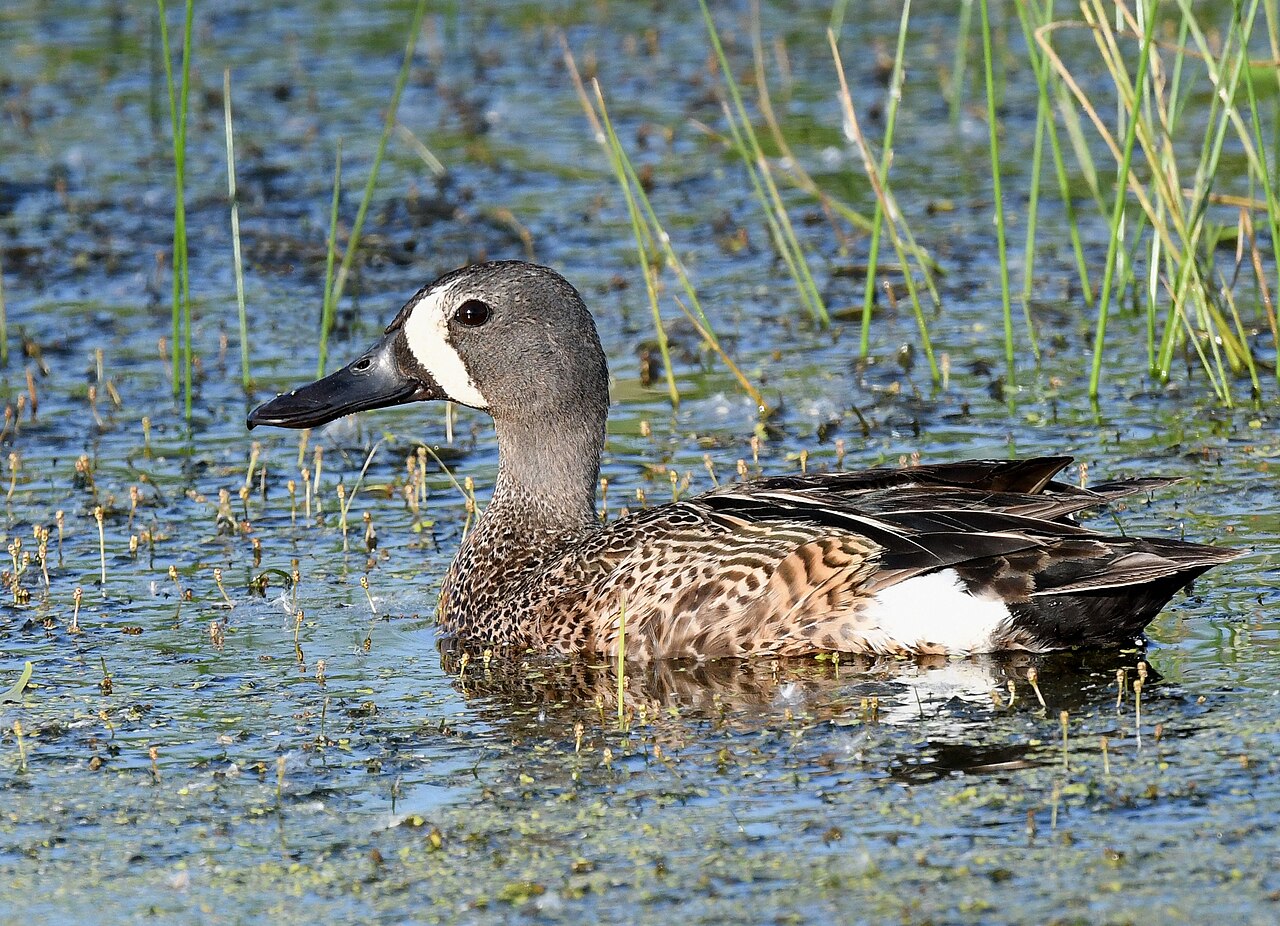
Blue-winged Teal is one of the first ducks to head south each autumn and one of the last to return each spring, as if it would rather skip winter altogether. The male wears a slate-grey head with a bold white crescent before the eye and a spotted cinnamon-brown body; in flight both sexes flash a bright pale-blue shoulder patch. Its closest relative, Cinnamon Teal, looks almost identical in female plumage and is the classic identification puzzle of the West.
Voice
The male gives a fine, high-pitched whistle, often in short series, often masked by the calls of other ducks. The female quacks more softly and nasally than a Mallard, in a short, descending series. When a flock flushes, a light rustling whir of wings is often the first sign that teal are nearby. True song is absent; most calls serve to keep the pair or the flock together.
Recording: Stanislas Wroza — CC BY-NC-SA 4.0 · Le Fjord-du-Saguenay Regional County Municipality (near Saint-Fulgence), Saguenay–Lac-Saint-Jean, Quebec, Canada · xeno-canto
Identification
The breeding male has a blue-grey head with a white crescent just in front of the eye, a spotted cinnamon-brown body, and a black rear end marked with a white flank patch. The female is evenly streaked light brown, with a fairly small, narrow bill and a plain, unpatterned head. In flight, both sexes show a pale-blue forewing bordered by a green speculum edged in white — the feature that gives the species its name. The eclipse male, after the late-summer moult, closely resembles the female and is then recognisable almost only by the blue shoulder patch.
Confusion species
Females and eclipse males are hard to separate from Cinnamon Teal (Spatula cyanoptera), which has a slightly longer, broader bill and often reddish rather than brown eyes, though the difference only shows at close range. The breeding male is immediately told apart from Cinnamon Teal's uniformly cinnamon-red head by its white facial crescent. In the eastern part of the range, Garganey (Spatula querquedula) can also cause confusion: its female closely resembles a female Blue-winged Teal but shows a more sharply defined pale eyebrow stripe.
Habitat
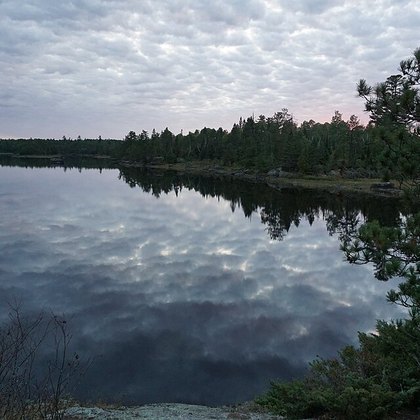
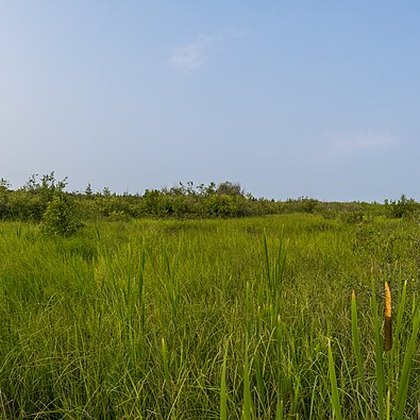
Shallow freshwater marshes with dense fringing vegetation, prairie potholes, wet meadows and flooded fields are its favoured breeding habitat. Outside the breeding season it also uses shallow coastal marshes, mangrove-lined lagoons and mudflats. It avoids deep, open water and dense forest; what it needs is shallow water with food near the surface and cover at the edge for nesting.
Where the bird is most often found, arranged by the USNVC — the vegetation classification of the United States and Canada — and CMECS for sea and coast.



Range and movements
Breeds in the prairie potholes of the northern Great Plains and the Canadian prairie provinces, with smaller populations east to the Atlantic coast and scattered across the West. Almost the entire population leaves North America for the winter, moving via the Gulf Coast into Mexico, Central America, the Caribbean and northern South America. It is among the fastest and earliest migrants of all North American ducks — the first birds already depart in August, while other duck species are still breeding.
- Resident
- Breeding (summer)
- Winter
- Passage
- dark = core range, pale = thinly spread
Where and when to look
Watch for the first returning flocks on a prairie marsh in April, or for the season's first southbound birds in August, well before most other ducks move. The pale-blue shoulder patch is the quickest clue at a distance, but it does not separate this species from Cinnamon Teal; for those two, a look at the face is needed.
Conservation
One of the most numerous ducks in North America, with a population closely tied to the condition of the prairie potholes where it breeds. Drainage of those wetlands for agriculture is the main long-term threat, partly offset by waterfowl habitat conservation programmes.
Scientific name
Spatula discors | (Linnaeus, 1766)
Linnaeus described the species in 1766 as Anas discors, within the then catch-all genus for nearly all ducks. Boie had already established the genus Spatula in 1822 — Latin for 'spoon', after the broad bill of the Northern Shoveler — but only DNA research in 2009 showed that Anas consisted of several not closely related branches, after which this species was moved to Spatula; hence the parentheses around author and year. discors is Latin for 'different' or 'discordant'. The type locality lies in Virginia or Carolina.