All species › Passerines › New World warblers › Blackburnian Warbler
Blackburnian Warbler | Setophaga fusca
Sparrenzanger | Reinita gorjinaranja
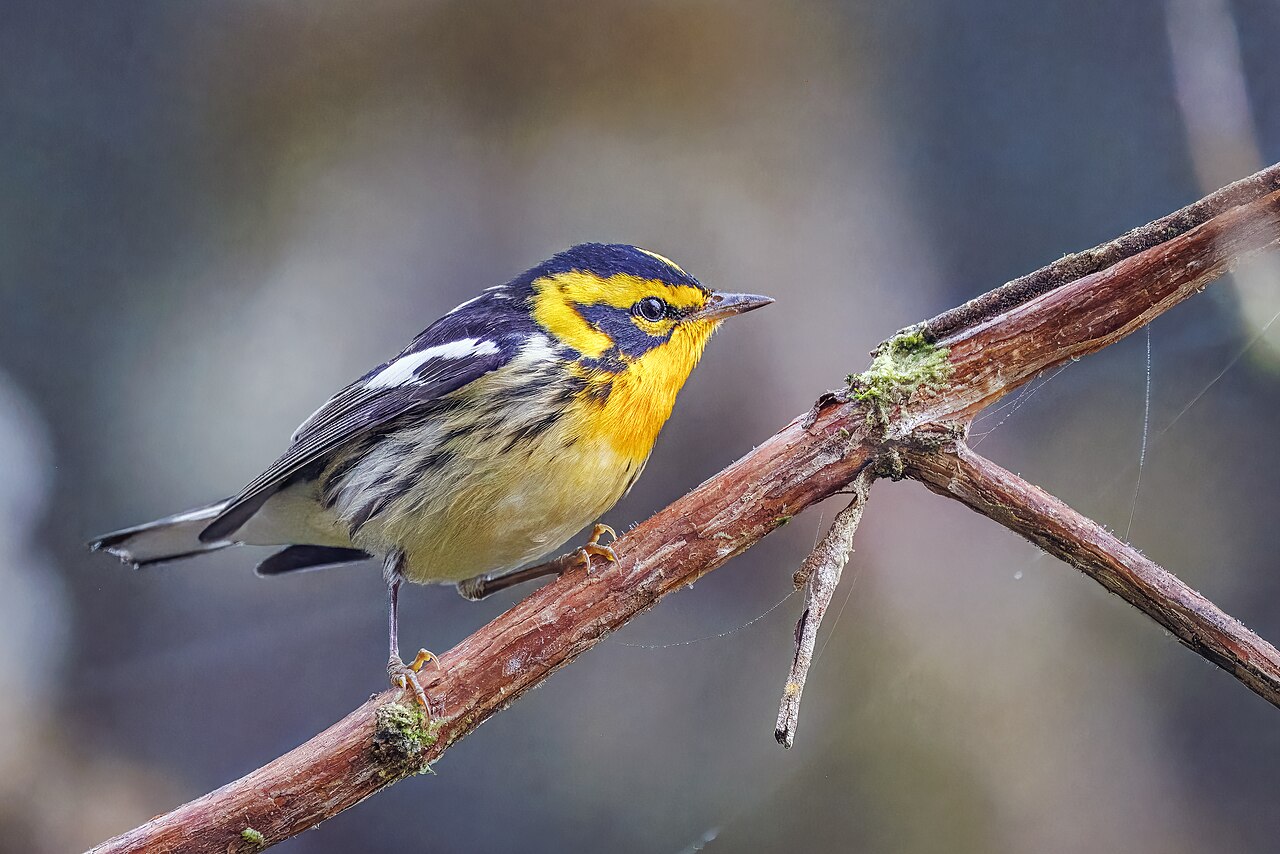
The Blackburnian Warbler is the only North American warbler with an orange throat and head; in the male the throat, brow and forehead are orange to flame-coloured, framed by a black triangle over the ear. It breeds in mature coniferous forest from southern Canada to the Appalachians and winters in the montane forests of the northern Andes.
Voice
The song is high and thin: a series of wiry sip notes that accelerate and pass into a sustained, steadily rising tseeee that often climbs beyond the hearing of older observers. There is also a shorter, lower version used through the day and against neighbouring males. The call is a sharp, high sip, barely separable from that of related warblers. Males almost always sing from the spire of a tall conifer.
Recording: Bates Estabrooks — CC BY-NC-SA 4.0 · Donegal Township (near Seven Springs), Somerset County, Pennsylvania, United States · xeno-canto
Identification
The breeding male has an orange throat and breast fading to white on the belly with black flank streaks, a black crown with an orange central stripe, and a black triangular ear patch that the orange runs around. The back is black with white lengthwise stripes, and the wing shows a large white panel formed by the two wing bars. The female has the same pattern in yellow and grey-brown, with two narrow white wing bars and two pale stripes down the back, the so-called braces. In autumn the throat is pale yellow, but the dark ear patch and the braces remain.
Confusion species
In autumn plumage it resembles Black-throated Green Warbler, which has an all-green back without braces, and the yellow form of Pine Warbler, which has a longer tail, unstreaked flanks and vaguer wing bars. Cape May Warbler has a streaked breast, a yellow rump and a finer bill. What settles it are the two pale stripes down the dark back and the triangular dark cheek patch, both visible on a Blackburnian all year.
Habitat
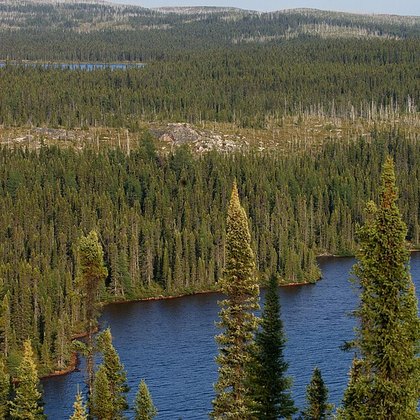
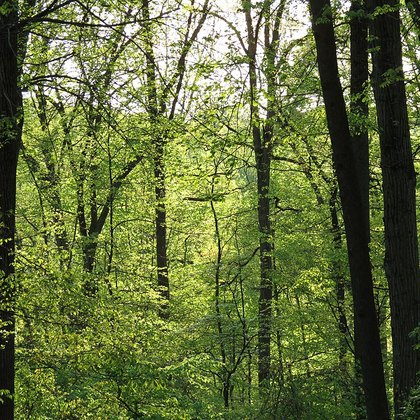
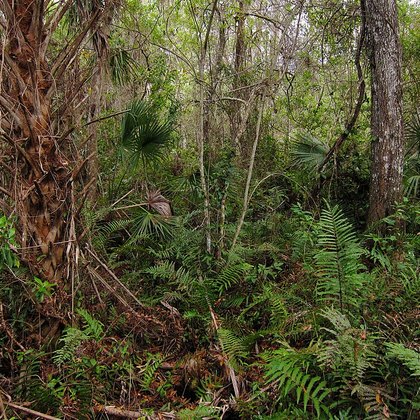
Breeds in mature, closed coniferous and mixed forest with spruce, fir and hemlock, and keeps almost entirely to the upper layer of the canopy; the nest is usually above twelve metres. In the southern Appalachians its occurrence follows old hemlock stands. On migration it drops into deciduous woodland and sometimes into shrubs and lawns along the coast during heavy arrivals. In winter it is mainly above a thousand metres in rain and cloud forest, second growth, dwarf forest and shade coffee.
Where the bird is most often found, arranged by the USNVC — the vegetation classification of the United States and Canada — and CMECS for sea and coast.

Range and movements
The breeding range runs from central Alberta and Saskatchewan east through Ontario, Quebec and the Maritimes, and in the United States through Minnesota, Wisconsin, Michigan, New England and New York, with a narrow extension along the Appalachians to northern Georgia. Migration crosses the east of the continent, with many birds along the Gulf Coast and through eastern Mexico and Central America. The winter range lies in the mountains of Colombia, Venezuela, Ecuador and Peru into Bolivia; within the guide area it winters only in Colombia and Venezuela.
- Breeding (summer)
- Winter
- Passage
- dark = core range, pale = thinly spread
Where and when to look
Look for it in May in the tops of tall conifers and along old hemlock ravines; the orange carries a long way in side light. Anyone who no longer hears the highest notes should watch for movement and for the black cheek triangle rather than listen for the song, since the last note of the phrase lies beyond many ears.
Conservation
Partners in Flight puts the world population at about 13 million breeding birds and records an increase of some ten per cent since 1970; the Continental Concern Score is 9 out of 20. The species is thus widespread and listed as Least Concern (LC), but it hangs on two vulnerable forest changes: the loss of old hemlock in the Appalachians to the hemlock woolly adelgid, and deforestation of the Andean montane forests where nearly the whole population winters. Spraying against spruce budworm affects both the bird and its main prey.
Scientific name
Setophaga fusca | (Müller, 1776)
Philipp Ludwig Statius Müller described the species in 1776 as Motacilla fusca; the parentheses around author and year mark its later move to another genus. The epithet fusca is Latin for 'dark, brownish black', after the black parts of the plumage rather than the orange. The type material was attributed to Guyana, where the species at most passes through. The English name Blackburnian, introduced in 1785, refers to the English collector Anna Blackburne, in whose cabinet lay the specimen her brother sent from North America. The Dutch name points to the spruce forest it breeds in. The genus Setophaga means 'moth-eater', from Greek ses 'moth' and phagos 'eating'.