All species › Tubenoses › Petrels, shearwaters and diving petrels › Black-vented Shearwater
Black-vented Shearwater | Puffinus opisthomelas
Zwartbuikpijlstormvogel | Pardela culinegra
Black-vented Shearwater is a small, dark shearwater that, unlike most of its relatives, stays close inshore along the American west coast: it usually remains within a few dozen kilometres of the beach, over the continental shelf. It breeds almost entirely on a handful of islands off Baja California and is a familiar sight off central and southern California in the colder months.
Voice
At the colony, like most shearwaters, Black-vented Shearwater is heard only at night: a hoarse, cackling call rises from the burrows under the scrub, by which partners and neighbours recognize each other in the dark. By day, and at sea, the species is silent. Along the American coast, where it is seen only as a non-breeding wanderer, no call has ever been recorded from it — what an observer here hears is at most the splash of the water as a bird lifts off.
Recording: Justyn Stahl — CC BY-NC-SA 4.0 · Los Angeles County, California, United States · xeno-canto
Identification
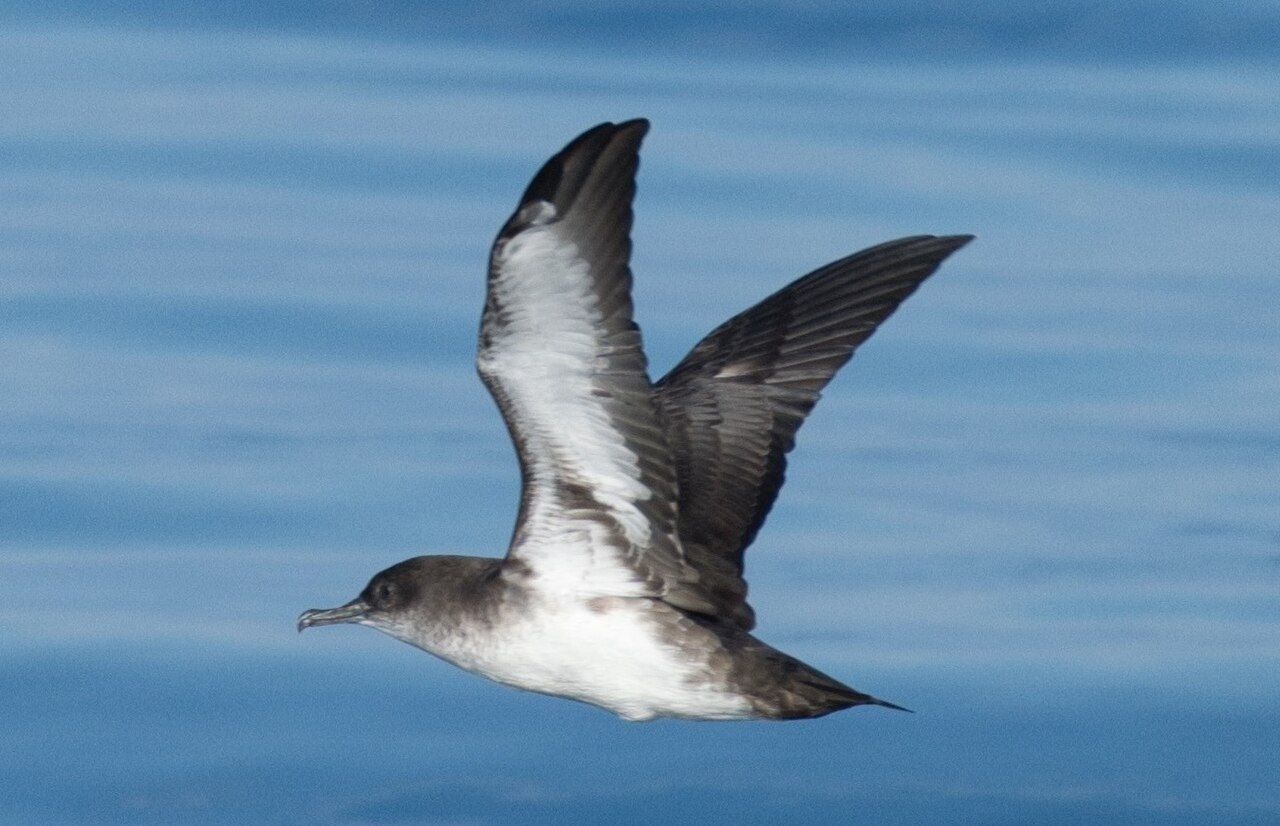
A small, compact shearwater, dark brown to black above and white below, with dark undertail coverts, a rather diffuse line along the flank and an underwing that is mostly white with a narrow dark trailing edge. Bill and legs are grey to flesh-coloured. Male, female and juvenile look alike. Flight is low over the water, with quick, somewhat stiff wingbeats broken by short glides — less of the long, buoyant glide shown by the larger shearwaters.
Confusion species
Sooty Shearwater (Ardenna grisea) is larger and nearly uniform dark brown all over, lacking the sharp line between upperparts and underparts that marks Black-vented Shearwater. Pink-footed Shearwater (A. creatopus) is likewise larger, with a thick pink bill and a less crisp transition between dark back and pale underparts. Next to both, Black-vented Shearwater is noticeably smaller and more compact, with quicker wingbeats.
Habitat
Within this area Black-vented Shearwater is chiefly a bird of the shallow continental shelf, where schools of anchovy and sardine keep it close inshore — often no more than a quarter-hour's run from the harbour. For breeding it seeks low, often rocky islands with scrub cover, nesting in a self-dug burrow or a crack between rocks. It largely avoids the open ocean far from shore that most of its relatives seek out instead.
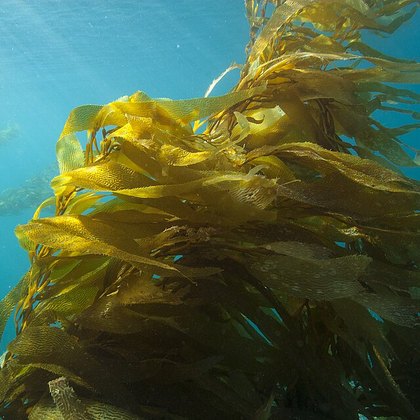
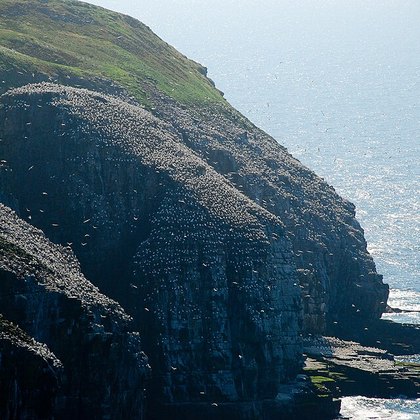
Where the bird is most often found, arranged by the USNVC — the vegetation classification of the United States and Canada — and CMECS for sea and coast.
Range and movements
Black-vented Shearwater breeds almost entirely on islands off the west coast of Baja California: over ninety-five per cent of the world population nests on Isla Natividad, with smaller colonies on Isla Guadalupe and the San Benito Islands. After breeding, mainly young birds disperse north along the coast; from September to April the species is a regular, sometimes numerous visitor off central and southern California, with occasional reports as far as British Columbia. To the south it stays close to the Mexican colonies and the Gulf of California.
- Resident
- Breeding (summer)
- Winter
- Passage
- dark = core range, pale = thinly spread
Where and when to look
Look for Black-vented Shearwater from late summer through spring on a short boat trip off the Southern California coast, for instance from San Diego or Dana Point, where it runs close inshore alongside fishing boats. Watch for the sharp line between the dark upperparts and white underside: it is exactly what Sooty and Pink-footed Shearwaters, the species it is most often confused with, lack.
Conservation
The world population numbers between two and three hundred thousand birds and is stable; the species is listed as Near Threatened (NT). Feral cats once killed more than a thousand birds a month on Isla Natividad; since cats were fully removed there, and are being removed from Isla Guadalupe as well, breeding success has improved sharply. Oil pollution, fishing nets and the small number of breeding islands remain the main lingering risks.
Scientific name
Puffinus opisthomelas | Coues, 1864
Elliott Coues described the species in 1864 as Puffinus opisthomelas, based on a specimen from Cabo San Lucas at the southern tip of Baja California; it has remained ever since in the genus Puffinus, erected by Brisson as early as 1760, so no parentheses stand around author and year. The species name opisthomelas is Greek for 'black behind', referring to the dark undertail and rump that set it apart from paler relatives. The type locality, Cabo San Lucas, lies far from the actual breeding islands, which were discovered only later.