All species › Passerines › Shrike-babblers, Erpornis and vireos › Black-capped Vireo
Black-capped Vireo | Vireo atricapilla
Zwartkapvireo | Vireo cabecinegro
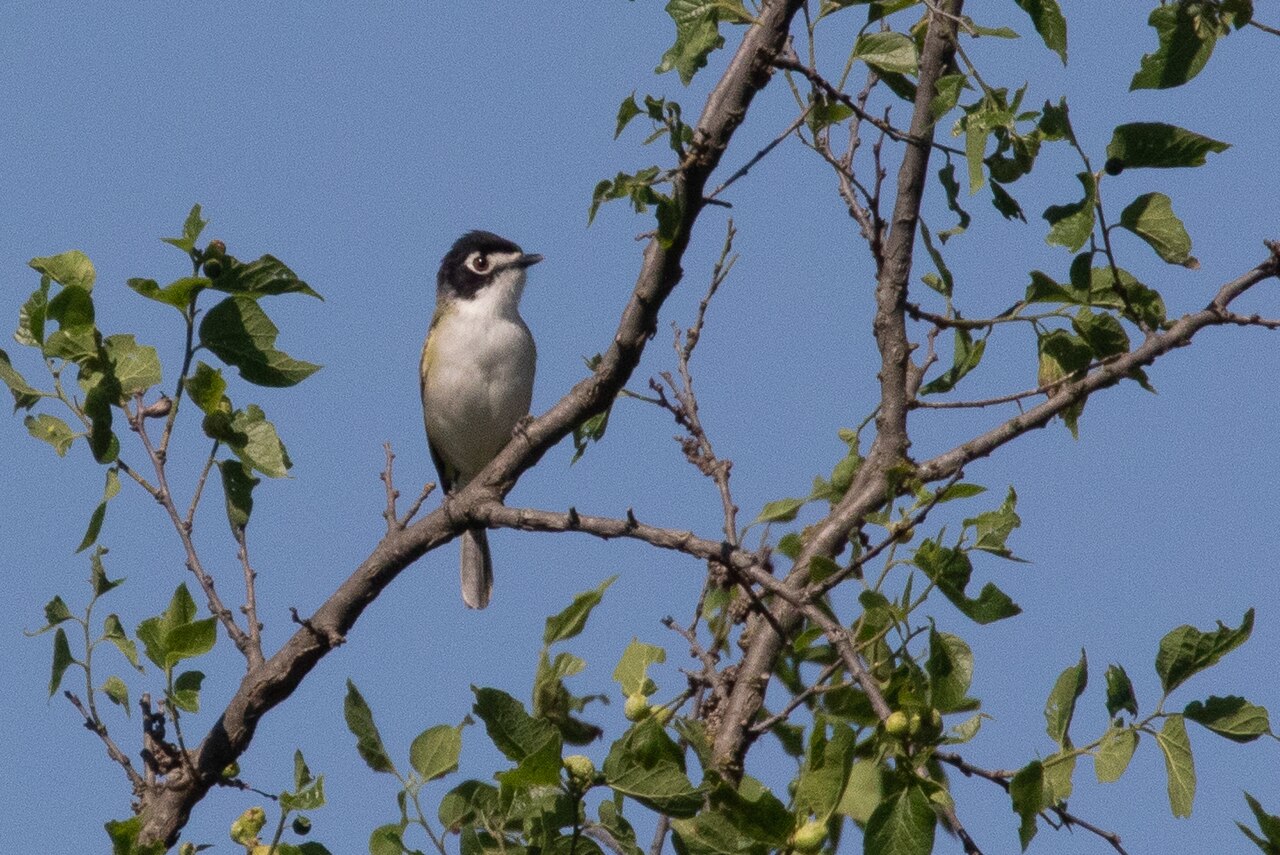
The Black-capped Vireo is the only vireo in which male and female differ in colour: the male has a black head with white spectacles around a red-brown iris. It breeds in low oak scrub on the limestone slopes of central Texas, Oklahoma and northern Mexico and winters along the west coast of Mexico.
Voice
The male sings a continuous string of rapid two- and three-note phrases, rising and falling by turns, with much variation between phrases. Singing goes on all day, at high temperatures as well, and one bird holds a large number of phrase types. The commonest call is a rapid jidit, closely resembling the call of Ruby-crowned Kinglet. When disturbed, birds snap the bill.
Recording: Sue Riffe — CC BY-NC-SA 4.0 · Santa Margarita Ranch - hike, Starr Cty, Texas, United States · xeno-canto
Identification
The male is olive-green above and white below with a yellow wash on the flanks; head and throat sides are black, with white spectacles broken in front of the eye. The iris is red-brown. The female has a slate-grey rather than black head and a yellow-green wash across the underparts; the first-year male falls between the two, with a greyish-black head. Both sexes have two yellowish wing bars. The bird forages low and stays largely in cover.
Confusion species
No other vireo of the region has a black or slate-grey head with broken white spectacles. Blue-headed Vireo has a blue-grey head, complete white spectacles and a white throat, is larger and lives in woodland rather than low scrub. The female Black-capped Vireo is most often taken for a warbler in flight; the heavy, hooked bill and the slow foraging settle it. The call is hardly separable from that of Ruby-crowned Kinglet, so do not rest the identification on that sound alone.
Habitat
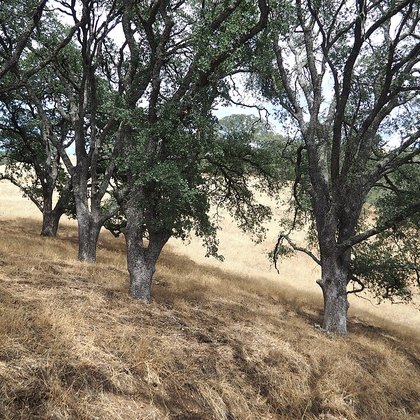
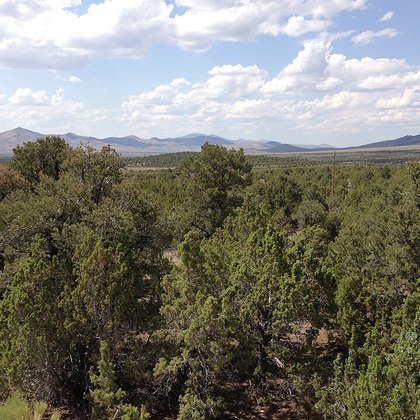
Low, irregular scrub on shallow limestone soil, with shin oak (a knee-high oak of the Texas limestone plains that spreads by runners), Texas oak, sumac and juniper, the foliage reaching down to the ground. The nest usually hangs between 40 and 130 centimetres above the ground. Scrub set back by fire or grazing and then recovering is suitable; where the shrubs grow on into closed woodland, or where stock strips the lower branches, the species drops out. The wintering habitat is tropical dry scrub and deciduous woodland on the western slopes of Mexico.
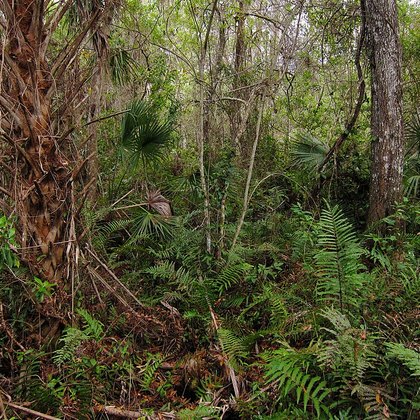
Where the bird is most often found, arranged by the USNVC — the vegetation classification of the United States and Canada — and CMECS for sea and coast.


Range and movements
Breeds from southern Oklahoma through the Edwards Plateau and the Texas Hill Country into Coahuila and Nuevo León; in Kansas it has gone as a breeding bird. The highest densities are on military lands in Texas and Oklahoma, which hold large unbroken blocks of scrub. Migration passes through northeastern and western Mexico. Wintering is along the Pacific slope from Sonora and Sinaloa south to Guerrero, from August or September to March.
- Breeding (summer)
- Winter
- Passage
- dark = core range, pale = thinly spread
Where and when to look
Look for it between mid-April and June; song falls off sharply in July. Head for a song post and wait rather than walking into the scrub — the bird often comes to the edge of its own accord. Note whether the head is black or slate-grey, since that decides whether you are looking at a male or a female.
Conservation
The species is Red-Listed as Near Threatened (NT), with an estimated population of 10,000 to 20,000 mature birds. In 1987 it was protected in the United States as an endangered species; that listing was withdrawn in 2018 after counted numbers had risen. The main pressures are brood parasitism by Brown-headed Cowbird, grazing that removes the lower foliage layer, succession of scrub into closed woodland where fire is absent, and conversion of scrub to pasture and housing. Most of the current numbers sit on managed lands where cowbirds are trapped; outside those lands trend and numbers are less well known, and the Mexican part of the range is barely surveyed.
Scientific name
Vireo atricapilla | Woodhouse, 1852
Samuel Washington Woodhouse described the species in 1852 from a specimen taken on the Rio San Pedro, 208 miles (about 335 kilometres) from San Antonio on the road to El Paso del Norte — later fixed as the Devils River near Sonora, Sutton County, Texas. Author and year stand without parentheses, since the species is still in Vireo. That name is the Latin term for a green migratory bird, related to virere 'to be green'. The species name atricapilla comes from ater 'black' and capillus 'hair of the head', hence 'black-crowned'.