All species › Passerines › Shrike-babblers, Erpornis and vireos › Bell's Vireo
Bell's Vireo | Vireo bellii
Bells vireo | Vireo de Bell
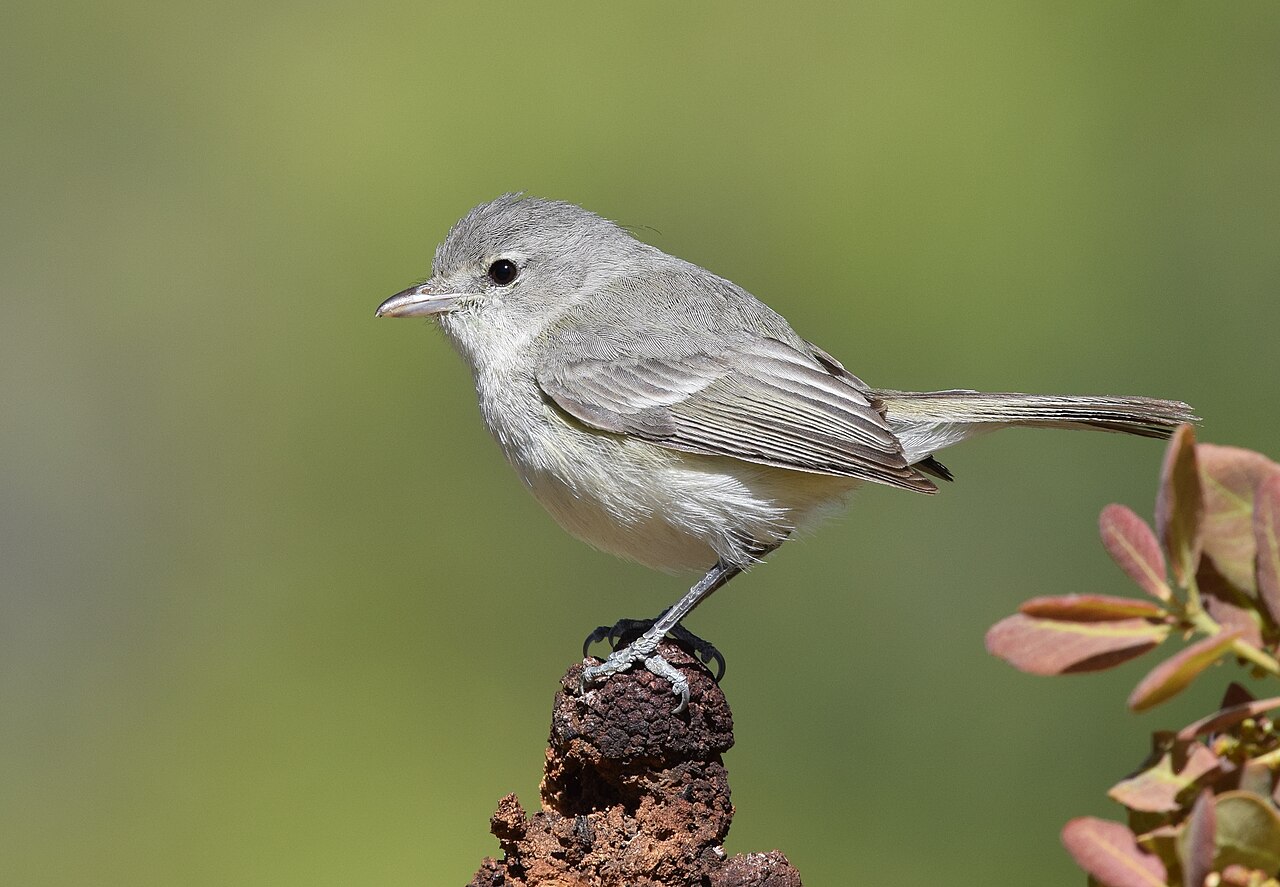
Bell's Vireo is a small, dull olive-grey vireo of dense scrub along streams, arroyos (dry, steep-sided gullies that carry water only after rain) and prairie edges in the central and southwestern United States. The plumage carries little pattern; the species is detected mainly by its hurried, scratchy song and by the tail it swings from side to side without stopping.
Voice
The song is a hurried, scratchy series of six to ten notes in two parts: the first part ends rising, the second falling, as though a question were followed by an answer. The male sings persistently, through the heat of the day as well, alternating the two parts. Females rarely sing. Young males give a softer, unsteady version late in the season. The alarm call is a fast, nasal scold recalling a wren; besides this there are separate zip and churt notes and a high, piercing squeal.
Recording: Scott Crabtree — CC BY-NC-SA 4.0 · Tucson, Pima County, Arizona, United States · xeno-canto
Identification
Dull olive-grey above, dingy white below with a yellow wash on the flanks in eastern birds; western birds are greyer and paler. Head pattern is weak: a thin, vague white eye-ring and a short line towards the bill, not crisp spectacles. One wing bar is clear, the second often barely visible. The tail is long for a vireo and is swung from side to side continually while foraging. The nest hangs in a fork of a low branch.
Confusion species
White-eyed Vireo has crisp yellow spectacles, sharply set-off yellow flanks and, in adults, a white iris; Bell's Vireo has a dark eye and a vague eye-ring. Gray Vireo of the southwest is larger, plain grey, has a clearer eye-ring and also moves its tail, but lives in dry juniper scrub rather than at water. A warbler such as Tennessee or Orange-crowned has a thin, pointed bill, while Bell's Vireo has a heavy bill with a small hook. The tail movement together with the scratchy two-part song is the quickest character.
Habitat
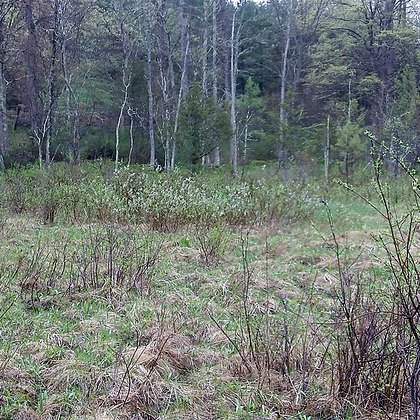
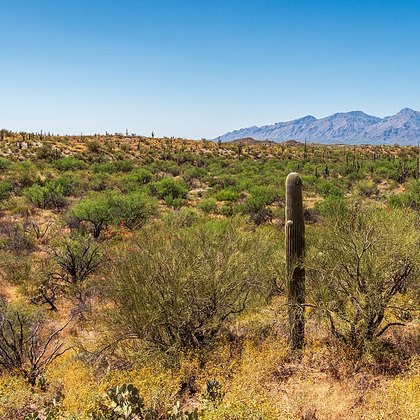
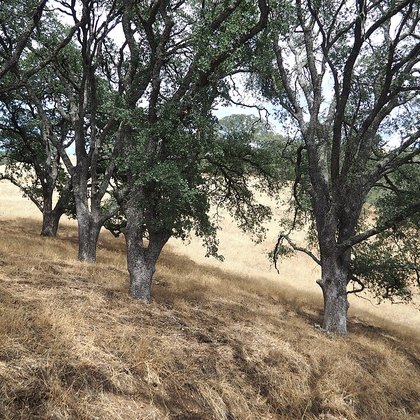
Dense low scrub with a closed understorey: willow and cottonwood growth along streams and rivers, mesquite woodland, thorn scrub in arroyos, overgrown prairie edges and young regrowth after cutting. The structure of the shrub layer matters more than the plant species. In the western deserts it is largely confined to the green strips along watercourses.
Where the bird is most often found, arranged by the USNVC — the vegetation classification of the United States and Canada — and CMECS for sea and coast.


Range and movements
Breeds from central and southern California east through Arizona, New Mexico and Texas into Oklahoma, Kansas, Nebraska, Iowa, Missouri, Arkansas and Illinois, and in northern Sonora, Chihuahua and Baja California. All populations leave: winter is spent along the west coast of Mexico from Baja California Sur and Sinaloa south to Guerrero and Oaxaca, and in smaller numbers as far as Guatemala and Honduras. Spring migration runs through the northeastern Mexican states and central Texas; arrival on the breeding grounds falls in April and May, departure in August and September.
- Resident
- Breeding (summer)
- Winter
- Passage
- dark = core range, pale = thinly spread
Where and when to look
Look for it in May and June in a willow strip along a stream and listen for the two-part song, the first part of which seems to end on a question mark. Pishing often buys a brief moment in which the bird shows the tail. Appearance says little: put the song ahead of the plumage.
Conservation
Range-wide Bell's Vireo is listed as Least Concern (LC), but numbers have fallen across much of the range through loss of riparian scrub to grazing, water abstraction and cultivation. The southern Californian subspecies, the Least Bell's Vireo, has been federally listed as endangered since 1986; it then held about 300 breeding pairs and rose to some 2,000 pairs by 1998, alongside riparian restoration and trapping of Brown-headed Cowbirds. Where cowbirds are not controlled they lay in a large share of nests; in upland scrub away from the stream bottoms parasitism is lower.
Scientific name
Vireo bellii | Audubon, 1844
Audubon described the species in 1844 from a specimen he collected on his Missouri River journey, a short distance below Black Snake Hills near present-day St. Joseph, Missouri. He named the bird for John Graham Bell, the taxidermist who accompanied him on that trip; author and year stand without parentheses, since the species is still in the genus in which it was described. Vireo is the Latin name of a green migratory bird, related to virere 'to be green'.