All species › Waders, gulls and terns › Plovers and lapwings › Black-bellied Plover
Black-bellied Plover | Pluvialis squatarola
Zilverplevier | Chorlito gris
The Black-bellied Plover is the largest plover in the guide area and the only one with jet-black axillaries — a mark that opens up only when the bird takes off, and then settles the matter. It breeds on the bare tundra of the high Arctic and spends the rest of the year on tidal flats along almost every coast in the world.
Voice
The call is a clear, far-carrying, plaintive three-note whistle, plee-oo-wee, with the middle note lowest; over an empty flat it betrays the bird long before it is seen. It calls mainly in flight and at any alarm, and one bird lifting takes the whole flat up with it. On the breeding grounds the male delivers a long, drawn-out, wailing pee-oo-wee … pee-oo-wee in a slow display flight on stiff, shallow wingbeats, kept up for minutes on end. Near the nest the note shortens to a harder kleep that quickens as the intruder closes.
Recording: Teet Sirotkin — CC BY-NC-SA 4.0 · Skvallerhamnsudden, Arholma, Sweden · xeno-canto
Identification
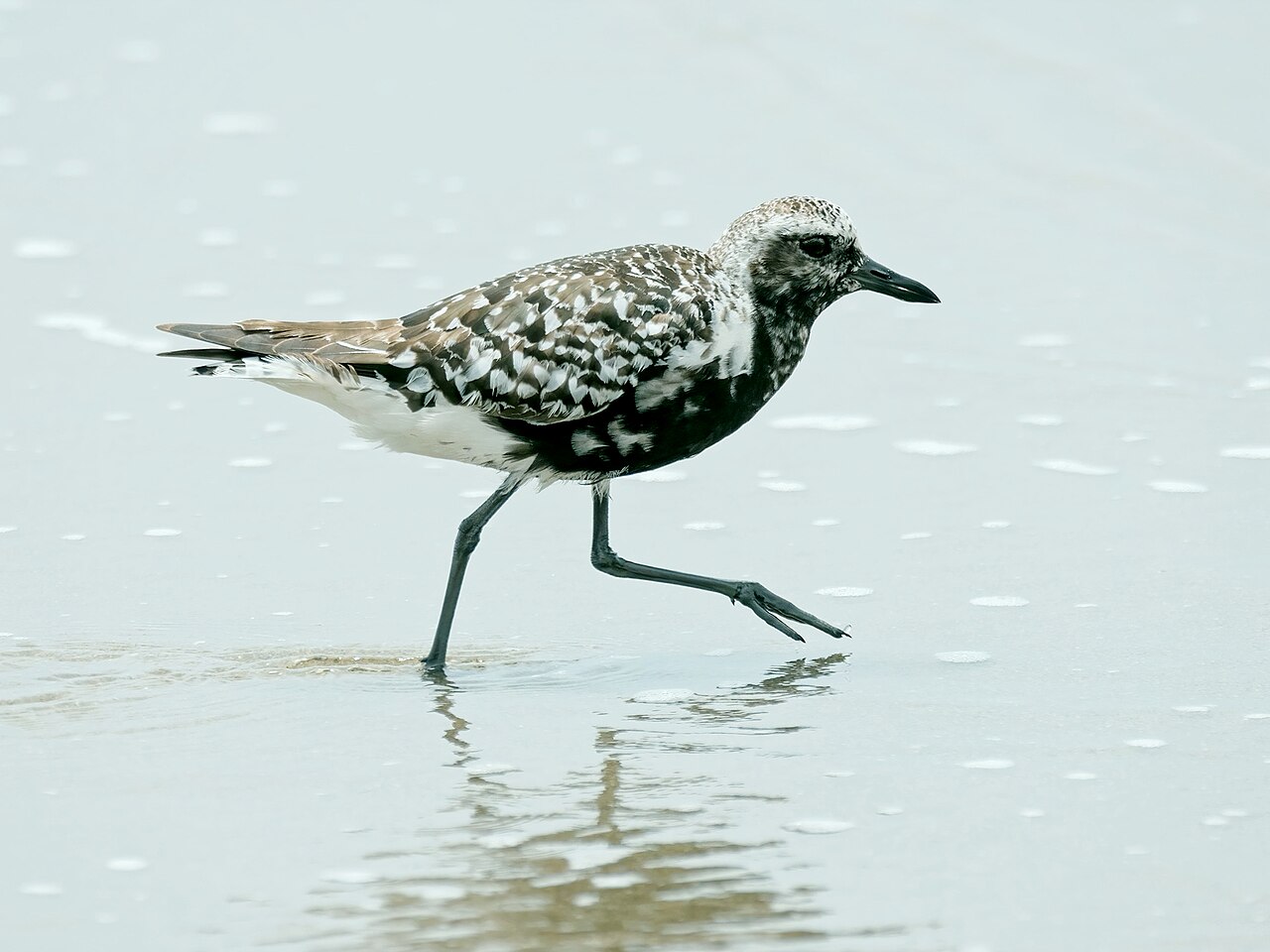
In breeding plumage the underparts from face to belly are jet black, sharply bordered by a broad white band running from the forehead over the side of the neck down onto the flank; the upperparts are silvery grey spangled with white, without a trace of gold. The female usually shows less solid black, with white feathering breaking through the dark, and juveniles are grey-brown with a finely spotted back and a faintly streaked breast. In non-breeding plumage it is plain grey-brown above and dirty white below, with a pale supercilium and a dark smudge behind the eye. It is heavily built, with a large head and a short, thick black bill clearly stouter than any golden-plover's. In flight three things catch the eye at once: the white rump, the white wingbar and the black feathering in the wingpit.
Confusion species
The three golden-plovers are smaller and finer-billed, lack the white rump and wingbar, and have grey-white or white rather than black axillaries — on a bird taking off that is settled at a glance. In breeding plumage the Black-bellied Plover shows no gold on the back at all, where Pluvialis dominica, P. fulva and P. apricaria are all spangled yellow to golden. In winter plumage it is greyer, bulkier and heavier-billed than any of them, and its breast is paler and more blotchily streaked. Juveniles in their first autumn carry the most golden tone; the thick bill, the white rump and the three-part call still hold.
Habitat
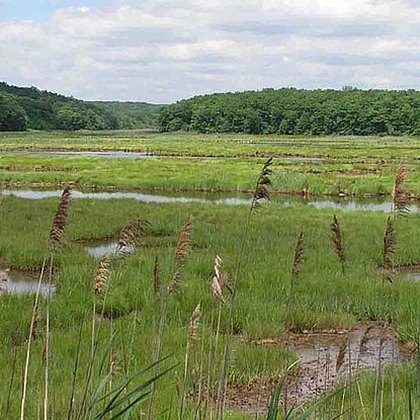
Breeds on dry, stony or lichen-covered tundra, often on the higher ridges above the lowland lakes, where the view is open all round. Outside the breeding season it is a bird of open tidal ground: mudflats, sandy beaches, saltmarsh edges and the mud of estuaries and lagoons. It avoids vegetated shorelines and sheltered creeks; what it needs is a wide bare plain to look across, because it hunts by sight and not by touch. On passage it also stands on ploughed land and short-grazed pasture inland, but seldom for long.
Where the bird is most often found, arranged by the USNVC — the vegetation classification of the United States and Canada — and CMECS for sea and coast.




Range and movements
Breeds on the coastal plains of northern and western Alaska and across the Canadian Arctic east to Baffin Island; it does not breed in Greenland. North American birds winter along both coasts, from Washington and Massachusetts south through Mexico, Central America and the Caribbean far into South America, and on passage it turns up in almost every state and province, well inland included. Adults leave before the young: the first are back off the tundra in July, while juveniles keep coming through into October. Part of the yearling cohort stays in the wintering area through its first summer, so Black-bellied Plovers stand on the flats in June as well.
- Resident
- Breeding (summer)
- Winter
- Passage
- dark = core range, pale = thinly spread
Where and when to look
With a party of grey waders on a flat, wait until they lift of their own accord: at that moment the Black-bellied Plover gives itself away with a black wingpit and a white rump, and the golden-plovers drop out of the running in the same movement. The best time is around high water, when the flats go under and the birds must move to their roost. Anyone working by ear need not even look: the three-note whistle carries hundreds of metres over open mud.
Conservation
The world population is put at a few hundred thousand birds and is falling in nearly every flyway; on that basis the species was moved from Least Concern (LC) to Vulnerable (VU) in the 2024 reassessment. On the American Pacific coast some counts have dropped by tens of per cent over thirty years. The causes lie mainly at the staging sites and in the wintering areas: reclamation and building over of tidal ground, disturbance on beaches, and hunting along the Asian coasts. On the breeding grounds the lemming cycle plays its part, since foxes turn to wader nests in poor lemming years.
Scientific name
Pluvialis squatarola | (Linnaeus, 1758)
Linnaeus described the species in 1758 in the tenth edition of Systema Naturae as Tringa squatarola, among the sandpipers; because it was later placed in another genus, author and year stand in parentheses. The genus Pluvialis was introduced by Brisson in 1760. Pluvialis is Latin for 'of rain', from pluvia, 'rain' — an old name for the plovers, which were said to gather in flocks in wet weather. squatarola comes from Venetian, where sgatarola was a name for some kind of plover; Aldrovandi took the word into ornithology in 1603. Linnaeus gave the locality broadly as 'Europe'; the type locality was later restricted to Sweden.