All species › Passerines › New World warblers › Black-and-white Warbler
Black-and-white Warbler | Mniotilta varia
Bonte zanger | Chipe trepador
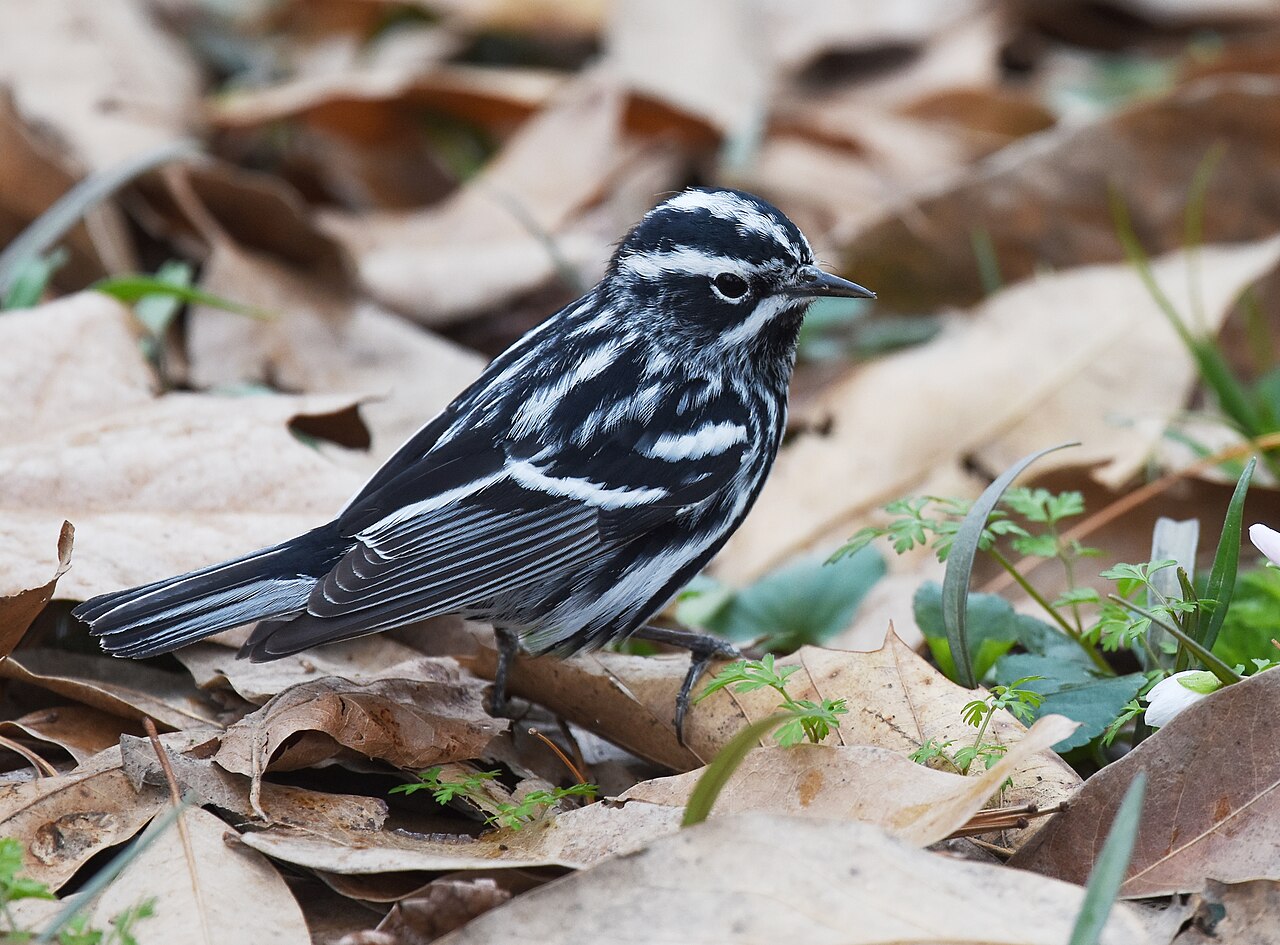
The Black-and-white Warbler is the only American warbler that walks up and down trunks and heavy limbs; for that it has a long hind toe and a heavy claw to hook into the bark. From crown to tail it is streaked lengthwise in black and white, with a white line down the middle of the black crown. It is among the first warblers back in spring.
Voice
The song is a thin, high, two-note series like a squeaking wheel: wee-see wee-see wee-see, repeated six to eleven times, the second syllable lower than the first. It sings from a branch halfway up a tree and carries on singing while it climbs, which most warblers do not. The male has two song types: one aimed at other males, the other heard mainly near the female. The call is a sharp chip; on migration a high, thin seet passes overhead at night.
Recording: Bobby Wilcox — CC BY-NC-SA 4.0 · Tama (near Burlington), Des Moines, Iowa, United States · xeno-canto
Identification
Streaked lengthwise in black and white throughout: back, flanks, two white wingbars, and a black crown with a white line down the centre. In summer the male has a black throat and black cheeks and heavy black flank streaks. The female has a white throat, grey cheeks and finer streaking, often with a pale buff wash on the flanks and undertail coverts. Juveniles resemble the female but are more faintly streaked still. The bill is slightly decurved, the legs are short and the hind toe is long; against a trunk the bird lies flatter than a warbler that hops from branch to branch.
Confusion species
Brown Creeper (Certhia americana) does the same work on the same trunks, but is brown with white underparts, climbs only upward and starts again at the bottom of each new tree. White-breasted Nuthatch (Sitta carolinensis) is larger, blue-grey and unstreaked, and climbs head-down. Red-breasted Nuthatch also has black and white on the head, but carries a black eyestripe below a white eyebrow and is rusty below. A warbler marked just as black and white that hops from branch to branch in the canopy instead of walking on the bark is more likely a spring Blackpoll Warbler (Setophaga striata): an entirely black crown without a white central line, and a white cheek.
Habitat
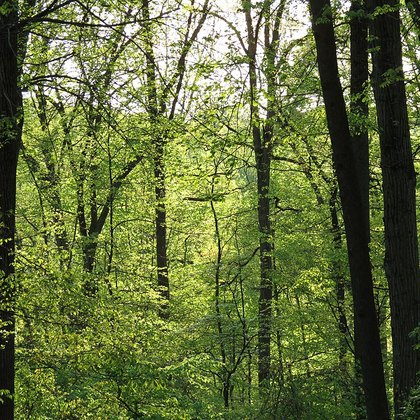
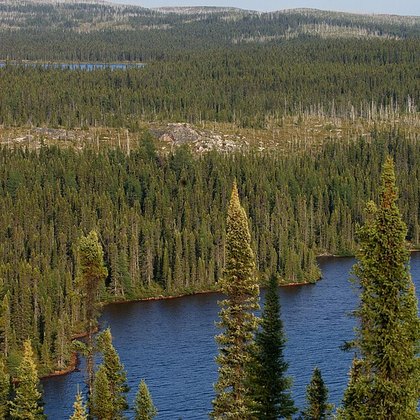
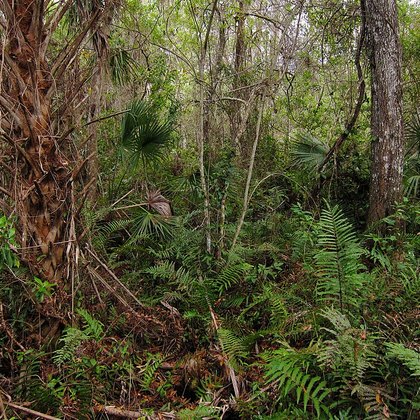
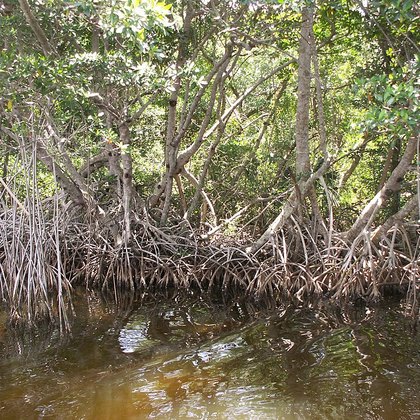
Deciduous and mixed woodland with large trees, from grown-out coppice to old forest, on dry slopes as much as along streams. It does not need dense undergrowth, but it does need bark with fissures: rough trunks and heavy side limbs holding overwintering insects and their eggs. The nest is on the ground, against a trunk or under a fallen tree, which makes the bird sensitive to forest fragmentation. In winter it uses tropical forest from lowland to cloud forest, shade coffee, mangrove and dry thorn woodland; it occupies a wider set of forest types there than most other warblers.
Where the bird is most often found, arranged by the USNVC — the vegetation classification of the United States and Canada — and CMECS for sea and coast.

Range and movements
Breeds across the east and centre of the continent, from the southern Northwest Territories and Alberta east to Newfoundland, and south into eastern Texas, Louisiana and Georgia. It winters from northern Mexico and Florida through Central America and the Antilles to Colombia, Venezuela, Ecuador and Peru; that southern part of the winter range lies outside this map. It migrates early: the first birds are in the Gulf states in March and in Canada by late April, and autumn passage begins as early as July. Part of the population crosses the Gulf of Mexico in a single night.
- Resident
- Breeding (summer)
- Winter
- Passage
- dark = core range, pale = thinly spread
Where and when to look
Look for it in April, in the first green, while the wood is still open: it then works along the heavy limbs of the oaks and is more often in view than later in the season. Watch the movement rather than the colour — a bird that walks over the bark both head-up and head-down and is streaked lengthwise while doing so is this species. In the tropics you will not hear it sing in winter; there it gives itself away with the sharp chip from inside a mixed flock.
Conservation
Not threatened (LC), with a breeding population estimated at about twenty million. The North American Breeding Bird Survey has shown a slow decline since 1966, stronger in the south of the breeding range than in the north. As a ground-nester in woodland it suffers from fragmentation: small woodlots yield more nest predators and more Brown-headed Cowbird eggs. On migration large numbers are killed against windows and lit buildings.
Scientific name
Mniotilta varia | (Linnaeus, 1766)
Linnaeus described the species in 1766 as Motacilla varia, among the wagtails; because it was later placed in another genus, author and year stand in parentheses. The genus Mniotilta was introduced by Vieillot in 1816 and is built from Greek mnion, 'moss', and tillo, 'to pluck': the moss-plucker. varia is Latin for 'varied' or 'variegated', after the streaking. Linnaeus gave the origin as Jamaica and Santo Domingo; the American Ornithologists' Union restricted the type locality to Santo Domingo in 1910.