All species › Woodpeckers and allies › Woodpeckers › American Three-toed Woodpecker
American Three-toed Woodpecker | Picoides dorsalis
Amerikaanse drieteenspecht | Pico tridáctilo americano
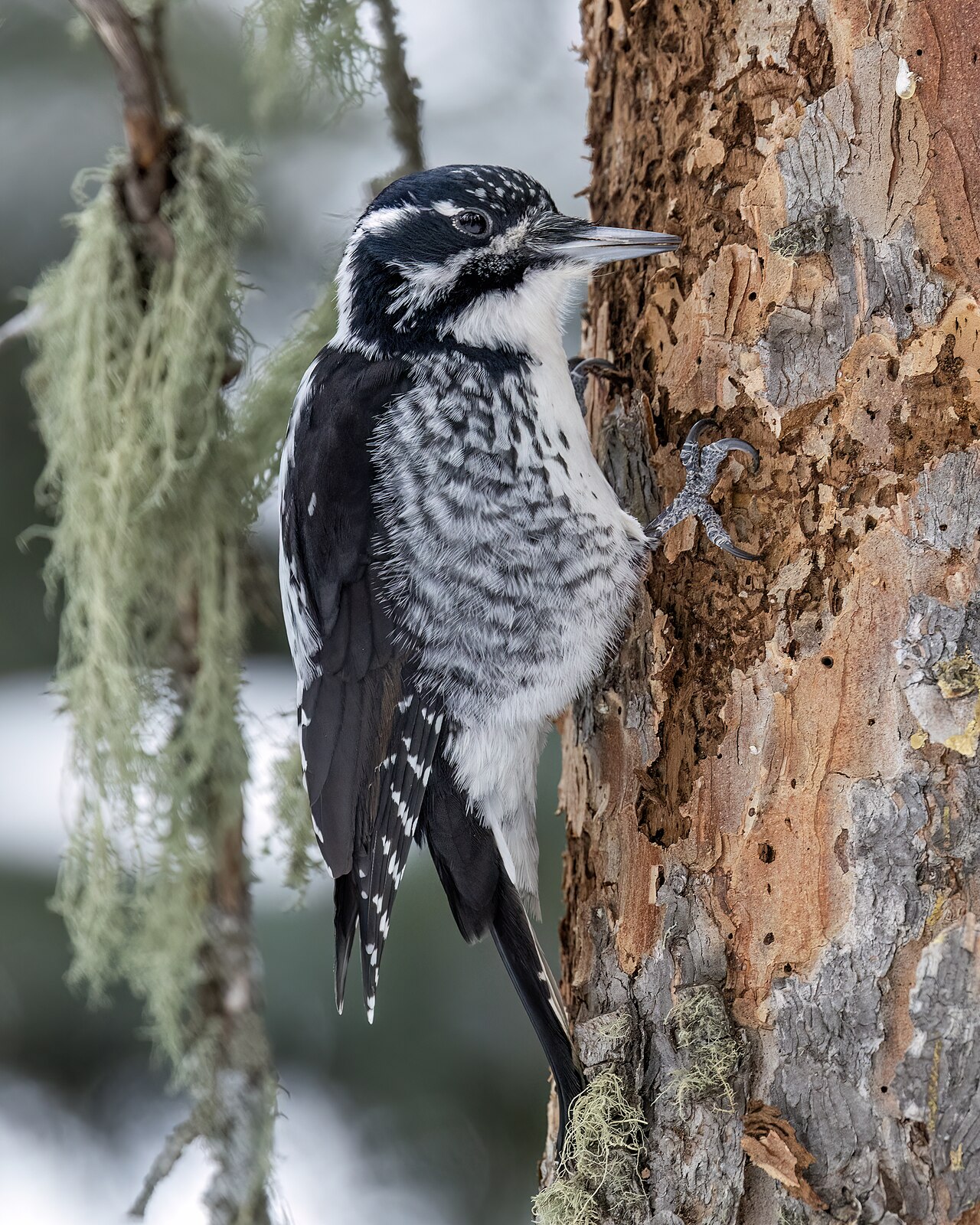
The American Three-toed Woodpecker is the woodpecker of dying conifer forest: a stocky black-and-white bird with a white, black-barred stripe down the back, densely streaked flanks and, in the male, a yellow crown patch. It follows bark-beetle outbreaks, forest fires and windthrow, and turns up wherever spruces die off en masse. At work it draws attention less by loud hammering than by the soft tapping with which it flakes bark off the trunk.
Voice
The call is a soft, short pik or kik, clearly softer and less sharp than the call of Hairy Woodpecker. When excited, and in contact with its mate, it gives a short rattle of even, dry notes. The drum is fairly long and full-sounding: it starts fast and slows a little towards the end, a pattern shared among North American woodpeckers only by Black-backed Woodpecker. Outside the breeding season it is silent, and the tapping of a foraging bird is often the only thing that gives it away.
Recording: Bill Pyle — CC BY-NC-SA 4.0 · Daniel, Sublette County, Wyoming, United States · xeno-canto
Identification
A medium-sized, compact woodpecker with a black head bearing two white stripes: a narrow one behind the eye and a broader one running below the cheek to the nape. A white stripe with black cross-bars runs down the middle of the back; in Rocky Mountain birds it is almost pure white, in those of Alaska and the east much more densely barred. The flanks are densely streaked black and white, the wings black with rows of small white spots, the outer tail feathers white with black bars. The male has a yellow crown patch, the female a black crown with fine white streaks. As the name says, it has only three toes on each foot instead of four.
Confusion species
Black-backed Woodpecker is the trickiest: also three-toed and also with a yellow crown in the male, but larger, with a longer bill and an entirely black back without a white stripe, and with almost no white stripe behind the eye. Hairy Woodpecker has four toes, a clean white back without bars, unstreaked white flanks and, in the male, a red rather than yellow patch, placed on the nape rather than the crown. Eastern American Three-toed Woodpeckers with heavily barred backs can look dark-backed at a distance; check then for the white eye-stripe and the densely streaked flanks. Eurasian Three-toed Woodpecker (Picoides tridactylus), with which it was long treated as one species, does not occur in North America.
Habitat
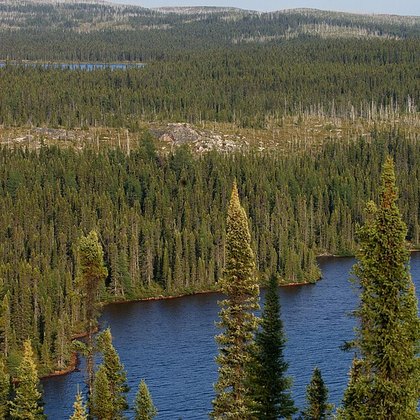
Boreal conifer forest of spruce and fir and, in the western mountains, subalpine forest of Engelmann spruce, fir and lodgepole pine. It seeks mature and old forest that has been damaged by fire, storm, flooding or bark beetles and is full of dead and dying trees, and is scarce or absent in logged forest. Unlike Black-backed Woodpecker it is less tightly tied to fresh burns and also forages in living forest with scattered dead spruces. It excavates its nest cavity in a dead or dying tree, usually a conifer and sometimes an aspen.
Where the bird is most often found, arranged by the USNVC — the vegetation classification of the United States and Canada — and CMECS for sea and coast.

Range and movements
From western Alaska through the boreal forest of Canada to Labrador and Newfoundland, with southern outliers in the northern states around the Great Lakes and in northern New England. In the west it follows the Rocky Mountains and other high ranges south into Arizona and New Mexico, with smaller populations in the Cascades of Washington and Oregon. It does not reach Mexico. Three subspecies are recognised: fasciatus in Alaska and the north-west, bacatus in the east and dorsalis in the Rocky Mountains. It is resident, but after a large fire or beetle outbreak it gathers locally in large numbers.
- Resident
- Breeding (summer)
- Winter
- Passage
- dark = core range, pale = thinly spread
Where and when to look
In summer, look for a forest of red, dying spruces or a burn a few years old, and listen for soft tapping rather than loud hammering. The American Three-toed Woodpecker peels off the outer bark in flakes, so that dead trunks below its work site show bare, reddish-brown patches and the snow beneath becomes littered with bark chips: that is often the first sign that it is present. It is usually unhurried and lets an observer approach closely.
Conservation
The IUCN rates the species as Least Concern (LC). Partners in Flight puts the global breeding population at about 1.6 million birds, and the Breeding Bird Survey shows an increase between 1966 and 2015, although that trend is uncertain because the northern core of the range is hardly covered by standard counts. The species depends on old forest and dead wood: clear-felling and the salvage logging of burnt and beetle-killed timber after a disturbance remove precisely what it lives on. Because it moves with its food supply, local numbers fluctuate strongly.
Scientific name
Picoides dorsalis | Baird, 1858
Spencer Fullerton Baird described the species in 1858 as Picoides dorsalis; because it still stands in that genus, author and year are given without parentheses. For a long time it was treated as a subspecies of Eurasian Three-toed Woodpecker, until the American Ornithologists' Union recognised it again as a separate species in 2003 on the basis of genetic research. Picoides, introduced by Lacépède in 1799, means 'resembling Picus', with the Greek suffix -oidēs; dorsalis is Latin for 'of the back', after the white back of the Rocky Mountain birds. The type locality is Laramie Peak in Wyoming.